Omar Souleyman – Wenu Wenu: Round 60, Nick’s choice

Omar-Souleyman-Wenu-WenuWhat the hell is an “album of the year” anyway? Despite Tom’s exhortations, I couldn’t pick just one record from last year, and of the four or five that I like an awful lot I’ve already played some either here or at the other place (Melt Yourself Down, These New Puritans) and the others are 75+ minutes in length (Holden, Nils Frahm). So I thought I’d just play something that I liked quite a bit and found fascinating and thought would make for a really good record club experience.

Step forward Omar Souleyman, Syrian wedding singer.

Souleyman’s musical career spans more than 20 years, and superseded his earlier career as a labourer. He’s released more than 700 albums, the vast majority of which are live recordings of performances at weddings, dubbed straight to tape and handed, as a single, unique copy, to the bride and groom. His essence is his live performance, and Wenu Wenu is his first “studio” album, and was produced by Kieron Hebden, aka Four Tet.

Compilations produced for a western audience exist (mostly on the Sublime Frequencies label), hatched together from live recordings, but this is the first time he’s recorded something specifically as an album, to be released on CD, for a British record label (Domino, the same label as Arctic Monkeys, also played this evening), and that can be reviewed, purchased, listened to, and ranked in end-of-year polls according to the suffocating orthodoxy of how we consume music in the US and UK these days.

Souleyman, a native of Syria who now lives in Turkey, plays a type of music called dabke, a popular style of performance and dance across the whole of the Middle East, which is particularly well suited to celebratory events. Like weddings. It consists of intricate, almost hysterical instrumental leads played (on Wenu Wenu, at least) on electric saz (a teardrop-shaped stringed instrument that looks a little like a lute) and a synthesizer imitating traditional Arabic reed instruments. These riffs spiral at the edge of chaos over the top of relentlessly thumping 4/4 rhythms, the mournful lyrics (“wenu wenu” means “where is she?”) and dramatic delivery at odds with the rampant tempos.

If you need a western comparison as an entry point, then it’s dance music. Really fast, electronic dance music. Wenu Wenu is a string of club bangers, only relenting when the final two tracks slow the pace a tiny bit. “It used to be slow, but when the keyboard came into this music, every year we made it faster, until we reached what we have now,” Souleyman said to The Guardian last autumn. You can hear why DJs looking for something esoteric and different to drop into a set without breaking pace would choose Souleyman, why Hebden wanted to record him.

“I have a good voice, and am interested in music,” Souleyman also said, and he does. I gather from people who are properly into dabke and other Middle Eastern genres that there are better wedding singers out there than Souleyman; some of them seem perturbed that he has crossed over into the European and American musical consciousness when others haven’t. I can’t speak for that, but I can say that Wenu Wenu is great fun, and strangely moving, and slightly uncanny in its fusion of familiarity and otherness.

Rob listened: More reports from the frontline of a fracturing musical landscape. Say what you like about Omar Souleyman, call him a novelty cross-over, a hipster breakthrough act, the fact is that we’re at a point now where we can discover the work of a frenzied Syrian wedding singer and marvel not only at the energy, the textures, the sheer fizzing pizzaz of it, but also at the fact that it sounds pretty much like the sort of stuff we could be hearing on niche dance labels or on a 3am dancefloor. I don’t know whether this means we’ve come full circle, whether music is running out of ideas or catching up with its own future, but I love the implied chaos and I specifically love the idea of this chap rocking up at a wedding in some corner of Syria and banging out tunes most scowling dance acts would kill for.

Tom Listened: Although I enjoyed Wenu Wenu, I found the first two thirds of the album pretty exhausting. It’s my age! At first the relentlessness of the sound was captivating but by the time I had finished my Balti, I was wishing for a bit of variety. And, almost instantly, it came, the last couple of songs being much slower and groovier. If the album had a bit more shade to go with the light (or, even, if it had been sequenced differently) I would probably be championing it unequivocally.

House of Blondes – Clean Cuts: round 58, Nick’s choice

COVER
I’ve been wanting to play this gorgeous, modest album for quite some time, but holding off until we were at my house so that people could feel its beautifully-rendered synthesisers emanating from my speakers. Not that there’s anything wrong with anyone else’s speakers; just that I know that Clean Cuts sounds mighty fine through mine, and I didn’t want to risk a sub-optimal first impression.

Except that 2012’s Clean Cuts, despite being House of Blondes’ debut album, wasn’t my first impression of House of Blondes; in 2007 a band by the same name, led by the same man (New Yorker John Blonde) released another debut album (there’s quite a backstory regarding how I came to hear them in that linked article).

That band was a decent-enough indie coterie with some gently florid tunes, and I enjoyed their eponymous record. The House of Blondes that released Clean Cuts early last year is a synth-based three-piece however, and sounds almost completely different bar a few melodic similarities which seem to come, understandably, from the fact that the same guy is singing the songs. Beyond that, though, the analogue pulse, drift, reverberation and oscillation of this record sounds completely unlike the faintly folky guitar piano bass drums of House of Blondes mk1. And I’m glad, because while mk1 was nice, mk2 is wonderful.

Clean Cuts is, to my ears, almost perfectly pitched and sequenced as an album of this kind; there’s an exquisite balance between “songy songs” and “tracky tracks” (as I so eloquently put it on the night), much like on Burst Apart by Antlers. ‘Ego songs’ – tunes that demand your attention, want to be hollered along with, be a single or thought of as an important statement – can be tiring if over used, as they often are on BIG. IMPORTANT. RECORDS. where every song matters and there’s no room to breathe. I’ve always liked the moments in between the ego songs, the segues and instrumentals and low-key songs and ambient wibbles that act as respite and palette cleansers, giving you space to just enjoy the wonder of recorded sound. Clean Cuts has those moments in abundance, and even the “songs songs” never stray fully into ego territory; as a result I’ve never grown tired of this record, despite having played it over and over and over and over again. And the “tracky tracks”, although occasionally beatifically absent and vatic, always feel like something more substantial than sheer ambience.

In terms of influences, similarities, and sound-alikes, you can draw obvious lines to New Order, Gary Numan, Bowie’s Berlin trilogy, Suicide, OMD, and countless other synth-oscillators over the last 30-40 years, but to do so is a little reductive; House of Blondes are their own thing, and very good too. The question of what happens to make some bands get picked up and go over the precipice into wider awareness is a strange one; Clean Cuts is self-released but as good as anything I’ve heard on an established record label. It’s one of my favourite records that I’ve come across in the last 12 months.

Rob listened: Liked this a great deal. Mainly on a purely sonic level, the sounds were lovely and assembled with exquisite care. Secondly, it seemed to chime with the Pinkunoizu record in that it took influences which it seemed happy to display, but wove something new and exciting from them. That’s a tough thing to do and when it’s done right it hits a big sweet spot.

Tom Listened: Whilst sharing only the slightest of direct musical similarities, Clean Cuts seemed to share much common ground with Rob’s offering – Pinkunoizu’s The Drop (to be honest, most records surely will have some common ground with The Drop). Both are records from bands that are so far off the radar that I haven’t seen their name mentioned yet at all in any of the end of year best of lists I have glanced at. Which is simply wrong – both sound to me worthy of adulation and respect….much more so than many of the records that have found their way onto said lists. And both are records that sound unencumbered by the weight of expectation, records made by people who are simply doing what they have to do, just getting it out there. Both are records that I will probably end up buying. Fantastic stuff.

Graham Listened: Sat nicely alongside Pinkunoizu, though a lot more sophisticated and mature than the cheeky upstart. Lots of reference points to electro that could be dubbed “my era”, which made it easy to get on with.

Portishead – Third: Round 57, Nick’s choice

ThirdI drew 2010 and 2008 out of Tom’s little bag of years, and knew straight away which year I had to choose an album from; 2010 is one of my favourite recent years for music, with wonderful albums by Four Tet, Owen Pallett, These New Puritans, and Caribou all having serious staying power in my affections, plus excellent records by Luke Abbott, The Knife, Warpaint, Vampire Weekend, Polar Bear, Lindstrøm & Christabelle, Laura Marling, Spoon, and LCD Soundsystem. It felt like a banner year.

2008, on the other hand, sucked so much that I didn’t even bother to make a list of my favourite records at the end of the year. Admittedly I was in a bad place – my career and health were suffering, I wasn’t writing about music regularly for anywhere, and I felt as if the musical support networks I’d had for the previous 7 or 8 years had collapsed somehow. Only perhaps three or four records from 2008 moved me at all, and they all felt tarnished somehow by how little I cared about anything else. Admittedly, in hindsight, this is my ‘fault’ more than it is the fault of ‘music’ – how can one blame music? – but at the time it felt profound and significant, and I wondered if my relationship with music was finished.

So obviously I had to pick something from 2008. Portishead it is.

Third is a record I admire much, much more than I love. It’s difficult to love; it’s difficult to bloody listen to, to be fair; it is an oppressive, intense, desolate affair, a soundtrack to nuclear terror and emotional isolation, a far cry away from the coffee-tabled trip hop of Portishead’s debut album, even if that record is unfairly maligned by association, and far more emotionally intense and bereft than its trendy ubiquity in the 90s would suggest.

It’s actually one of the few records I reviewed back in 2008, and I rolled out pretty much the entire breadth of my descriptive powers in that piece. Rather than smoky cinematic jazz, lounge, and hip hop, it draws from industrial music, krautrock, and post-punk, but it’s still just as cinematic as Portishead ever were, but it’s soundtracking a very different kind of film to Dummy.

Third is also mixed and mastered with oppressive volume and lack of space; there’s no air to breath and no room to move, but far from being a dunderheaded move to get on the radio (and remember hearing “Machine Gun” on the radio; fuck!) this is an artistic, aesthetic decision to pummel the listener quite deliberately. It works. I seldom listen to Third, but when I do I get to the end feeling suffocated, bruised, tortured. It’s an experience rather than a pleasure. In its way, it’s brilliant. It might have been a better choice for Halloween.

Tom Listened: This was a great record club evening for me – four top-notch albums that more than held their own in each other’s company. Third rounded proceedings off brilliantly.

I missed out on Third at the time of release. I heard Machine Gun somewhere and thought it was just too grey and industrial and harsh for me. And it still is in isolation. But it makes much more sense when nestled…that isn’t really the right word, is it?…in amongst the rest of the album.

Now, I’m a sensitive soul and scare easily. I don’t like scary films, or Sunn O))) or looking at the Exeter Record Club’s blog since Halloween and when I was little I was terrified of a picture in my Guinness Book Of Records of a speed skier wearing one of those funny helmets. So much so, that I would have to dare myself to look at it. I was about 15 at the time!

But I really didn’t see what was so difficult about listening to Third. I really liked it, don’t get me wrong, but I thought it was hooky and pretty melodic on the whole – not in a Russ Abbott way, admittedly, but it seemed to me that not far under the noise and the industrial atmosphere, form and light and humanity were readily detectable. In fact, the only thing that put me off rushing out and buying Third straight away were Beth Gibbons vocals. On Dummy they were theatrical. I thought that on Third they seemed (on first acquaintance anyway) a tad hammy. But maybe this would be something I wouldn’t even notice with familiarity as everything else about this record was astonishing.

Rob listened: Even if I didn’t love ‘Third’ as a record, I’d love it for the fact that it exists. In 1994 they were soundtracking sophisticated soirees. By 2008 they were doing… this. We can only pray that this album was picked up by hundreds, no let’s allow ourselves thousands, of people with their weekly supermarket shop and slipped out of its rounded jewel case in the same dinner party setting to horrified recipients. It would be up there with the great fan-alienating albums were it not for the fact that most of their casual fans had, presumably, moved on. (Actually, this is a slack point to make – ‘Third’ seems to have been pretty much their most successful album in terms of global chart positions). It would be up there with ‘Kid A’ as one of the highest profile left-turns, were it not for the fact that for Portishead ‘Third’ was a natural evolution, consistent with the work Barrow, Gibbons and Utley has been doing, a compelling synthesis of the sounds they made over their first two records, and the sounds that influenced them to make them. No matter if it misses these debatable marks, it’s up there anyway because it’s one of the most bracing and brilliant albums of the last ten years.

Graham listened: When, like many others, I rushed to hear what this sounded like on release, I was stunned. I remember seeing them perform ‘Machine Gun’ on Jools Holland and thought WTF? I was even prepared to consider that tape machines/backing tracks weren’t working when they did the performance. It feels like an album that should be kept in a locked draw but will still keep you awake by rattling and growling at the back of the cupboard. It was great to sit and listen properly as ‘MG’ just alienated me from the whole album and I never really went back to give it time. I still think it is a record that needs to be used cautiously.

The Dismemberment Plan – Emergency & I: Round 56, Nick’s choice

The-DismembermentPlan-EmergencyAndIThe Dismemberment Plan have just released a new album; their first in a dozen years, after they split up, almost due to lack of interest, in 2003. Their previous album, Change, was their fourth, and this, from 1999, was their third. I love it.

Formed in Washington DC in the early 90s, The Plan, as their fans called them, were in that heritage of DC post-hardcore bands like Fugazi and Jawbox (J. Robbins, the latter’s singer and guitarist, is co-producer here). Unlike some of their forebears, though, The Plan didn’t have any kind of manifesto or ideology; they were just a good time party band, for gawky kids who didn’t quite fit in. They took the jerking, stop-start guitar thrash of post-hardcore and mixed in a bit of everything else they liked; hip hop, 80s synthpop and New Wave, funk, indie pop.

The result is a technicolour riot, far more flamboyant than their local progenitors were, and far more dorky, too: where Fugazi sang about mortgage foreclosures and house repossessions and the perils of capitalism, The Plan sang about following girls across the country and not knowing how to talk to them, about no one dancing at their gigs no matter how hard they tried, about imaginary fights where you get beaten-up by giants.

Emergency & I pushed The Dismemberment Plan over the parapet of indie rock circles in a way that, had it happened a decade later, might have seen them become one of the biggest bands on the planet. But in 1999 a 9.6 or whatever from Pitchfork didn’t mean quite what it did for Arcade Fire, even if it did make them a big deal in small circles. Maybe they were too dorky, but it was that dorkiness, as manifested in the socially-inept fantasy of “You Are Invited” – literally about receiving a magical invite that gets you into all the coolest parties you could only usually dream of attending – that marks them out as something special; if they’d been cool or didactic they’d not have captured the awkwardness of being in your early 20s quite so well.

And they do capture it with amazing insight and prescience, Travis Morrison’s lyrics a tumbling stream-of-conscience that seem to predict the likes of Facebook (“Memory Machine”), capture the frustrations of lust (“Girl O’Clock”), perfectly render the pain of dying, urban, post-adolescent romance (“The City”), and, occasionally, reach some kind of zenith of almost Joycean American tone-poetry (“Back and Forth”).

Which is all good and all, but which would be dull if the music backing it wasn’t twitchy and hooky as hell, a maniacal rhythm section and a hyperactive guitarist competing to show off the most but not in a bad way, keyboards and crazy production touches making musical colour match lyrical colour daub for garish daub.

I was thinking aloud on Twitter earlier about what makes a band “important”, and I think I was using the term pejoratively to refer to self-important proclamations about self-important music; Emergency & I feels important to me, but in a very personal, insular, microscopic way.

Tom Listened: I have spent a long time agonising over The Dismemberment Plan since Nick played it at record club. Nick lent me Emergency & I a while ago – I had been keen to hear it ever since it appeared in very high positions in some round up lists on the internet around the turn of the millennium. I guess the cover art caught my eye and the name stood out and, on reading about the band, the music sounded like it should be right up my street…

However, it never quite worked out for me and The Plan (or is it The Dismemberments?) and I returned Nick’s CD a little bemused as to:

a) Why I hadn’t clicked with the album.

and

b) Why it is so lauded.

So I was really pleased to have the chance to hear it again in a different context and thought that maybe a proper listen with a bit of heft and concentration would do the trick. But there is something about Emergency & I that I just don’t like…and I have found it nigh on impossible to pin down just what that is. Whilst I was deep in thought on this matter, I considered that it ticks pretty much all the right boxes for me and maybe this is the problem…it feels to me as though The Dismemberment Plan are trying to cast their net as wide as possible (as Nick has stated, it’s a much more varied and colourful beast than Jawbox’s album) and in so doing feel to me as though their music comes from the head not the heart – too clinical and calculated for my taste. But I could be wrong on this one as I am still really confuzzled and this is just a hunch.

Rob listened: I too have sort-of-worried about the Dismemberment Plan. We’ve talked about them before, quite a bit, and as Nick advocates so strongly I checked this album out and just couldn’t find anything attractive. I tried it a few times. Nothing. And then, of all things, after a long lay-off, I thought it sounded great this evening. I started to wonder what the hell i’d been hearing instead of this brimming collection of perky, spiky dork rock. I started to think I may have been… wrong.

Then I listened to it again the week following, and nah, nothing. As you were.

My conclusion as to why ‘Emergency’ and I don’t click? It’s an age thing. It sounds exactly like I imagined the descendants of the post-hardcore I loved would sound after they had, in my imagination, sucked out the rage, the life force, the will to be, the uncontainable verve from the music and replaced it with technical proficiency. I think this is my problem, not theirs. I’m sure Dismemberment Plan are committed and passionate musicians. I’ve seen nothing to gainsay that assumption. It just doesn’t sound like the bands I love. If I was ten years younger, i’m sure i’d be getting the same charge from this as I actually did from Fugazi, Circus Lupus, Shudder to Think. If I were ten years older, i’m sure I would have found those bands weak and watered down compared to Bad Religion, Descendants and Black Flag.

Darkside – Psychic: Round 55, Nick’s choice

DARKSIDE-PSYCHICOnce again without a theme I was free to choose whatever the hell I liked. Two factors made me pick this super-current release, which had only come out two days before: the fact that Rob, when confronted with Pink Floyd’s The Dark Side Of The Moon for the first time ever the other week, claimed it sounded like “half the stuff in Nick’s record collection” despite my prolonged dislike of all things Floyd; and the fact that I’d arranged to review this record for The Quietus, and was planning on writing it up the next night so needed to get some serious listens and cogitation in!

If you’re unaware, Darkside is Nicolas Jaar, who’s debut solo album I played here a couple of years ago, plus Dave Harrington, a jazz guitarist college friend from their only-just-finished student days at Brown University. This is not, though, just a Nicolas Jaar album with some guitar over the top; Harrington plays as wide an array of instruments as Jaar, and shares writing and production credits with him equally too.

Psychic is every bit as, ahem, phenomenologically beautiful as Space Is Only Noise (and probably less, um, non-diegetic, on the whole), but there’s something a bit more linear, consumable, and compelling about it, perhaps. Maybe it’s the guitars, but I’m not sure they’re quite as important as some people are suggesting; Harrington’s playing on Psychic is a long, long way from John Squire’s on Second Coming, for example. It’s a krautrock linearity rather than a jam band linearity, and thus much more palatable to people who find the idea of Phish offensive, but who can fully accept 20-minute freak-outs if the singer is Japanese and the musicians are German. There’s nothing like festishisation of the ‘other’ to bring out the music fan’s inner hypocrite?

This has arguably been a stonking year for records that sit somewhere in that weird genre-less area that one might call post-dance the same way we called Bark Psychosis post-rock; Holden, The Knife, Boards Of Canada, The Field, Four Tet, Brandt Brauer Frick, Pantha Du Prince, Jon Hopkins, Fuck Buttons, Atoms For Peace if I’m feeling generous. Maybe even stuff like These New Puritans, Melt Yourself Down, and Sons Of Kemet kind of counts on there, too; they certainly all share headspace in my esteem. Darkside have made an album every bit as good as anyone else in that list.

Rob listened: I’d heard this before the meeting, having read a review on Pi***f**k. I liked it. It sounded nice. I’m intrigued by Nicholas Jaar and found his solo album pleasantly enveloping. I wish I felt more drawn to this stuff, as I always seem to enjoy it, but the fact is I don’t. Of Nick’s list above I’m familiar with three or four and  those which draw me back are always the ones which at some level deliver a punch to the solar plexus, i.e. Fuck Buttons or The Knife. There’s something academic about Jaar, Pantha du Prince, Jon Hopkins, or at least I impress that upon them, which puts distance between us. I guess there’s also something around close-listening. These are all lean-in records and I think I prefer to sway back as if dodging a knock-out punch. Perhaps ultimately this is my problem. I sometimes feel slightly inadequate for preferring the music which goes for the throat rather than the brain. I should get over that. It’s completely stupid.

Tom Listened: Last meeting was a strange one. William Basinski’s 5 seconds of music (that lasted an hour – that’s about 720 loops by my calculations…and it felt like it) overwhelmed proceedings to such an extent that the other records played on the night quickly became lost in the ether. The other meeting that felt similar to me was when we played Zaireeka – everything else seemed far too conventional and consequently a bit flat after that record too. However, the two other records from Zaireeka-gate went on to be my albums of the year (Apocalypse and Smoke Ring for My Halo) and if my recollection of the way I felt about the Darkside record (I can’t actually remember what it sounds like, just how I felt when it was being played) was that it sounded phenomenologically beautiful – God it feels great to write that! – and not really all that similar to Pink Floyd. I also remember thinking at the time ‘I might go out and buy this’ but then I thought about all those Smog albums I need to have and recalled that I don’t have any money and then also considered that it sounded possibly just a teensy bit too nice on first listen to really have sticking power and so, for now, I might have to ask that nice Mr Southall for a lend instead.

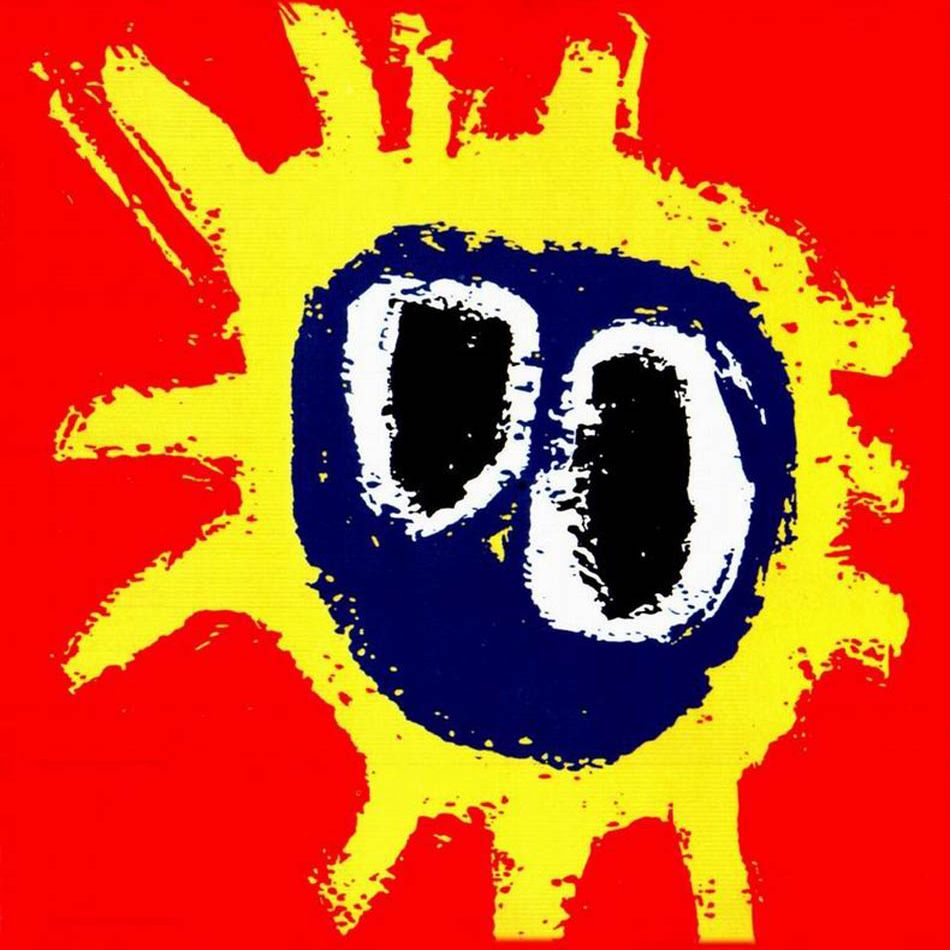
Primal Scream – Screamadelica: Round 54, Nick’s choice

screamadelicaSans a member for the evening I thought I’d take advantage, flagrantly disregard the rules concerned how long albums can be, and play this 63-minute mess/magnum opus/masterpiece [delete as appropriate] by Sabres Of Paradise Primal Scream, which I thought would be good for causing an argument stimulating discussion.

Primal Scream aren’t a band. They’re a shocking shambles. Quite literally for the last 23 years they seem to be whoever is in the studio with Bobby Gillespie and Andrew Innes on any given day. Their best records (this, Vanishing Point, XTRMNTR) are, by and large, surrounded by absolute tripe. I’ve been a fan for the best part of 20 years but for most of the last decade of that I’ve had zero faith in their ability to make a decent record. I still think that Primal Scream, as a phrase, in terms of how it sounds and what it means and the imagery it inspires, is pretty much the best band name ever. And Screamadelica is a great title for an album. And it has a great cover, too.

But it’s a mess; at times an absolutely brilliant mess, granted, but it’s still a mess. The Rolling Stones homages, even if they’re as platonic-essence-great as “Movin’ On Up” (which nicks from CAN as much as Jagger, to be fair) or as bruised and lonesome as “Damaged”, are still, of course, just reductive homages, and seem deranged next to the we-have-lift-off genius that is “Higher Than The Sun” or the amazing, swamp-house-voodoo-dub cover version of “Slip Inside This House”, that awesome sax solo at the end of “I’m Comin’ Down”, the bassline that sinews through “…A Dub Symphony In Two Parts”, the full-on joyous Italo-house of “Don’t Fight It, Feel It”…

But that’s Primal Scream. You have to take the good with the bad, the coke’d cockrock with the heroin blues with the inspired psychedelic-techno-pop-kraut-jazz-disco with the awful bloody country hoedowns. Do they mean it, man? Are they authentic? Trend-chasing? Easily-distracted? Is Bobby Gillespie a fan more than he is a musician? Does it matter? The key question is are they brilliant?, isn’t it? If you describe what they are, what they do, write it down on paper – a whirlwind trip through the entirety of counter-cultural music from The MC5 to Miles Davis to Giorgio Moroder and everywhere inbetween and beyond, on drugs – it sounds like the greatest idea for a rock’n’roll band ever. And, occasionally, just occasionally, they made music that matched that description. Screamadelica, for the most part, is one of those occasions. But even so, rock’n’roll bands are bloody silly creatures, and Primal Scream are the silliest of them all.

Tom Listened: I still remember quite clearly the moment I went off Screamadelica. I already owned the record and liked it well enough but was still getting to know it at the time. It wasn’t long after Primal Scream had released it and, back then, it was a BIG THING, about as big an event as the Indie Dance crossover genre thing managed to pull off. I recall the band performing Moving On Up on Top of The Pops and found myself…hating it. It suddenly occurred to me that, shorn of the music that surrounds it on the album, this was nothing more than a pale facsimile of prime era Rolling Stones. If I wanted Sticky Fingers I may as well listen to the real thing!

Listening at Nick’s the other night, it’s a pity I had such an epiphany as there is much to admire on Screamadelica and the album has laid dormant in my collection, neglected and unloved, pretty much since that day back in the early 90s. But the trouble with Screamadelica, as far as I am concerned, is two-fold. Problem 1: there is about equal amounts chaff and wheat. So for every Higher Than The Sun (astonishing) there is a Damaged, for every Don’t Fight It…there is a Shine Like Stars. Problem 2: the songs I like the most are almost exclusively the ones that sound like they have the least to do with Bobby Gillespie and the most to do with Andrew Weatherall. And that’s where the whole ‘authenticity and does it matter’ argument kicks off. So, to sum up, it was great to hear 5/11 of the album…the other 55% of the record I could live without!

Rob listened: Credit where credit’s due, this was a great talking point album. I don’t particularly object to ‘Screamadelica’ for any of the reasons around authenticity or authorship. There are potentially fascinating questions and can make for fascinating art, but ultimately the result is either good or bad. And I still find this one boring. Sure there are lovely sounds in there and some of them we hadn’t heard before, but I didn’t like it when my friends were telling me it was the future back in 1991 and it leaves me unmoved to this day. Perhaps underpinning my antipathy are some feelings to be associated with intent although as I’ve said, I hope not. I certainly love loads of bands and records which were sucked into the same orbit as this one, and I can’t explain why it seems to matter to me that the Happy Mondays were the real deal, or whether that genuinely affects how I hear this music. Okay, i’ll have one more go at communicating this… It’s a boring record. It doesn’t matter what new ground it may have broken. If Primal Scream were the Rolling Stones and the Stone Roses were the Beatles, well, you can take all four of them and piss off.

Melt Yourself Down – Melt Yourself Down: Round 51, Nick’s choice

mydAnd so back to normal proceedings, and Rob’s house, where we haven’t been for a while due to babies and things.

Sans theme I thought I’d take along something new from 2013 – it’s been a pretty good year thus far, with plenty of records I’ve really enjoyed, but I feel like I’ve barely played anything from the current crop at Record Club. Most of them are quite long though – These New Puritans is 53 minutes, Holden is 75, John Hopkins is 60, Boards Of Canada is 62 – and with all four of us bringing albums again, and a baby in the house, I wanted to take something relatively brief. Luckily the debut album by Melt Yourself Down is only 36 minutes… (Even if those minutes are extraordinarily rambunctious.)

I reviewed this record for The Quietus the other week, so I shan’t repeat myself too much by going into the make-up of the band or how individual songs work; suffice to say that Melt Yourself Down is, at heart, a dance record, a party record – despite liking a lot of ‘dance’ records this year (like the aforementioned Hopkins and Holden), it’s this group of live-action (if you will) postpunk afrobeat jazzers who make me want to dance the most, who seem to have the most physically compelling batch of beats.

Good as those beats are, they’re not quite the stars of the show. Partly this is because Pete Wareham is in this band, and thus hyperactive, riffing-not-soloing saxophone is upfront and centre, twisting down audaciously catchy routes, and partly it’s because of Kushal Gaya’s frankly nuts vocals, which take in French, English, Creole, and made-up-stuff. But mostly it’s because of Ruth Goller’s outrageous basslines, which drive Melt Yourself Down with irresistible momentum, oftentimes forcing Wareham’s saxophone to merely mimic their own rhythmic patterns.

You can hear all sorts in Melt Yourself Down’s DNA – no-wave sax punk, Morphine, Acoustic Ladyland, Mulatu Astatke, Fela Kuti, electric Miles, and far more besides – so much that one could almost dismiss them as just being an amalgamation of their (admittedly myriad, and awesome) influences. Except that Melt Yourself Down also have the tunes. Boy, have they got the tunes. Amazing fun.

Graham listened: I must admit the first few minutes of this had me wondering if Nick had come across an album from the CIA’s Psycholigical Warfare program, as it sounded frenetic, to say the least. But it must have made an impression as it is now the only album released this year that I have bought for myself. The wife doesn’t seem to like it which is generally a sign that it is good. There are moments when it does sound like a Moroccan wedding band (if such exists?), a Madness tribute band and a hip-hop outfit have all booked the same rehearsal room, and that’s what makes it great!

Tom Listened: A new one to me, somehow Melt Yourself Down slipped under my radar and I had never heard of it (or them) before Nick played it to us. I liked Melt Yourself Down well enough and sensed that it is one of those records that would benefit from familiarity as it is so busy and energetic. However, after one listen it gave me the impression that it would be one of those albums that, should I ever own it, would rarely find its way onto my turntable despite being a perfectly enjoyable listen once there.

Dusty Springfield – Dusty In Memphis: Round 50, Nick’s choice

dustyinmemphisSupposedly, the first song Mary O’Brien ever recorded, age 12, was “When The Midnight Choo Choo Leaves For Alabam’”, an old Irving Berlin composition. She sang it in one of those booths where you could record yourself, and took it home to West Hampstead for her mum and dad, where they listened to her sing with an affectation of a southern drawl.

Which is to say that, by the time Mary was in her late 20s, a successful, if wracked with conflictions pop singer known as Dusty, and undertook an experiment to transplant herself to Memphis and see what would happen if her breathy, sensual, impassioned vocals were backed by the muscle of the Atlantic Records house band, produced by Jerry Wexler and Arif Mardin and Tom Dowd, she’d already been fascinated by, if not obsessed with, the American South for well over half her lifetime.

Warren Zanes’ excellent 33 & 1/3 book (the first in the series) on this album is less about the music or the singer than it is the mythology – cultural, social, anthropological – that compels a certain type of person to look for authenticity – that most intangible, vague, and magnetic quality (I have some pairs of pants from Marks & Spencer which are adorned with the word ‘authentic’ across the waistband, as if some other, lesser pants exist which are ‘inauthentic’) – and specifically those people, like Dusty, or Alan Lomax, the musical anthropologist who collated a songbook of American ‘primitive’ music, who go looking for the ‘authentic’ determinedly in the American South.

Either Mary O’Brien was a fantastic actress of the method school, or the idea of Dusty Springfield was as virulent as a consumptive disease, because ‘Dusty’, invented as… more than a pseudonym or a mask… more even than a persona… as an alternative way for the former, a shy girl from the west of London, to manage to live in the accelerating modern and post-modern world that she was born into, eventually obliterated Mary, leaving barely a trace of the girl that was beneath a never-removed disguise of mascara.

Riddled with insecurities and taboo desires, Mary-as-Dusty / Dusty-as-Mary was a perfectionist in search of the ultimate performance every time she stepped into the recording booth to cut a vocal track. She was, apparently, the only person involved in the experiment that was Dusty In Memphis (and those involved do all refer to it as an experiment if you read up on it) who doubted that it could work, despite dismissing 80 out of 80 songs offered to her by Wexler at the start of the process. (Later she asked to be given more songs to choose from, and he offered her 20 of those original 80 once again, and she loved them all instantly.)

Wexler, Mardin, and Dowd had an outstanding pedigree selecting and arranging songs and producing albums for artists. For Dusty In Memphis they collected tunes by the greatest American writers of popular song – Bacharach and David, Goffin and King, Randy Newman – and created something which, at the time, seemed like a radical hybridisation of ‘white’ pop music and ‘black’ rhythm and blues. We’re so used to cross-pollination amongst genres now that the idea seems quaint. You’ll recognise “Son Of A Preacher Man” no doubt, a cover of “The Windmills Of Your Mind”, and “No Easy Way Down”, and perhaps “Breakfast In Bed”, but, despite enormous critical affection, Dusty In Memphis was seen as something of a commercial failure, only registering one bona fide hit single and not selling anywhere near as many copies as was hoped.

Used to performing over meticulously completed arrangements, working in Memphis with Wexler, Mardin, and Dowd cast Dusty into the role of co-creator as well as interpreter, as arrangements were created from the song upwards with her involved at every stage; she was effectively a fourth producer of the record, as well as its singer, helping to match the songs’ DNA to her vision, rather than paint her emotions over the top. Ironically, but perhaps not surprisingly given her fastidious perfectionism and near-crippling self-doubt, her vocals were recorded separately, in New York.

Dusty In Memphis gave poor Mary-as-Dusty chance to finally inhabit, however briefly and falsely, the mythological American South, its traditions preserved in aspic and its sexuality unfettered and free, the polar opposite of Mary-as-Dusty’s own self, a perpetual act of transformation and deception. It gave the rest of us an amazing record of outstanding songs, loaded with emotion, with stories and situations to project ourselves into and bask in the reflected glow of their illusory authenticity.

Like so many records I’ve played at our club, I bought this while I was a student. I bought it because I wanted the hit, and had a vague inclination that the album itself was held in high esteem by the kind of people who use words like ‘esteem’ in relation to pop records. They’re not wrong. I can’t claim to feel the same connection to the mythology of the American South as Dusty, or Jerry Wexler, or Alan Lomax, or Warren Zanes, to feel its sense of otherness and integrity and sensuality as an oasis from the speed and falsity of what Jamerson might call “later-period consumer capitalism”. But I do feel a stomach-punch and head-rush of emotion when I listen to it.

(Interestingly, one of my favourite songs on Dusty In Memphis isn’t on Dusty In Memphis; the version I have is the 1995 CD release, with appends 3 additional tunes recorded at the sessions, the last of which is “What Do You Do When Love Dies?”, which remained unreleased until it emerged as a b-side some years later. An observation on walking city streets alone that you used to walk hand-in-hand, at one point Dusty wails “somebody help me / I’m losing my mind” and you can hear her soul break into pieces.)

Tom Listened: An acknowledged classic and a record that more than lived up to its billing – Dusty makes it all sound so effortless (although, from the sound of Nick’s account, this couldn’t be further from the truth) and, crucially, gives the listener a glimpse into her soul in a way that so many ‘accomplished’ female vocalists – Mariah, Whitney, Celine to name but three – do not (at least as far as I am concerned).

Mark Eitzel’s version of No Easy Way Down has long been one of my favourite songs and the fact that Dusty’s version sounded quite different yet similarly awesome is testament to the quality of this album – it’s rare for me to hear a song I love in an alternative form to the one I am used to and not react negatively…in this case I got goose bumps but in a good way!

Rob listened: Yep, terrific. As I grew up, Dusty Springfield was, somehow, attached in my mind to the light entertainment roster, before her cameo appearance with the Pet Shop Boys (‘What Have I Done To Deserve This?’ was Dusty’s biggest US hit). I knew she was revered, but only after her death did I realise the hinterland. Clearly Springfield was no cabaret belter. Still, this was a first listen for me, and quite wonderful, combining the sweep and majesty of Bacharach and Barry with the Southern grit and heat I’ve loved since Lee Hazlewood reached me via Tindersticks. Wonderful stuff, and now up at the top of my ‘must have’ list.

Wild Beasts – Two Dancers: Round 49, Nick’s choice

twodancersA quickly-arranged meeting with an agreement to play short records because one of us has had a baby or something; I had three records in mind, all under 40 minutes, two of them American, one of them British. When I realised it was St George’s day, the choice became obvious: old George, English hero, spend a big chunk of time rampaging round Europe like a drunken idiot, abusing women and starting fights. Wild Beasts are English, and Two Dancers casts an unflinching eye over the baser instincts of gangs of young men. It seemed fitting.

In some ways Wild Beasts are a classic four-piece rock band, but there’s a lot more going on with them than that reductive description suggests. The songs on Two Dancers unfurl and evolve in ways which aren’t obvious and which seem capricious at first, but which start to feel refined with familiarity. Rhythms lock together and interplay in understated, compelling ways for extended periods. The band’s two (extraordinarily gifted) singers occasionally indulge in whooping, sensual cacophony, and there are explosions of almost-brutal guitar noise amidst the sensuous grooves. The tension between rhythmic and structural control and the emotional releases that puncture proceedings is exhilarating, but it seems much more controlled now than it did before.

I’m not normally one for dissecting lyrics, but the words on Two Dancers are fascinating. They could easily be taken as saucy, salacious even, if they weren’t also laced with disturbing, menacing imagery. You could see the album as presenting a narrative arc, beginning with songs which unflinchingly reveal the baser instincts of groups of young men out on the town, offering only description and leaving critique to the listener, ruthlessly depicting drunken one-night-stands (“trousers and blouses make excellent sheets / down dimly-lit streets”) and murderous sexual possessiveness; “Hooting And Howling” openly threatens to murder “any rival who goes for our girls”, the protagonist refusing to excuse himself, acknowledging the brutality in his nature.

Things climax unpleasantly with “Two Dancers (I)”, which seems to describe a sexual assault from the point of view of the victim; sung in a throaty, masculine boom, it acquires a disquieting air of disconnected sympathy. Is this the inevitable end-point of the untethered (unfettered) and unchecked and irresponsible masculinity already depicted? “They dragged me by the ankles through the street / they passed me round them like a piece of meat / his hairy hands / his falling fists / his dancing cock / down by his knees / I feel as if I’ve been where you have been”: the picture painted is stark and shocking and unflinching, but the context is vague, the narrative voice not explicit, the melody forces you to sing along and thus insert yourself into the trauma, the singer seemingly separating himself from the narrator, forcing you to identify with the victim. The final two songs seem to portray first guilt on behalf of the protagonist and then condemnation on behalf of his culture.

Two Dancers is a hell of a journey to undertake as a listener, as emotionally draining as it is exhilarating. And it takes less than 38 minutes to do it. It’s an incredible record, one of my very favourites. Hell, I even own a Wild Beasts t-shirt, like a fanboy.

Rob listened: Wild Beasts are a band to be cherished, not least for the way they have explored and understood their own sound and aesthetic, focusing relentlessly on the pulsing core of what they do/want/need and getting to it. In some senses their greatest achievement is their progression across three albums, meticulously stripping away the extraneous to get to ‘Smother’, perfect distillation yet still one which depends on its two predecessors to evidence what has been excised and thus illuminate its full splendour.

Going back to ‘Two Dancers’ after listening so much to ‘Smother’ I was surprised at how close the two actually felt. For me ‘Two Dancers’ was always unavoidably, and arguably unfortunately, dominated by ‘All The Kings Men’, a perfect intelligent pop single. Reflected against the album which followed it, the rest of this collection really shines. Unlike Nick I never found ‘Two Dancers’ a disturbing listen, to the extent that I never really worked out which was the gang rape song all the critics were referring to. I just loved the sounds, and now I think I love them even more.

Tom Listened: I bought the first Wild Beasts album, Limbo Panto, having been seduced by hearing the singles from it being played on 6Music. It was hard to ignore them, they sounded way off kilter but were hook laden and relatively accessible at the same time. They certainly stood out on the (lamentable) Steve Lamacq show when they were often surrounded by hours of the indie by numbers drivel he is so fond of playing. But the album itself was too much for me, voices strain way beyond their comfort zone, lyrics are smutty and too clever by half, songs are unrealised and underdeveloped. The singles were (by far) the best thing about Limbo Panto. So I kind of decided to part ways with Wild Beasts at that point.

Then, a couple of years later, Rob lent me a copy of Two Dancers. What a revelation! There can be few examples of bands raising their game so much between their debut and sophomore recordings. Two Dancers is not perfect and is still, to my ears, inconsistent, but the highs are many and very high indeed. The band sound confident and have begun to understand how to use their (amazing) voices to best effect. So I like Two Dancers a great deal but not unequivocally. However, one thing is for sure: with the song All The Kings Men, Wild Beasts surely have one of the best singles from the last ten years.

Graham listened: I must be a sensitive soul as I found this highly disturbing. Given the imagery and lyrical content, I felt I needed to go back to Smother, to see if I had missed something when I listened to that. Wary of the lyrics of Two Dancers, I needed to find child free time to do so and finally managed it tonight while making a risotto (its a great risotto album, nicely paced, could be on to a future theme here!). Whereas Smother seemed instantly accessible and the vocal styles seemed to fit, Two Dancers was far more of a challenge for me on all those fronts. Not saying I won’t get it in the end, but I would need to give it time to grow, or more appropriately, subvert.

Marvin Gaye – What’s Going On: Round 48, Nick’s choice

Marvin Gaye "What's Going On" high res cover artWhen I set us the theme of ‘turning points’ a fortnight or so ago I didn’t have a specific record in mind; or, indeed, a specific interpretation. A ‘turning point’ record could be a fulcrum of an artist’s career, a dramatic change in your personal relationship with music, a shift in the way an entire genre works, or anything else we could gerrymander an explanation for. It seemed like the kind of vague idea that could make for an interesting evening’s listening…

But when I actually started thinking about it I wasn’t feeling inspired. So I threw the idea out on Twitter to see what bounced back; someone mentioned this and a lightbulb went on in my head. It’s the most obvious turning point album there is, on several levels: Marvin’s seizing of creative control from Berry Gordy was an entirely new thing for Motown and for him (though not, quite, for soul music as a whole; Isaac Hayes’ Hot Buttered Soul pre-dates it by about 18 months); it set the scene for Stevie Wonder’s amazing string of 70s solo albums (as well as quite a few other people); it established the idea that a soul album by a big-name player could be something other than a collection of singles and cover versions; and, for me, it was a seismic marker in my teenage musical development – the first soul album I bought, and a gateway into entire worlds of r&b and jazz that I’d barely been aware of outside of oldies radio beforehand.

As a 16-year-old I was a bit baffled by What’s Going On at first; I’d read a huge amount about it, about how it was legendary and amazing and significant, Ian Brown from The Stone Roses claiming it was the greatest album ever made, how it was soulful and serious, dealing with the Vietnam war and ecological catastrophe and economic meltdown. So I was expecting big things, as you would. Given what I knew about soul music back then, which wasn’t much beyond recognising all those classic Stax and Motown singles, I expected What’s Going On to be a string of undeniably great soul bangers, hit after hit after hit.

But actually, it’s something else entirely; the entire 35 minutes is a single piece, almost, the first side flowing through six songs which are more like segues or sections than discrete units, the second side a sandwich of two amazing grooves and a piece of subtly devout gospel. The opening two numbers, for instance, are essentially the same; the title track and its near-twin are separated by little but their lyrics. “Save The Children” and “God Is Love” are hymn-like calls to God, enough to make an atheist teenager feel hypocritical and uncomfortable just by listening in. “Mercy Mercy Me (The Ecology)” and the title track were about the only two I recognised; the rest seemed formless, almost, strings and rhythm section and brass weaving through what seemed like improvisations (and which, I learned over the years, often were).

It took me some time to adjust my expectations and come to understand this record, but it wasn’t a difficult thing to do; not with music this amazing. Nearly 20 years on, I’d definitely claim What’s Going On as one of the greatest records ever made.

Tom Listened: Of course What’s Going On has been on ‘The List Of Albums I really Should Own But Don’t’ for years now and hearing it in full for the first time at Nick’s house has moved it way on up said list. I wouldn’t say I came close to working it out in a solitary listen and just as Nick has suggested in his write-up, it confounded my expectations (much more so than Innervisions which sounded more-or-less exactly as I had imagined it would beforehand) but I have been listening to records for long enough now to be able to tell the difference between discombobulatingly (is that a word?) good and discombobulatingly bad and this most definitely was the former.

A joy to listen to…as are most offerings at Record Club!

Interestingly (well I found it interesting anyway) I just noticed for the first time the lack of question mark in the album’s title.  Always assumed it was there. That changes things!

Rob listened: I too was baffled by ‘What’s Going On’ when I bought it in the mid-90s. It’s still a swirling, beguiling record, never quite what i’m expecting, always hiding something, always giving something different away. It still sounds like an amazing achievement. 40 years after its release I struggle to think of any other albums so compact yet fully-realised, so self-justifying as ‘What’s Going On’.

Graham listened:  Never heard this before and what a far cry from what I expected. Nick doesn’t credit himself enough for simply being a “bit baffled” by this as a 16year old. At my age it had me completely baffled by side 2. Having recently watched Platoon, I was happily groovin’ in the R&R bunker scene vibe as soon as the album began, but was not expecting the complete mixture of social and political commentary/religion/spirituality/jamming/gospel  that followed. Far too much to take in on a single listen.