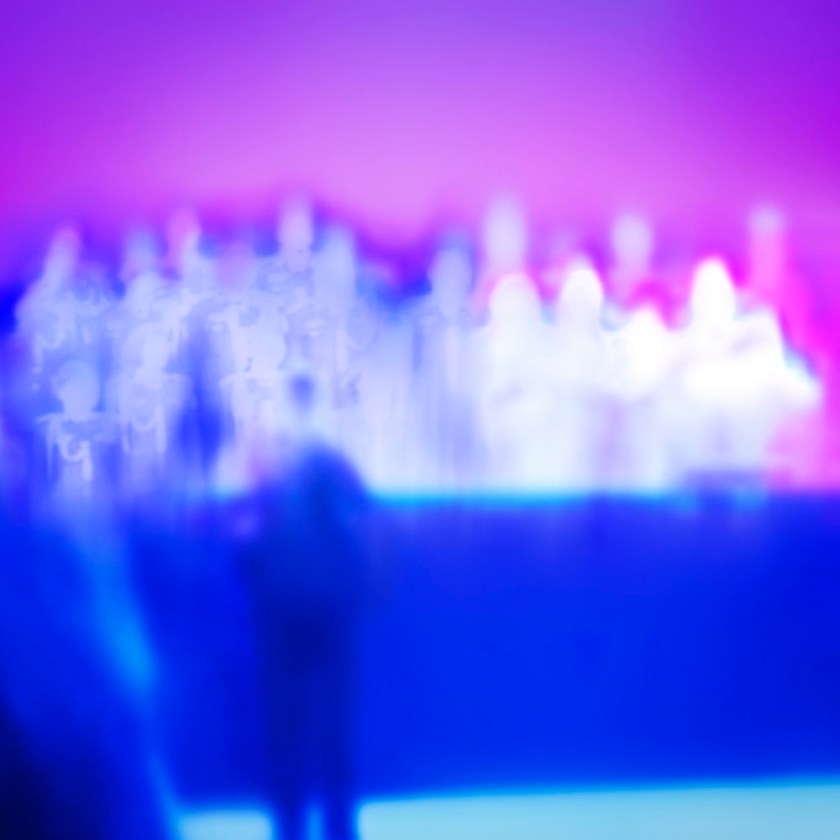
It’s tempting to hear and see ‘Love Streams’, the eighth album from Canadian electronic artist Tim Hecker, as his warm and fuzzy record. It certainly has a more organic, perhaps even welcoming sound than his previous couple. Also, it has a nice pink-infused cover, so, y’know, it could be ‘Chill Out with Tim’ couldn’t it? Well no, not quite.
Hecker, as far as I can see, has always used the building blocks of ambient electronic and contemporary classical music as his canvas and then employed distortion and degradation as his primary operating methods. He takes sounds as roots and nicks and chips and twists and bends and burns and intertwines them into shapes and forms that seem simultaneously to have burst from within and withered dreadfully away from their original forms.
Previously he’s been heavily into pipe organs, pianos, guitars, software, the ‘virginal’ (an early percussive harpsichord) and anything else he can get his hands on. He treats these instruments seriously, with reverence and technical curiosity, never as playthings or sound fodder to be thrown willy-nilly. Instead he uses them as serious thematic elements, to enhance, divert, combine and amalgamate, as colours to use to build shapes and as shapes to use as foundations for colours.
I don’t go all the way back with Hecker, not yet at least, only to his last three full lengths. ‘Ravedeath 1972’ took as its intent the destruction of music, and was suitably scabrous. ‘Virgins’ used live ensemble sessions as the basis for its explorations. It seemed to me to say something about the degradation of the human spirit, signified by the juxtaposition between the virginal instrument itself and song titles and cover imagery both of which invoked some of the darkest places in our recent history. It was a remarkable piece of work. I can’t explain why, but that’s always part of the wonder.
Now, with ‘Love Streams’, the human voice is given primacy, featuring for the first time in any of Hecker’s original work. He recorded raw material with the Icelandic Choir Ensemble, reportedly having them sing nonsensical words and abstract sounds, all to give him a source of sound to electronically manipulate, the way he has previously done with acoustic instruments.
The result is simultaneously warm and accessible – the human voice draws us in to any soundscape, almost no matter what else lurks therein – and endlessly fascinating. Following the routes of the interplay and entwined, slow-motion combat of voices and synths and percussion is both challenging and intriguing. the sounds confound, deflect, obfuscate and delight. Still, this is no twinkly piece of ambient electronica. It’s an floating, abstract miasma, an imagination of the way another species might invoke music. Whereas long-time Hecker buddy Daniel Lopatin seems to delight in deconstructing and then reconstructing music, twisting, perverting and destroying its body but retaining superficial traces to allow us to identify the corpse, Hecker is in another realm from start to finish, a place where music evolved under different influences into a different life-form.
There are breathtaking moments on ‘Love Streams’ and a thousand moments that will slip by un-noticed until the hundredth time. There are combinations of colour and flavour and texture that you will not have heard before. It will make little sense to you on many levels and perfect sense on others. Ultimately this is a beautiful work of sound, and perhaps my favourite thing to listen to this year so far.
Tom listened: It’s confession time…I can recall very little about this album, although I do recall liking it! And I think that’s the problem I have with music that is predominantly electronic – generally I enjoy the experience of listening to it, but don’t find myself seeking it out for repeated spins (Fourtet’s Rounds has sat on my shelf for years and year, gathering dust. Music Has the Right…by Boards of Canada has been doing a similar trick in my car, Dubnobasswithmyheadman I’ve pulled out on a few occasions more recently, loved it, but it’s drifted back into the lesser visited recesses of my collection over the last couple of years). So, it makes me even more pleased that Rob and Nick bring this stuff to Record Club – surely exposing you to music that you wouldn’t naturally encounter is what it’s all about!
Apart from those bees.
nick listened: can’t remember a bloody thing about this but wrote it on my list of things to buy, so assume I liked it. Have two other Heckers and feel as if they’re more like homework than hobby, but this seemed to bridge that gap.
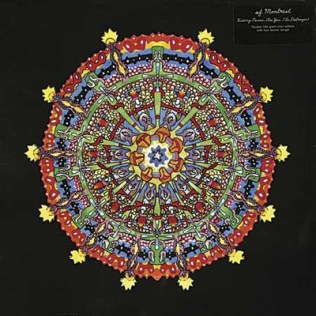 Imagine you’re watching one of those films whose opening sequence starts off with a view of a distant galaxy. The image starts to magnify and suddenly you are hurtling into an arm of the Milky Way (for it’s that galaxy), about two thirds of the way out from the galaxy’s centre. The magnification continues apace, now we’re being given a tour of the solar system, zooming past the gas giants, on through the asteroid belt and past Mars. Earth comes into view, we whizz through the atmosphere, puncture a wispy cumulus or two to hurtle (invariably) into a suburban landscape, through an open window to focus on, perhaps, the main character of the movie. But rather than cut to the inevitable ‘get ready for school’ off camera dialogue of the protagonist’s mother, let’s continue to their record collection. The dude is an indie kid, but left field indie rather than middle-of-the-road indie and so, of course, has all the Of Montreal albums…and there they all are chronologically arranged pretty much smack bang in the middle of his alphabetically ordered albums. The camera continues to zoom in right to the heart of the Of Montreal selection, to Hissing Fauna (which is the middle album since the kid has a promo of 2016’s Innocence Reaches) and on it goes, to the centre of the album, to the gargantuan groove fuck that is The Past Is A Grotesque Animal (track 7 out of 12), which happens to be the kid’s favourite 12 minute long existential dissection of a relationship gone bad in, like, ever. We carry on to the middle of the…I hesitate to say ‘song’ as that’s, kind of, doing it a disservice…piece, and examine the lyrics either side of the median:
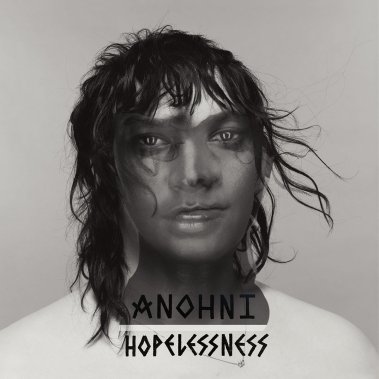 Hopelessness was one of my shortlist for the ‘no white men’ theme I set for the last meeting (which I then didn’t attend!). In the spirit of increasing the diversity of the artists we play at record club, and because I think it’s an excellent record, I thought I’d still play it.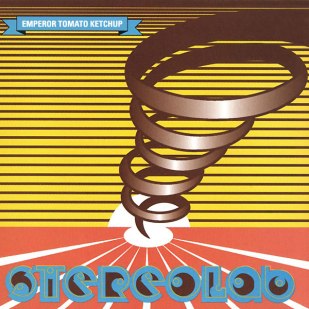


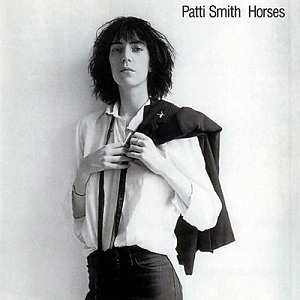 “Jesus died for somebody’s sins….but not mine”. The opening line for my ‘pick’ for this meeting smacked me in the face as a 16 year old record collector and indoctrinated Christian. I wa
 So Steve and I brought the same record to record club.
 Devon Record Club