Aldous Harding – ‘Aldous Harding’: Round 84 – Tom’s Selection

aldous-harding-aldous-harding

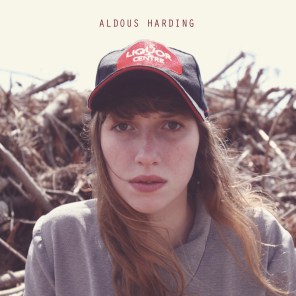
Well, Nick wanted quiet, so I thought I would bring something that is barely there, in a literal sense as well as sonically.

In fact, Aldous Harding is barely anywhere….a record that neither Rob or Nick had heard of is rare indeed. A record that hasn’t got an Allmusic review is hallowed ground. In fact, Aldous hasn’t even got a wikipedia entry, which must mean that either she doesn’t actually exist, is less than two years of age…or that she is from New Zealand.

Which of course, isn’t the case. Not EVERYBODY I take to record club is from New bloody Zealand! Having researched extensively by, y’know’ reading books and stuff, it turns out that Aldous ‘Keith’ Harding was born in Chipping Sodbury in the year 2000. Solely proficient in the playing of spoons, it is actually her pet chimp, ‘Mr Crumble’ who takes the lead on most of the guitar solos on the album. The jury is out as to whether the music on this, her eighth album, is ‘black’ or ‘death’ or, indeed, ‘black death’ metal but the pounding drums and terrifying vocals have to be heard to be believed.

No matter how many times I hear it, her hidden track cover version of Showaddywaddy’s Under The Moon Of Love never fails to move me to tears. A departure from her earlier work, Aldous Harding the album has a pop sensibility that underpins every damn note on the record – imagine Tribe of Toffs’ John Kettley is a Weather Man crossed with Meat Loaf’s Bat Out Of Hell…III, and you’ll be close to the overall sound of the album, the chiming guitars from Crumble coalescing with Harding’s finest cutlery to produce sounds that echo glories past but are, frankly, unlike anything else in recorded music. Don’t believe me? Well do yourselves a favour and go buy yourself a copy of this fine slab of vinyl and then get back to me if it isn’t one of the best things you’ve heard all year!

PS Aldous…If you ever happen to stumble upon this ridiculous piece of writing (and with your internet presence I doubt you will), I most humbly apologise. I actually think your album is a wonderful, wonderful thing; one of the most delicate, arid and quietly devastating records I have heard in a long time.

My post is really just a silly way of pointing out how over-reliant we are on the internet, how rare it is that we can stumble across gems like this, whilst knowing so little about the person who made them. My discovery of your music (with so little to go on..thank you Marc Riley on 6 Music), and the time I have subsequently spent with your songs, has brought me great pleasure.

Rob listened: In accidental keeping with Tom’s conceit of obscuring his real thoughts on this record with some other writing, a veritable palimpsest if you will, I wrote up and, I thought, published some rather erudite comments on Aldous Harding a couple of weeks ago and they seem, on my return, to have disappeared.

It was quite refreshing to hear a record none of us had heard of, including Tom more or less, and which was practically unfindable online. No preconceptions, no-one telling us what to think. Just like the old days, perhaps. The record turned out to be an intriguing listen, working inside a range but within that displaying wilful variety between tracks. ‘Aldous Harding’ was a fascinating counterpoint to the Grouper record. One is an artist who obscures her true intentions underneath layers of fog and reverb. The other makes it difficult to know her by skipping around wildly between styles and approaches, within a crystal clear sound. I hope the internet discovers Aldous Harding soon.

Grouper – ‘Dragging a Dead Deer Up a Hill’: Round 84 – Rob’s choice

Grouper - Dragging a Dead Deer Up a HillThat’s some album title ain’t it? I know what you’re thinking: ‘that’s a clever juxtaposition for an album of neon bright power-pop!’ Well, you’re an idiot.

Regular readers, if they exist, will be tediously familiar with me writing about records I love as if i’m not entirely sure that it’s okay for me to love them. This time around i’m going to try something a little different, by writing about a record, or more accurately an artist, who I listen to a lot, but about whom I really can’t figure out how on earth I feel, let alone why. Perhaps writing about it, and her, will help me figure something out. Perhaps not.

Let’s start at the top. Grouper is Liz Harris, a musician and artist from Portland, Oregon. She self-released her first album in 2005 and has been putting out music fairly regularly since then. I first came across her work when ‘Dragging A Dead Deer…’ placed highly in a number of end of year lists in 2008. I sought out her music, gave it some passing attention, and put it aside. ‘Too unpresent’, I thought. ‘Too insubstantial’. ‘Too deliberate in its constructed unknowability’ I didn’t think but probably could have if I’d tried. I still wonder all these things about this record, and the other four Grouper albums I own, but I no longer know whether these are reservations or recommendations.

Ultimately the music would not be put aside. I found myself going back to it when I found that I needed it. I used it as a background wash for work, or just for drifting. I still found it naggingly incomplete, baffingly lacking in intent. I still didn’t think I liked it. But I wanted to know more about it and I kept playing it. Right throughout I found it easy to walk away from and, even when I stayed, I couldn’t recall the details of what I’d just listened to. I’ve been through a couple of attempts at listen to nothing but Grouper for an extended period, in a push to really get a grip on what she’s doing. It hasn’t worked. The music drifts away, parting like fog to let you pass through. The closer you try to get to it, the less substantial it seems.

I owe you at least an attempt to explain what Grouper sounds like. Imagine gentle, haunting acoustic ballads, down-tuned, slow-moving and with the sort of infused melancholy someone like Angel Olsen captures in her gloomier moments. Now imagine those songs heard from the next room. Or a room just off the next room. The details start to fade. The piano takes on a felt-clad tone. Now imagine you record those songs from where you’re sitting, then play the tape back quietly. From the next room. Now you wonder whether that was a guitar in the first place, or the sound of a tree brushing against the window. Now, give that recording to Williams Basinski and let him put it through a half-cycle of his Disintegration Loops process. Then stick it out as an album with no lyric sheet, no context, no hint as to what or who this thing is, what it’s about, what it’s made of.

How does that sound to you?

Liz Harris’ voice floats like a spectre through the records. I’ve read reviews in which writers describe the beauty of her lyrics, detailing the emotional gutpunch of specific songs, of the records as overpowering conceptual suites. I have to assume they’re right, but I have to be honest: I can’t hear them, apart from a couple of snatches here and there (by which I mean a couple of snatches across the entire body of work). I’ve tried to listen closely, but they deflect.

To me, this is the music of memory. The more you want to understand it, the more you want to capture it forever, the more elusive it becomes. However you think you remembered it, something different is revealed when you go back.

Sometimes, these records seem genuinely to be pulled right out of memory. The last two albums, ‘The Man Who Died In His Boat’ and ‘Ruins’ are each comprised of left-over tracks and sessions from several years ago. And yet Ruins, on the face of it a collection of 8 part-songs recorded in an open room in Portugal in 2011, was one of the most highly regarded albums of 2014. I don’t know why it should have been, but I loved it too.

One of the old saws of music enthusiasm is the record that seemed inpenetrable at first but then, after repeated attempts, suddenly revealed itself. Or, as the vernacular goes, ‘just clicked’. Let me tell you, Grouper still hasn’t clicked for me after several years and I wouldn’t be surprised if it never did.

I really don’t know. Perhaps that’s part of the intrigue, the attraction, the inescapable pull. Grouper sounds like a graceful, lowing eminence calling through the mist, guiding us, hopefully home. Whatever I think about this almost unknowable music, I feel as if I need it in my life.

Nick listened: Grouper’s been a name on the outskirts of my experience for a few years, piquing my curiosity but never quite reaching that level of critical mass where you simply have to investigate. So when Rob suggested he might bring Grouper along to a future meeting some time ago, I eagerly encouraged him.

A number of different artists sprang to mind (or, rather, slowly insinuated themselves to mind; ‘sprang’ is far too jaunty a verb here): the slow motion ambience of Stars of the Lid; the other-worldliness of Julia Holter; the remembering-someone-else’s-song nostalgia of The Clientele. But while I can name all of those artists as being things that Grouper reminded me of, I can’t really remember anything about the actual record. Maybe because we talked over it – as we are wont to do – or maybe because of the intangibility of the music itself. Or, most likely, a combination of the two. So I’m still intrigued to hear Grouper.

Tom listened: This was excellent. Really disorientating, muffled to the point of total obfuscation…the opposite of the album I brought along really (in that Grouper seems to have a very clearly defined sound that is very much her own, whereas Aldous Harding has very clearly defined sound!). So whilst Dragging a Dead Deer Up A Hill reminded me, at times, of the quieter moments on Loveless where Belinda Butcher’s vocals kind of suffocate under the weight of the warped guitars, it was eerier and more pared down and, perhaps, more affecting as a result.

I could really see myself obsessing over this album, trying my hardest to work it out but, as Rob has suggested, maybe this one would always prove to be just too slippery to fully grasp.

Polar Bear – Same As You: Round 84, Nick’s choice

Polar_Bear_Same_As_YouIt wouldn’t be an exaggeration to say that Polar Bear have been one of my favourite bands over the last decade, since they first came to my attention as the ‘token jazz nominee’ in the 2005 Mercury Music Prize for Held On the Tips Of Fingers. I feel like I’ve talked about them a lot at record club but never played them – although I did play their (now defunct) rambunctious sister-group Acoustic Ladyland once upon a time.

Polar Bear have been notable for their constant evolution between – and sometimes within – records, but last year’s In Each And Every One pushed them in quite radical, and at times unrecognisable directions; it sounded like the work of a completely different band to their previous record, Peepers (to be fair, there had been a 4-year gap).

Somehow, Same As You manages to do the same again, and sees them broaching even more new ground. Mixed in the Mojave desert, Same As You appears at first glance and from a distance to be sparse, arid even, but upon closer inspection reveals huge detail and perpetual, subtle movement. Where its predecessor occasionally obsessed over the gloomy end of the emotional spectrum, its minimalism occasionally burst by skronking intensity, Same As You is quietly positivist and relaxed, its sunny, love-fuelled intent laid out in a spoken-word introduction about “life, love, and light”.

The key components of the album are Seb Rochford’s polyrhythmic drumming and Tom Herbert’s almost dub-y stand-up bass playing; they form a low-key, constantly shifting bedrock for tenor sax and electronics to subtly explore. Nowhere is this clearer than the 20-minute rumination of “Unrelenting Unconditional”, where Herbert’s nimble fingers are the absolute driving force for most of the running time. Solos exist, but they paint in the margins most of the time, and never seem to be overtly seeking attention.

After the spoken-word intro, “We Feel The Echoes” sets the tone for the album by almost completely disintegrating after four minutes. The tune slowly re-emerges, but it’s so low-key as to almost seem apologetic for being music; and yet it’s beautiful.

If Kamasi Washington’s The Epic is probably the biggest (in every sense) jazz album of the year – an acclaimed, hip-hop circling crossover success that lasts for THREE HOURS and celebrates an entire history of American jazz – then Same As You is almost its opposite: where The Epic is grand, flamboyant, searching and, well, epic, Same As You is quiet, humble, and contented, even as it explores new spaces and sounds. I like The Epic a lot, but through admiration and awe by and large; I love Same As You in a very different and much more personal way.

Rob listened: I loved this. I didn’t get sparse or arid vibes from it as Nick suggests. Instead, in its spaces and absences and digressions ‘Same As You’ seemed intimate adn human. From the grain of the voice that opens the record, you can hear the movement and concentration and the fingerprints of the people who made this music, in each pawed bass string, each brushed snare drum and each pushed sax key. We heard this straight after Grouper, another artist unafraid to remove herself from the foreground and let the world around her and the world in the listener’s head fill the spaces. I got the warmth that Nick describes, but not from sunny sounds, rather from the feeling of being in the company of good people making beautiful music.

Tom listened: This was a strange listen to me, a bit like one of my victoria sponge cakes, it was delicious all the way round but sagged a bit in the middle. So I was immediately hooked by the voice and atmosphere of the spoken word opener which led into the equally fine We Feel The Echoes. From there I don’t recall much until the gargantuan last track which lasted for twenty minutes and at no point felt too long! So, whilst I didn’t unequivocally fall for all the tracks on Same As You, I very much enjoyed at least 35 minutes of it!

Spacemen 3 – Playing With Fire: Round 83 – Tom’s Selection

51EY2DMGRCLAbout half a year ago I set the theme that at our next meeting we had to bring a record by someone who had been discussed at our previous get together. It seemed like a good idea at the time. Often the records that we are not playing – but talking about – sound like they could be even better than the fodder we are consuming there and then. We also like to play ‘Spot the Influence’, aka ‘This sounds a bit like…’ incessantly, although I have to admit that I am probably the biggest culprit in this respect, so names crop up regularly but often only a couple of us actually know what they sound like. I thought it might be fun to try to connect together two consecutive evenings in this way, join the dots and hear what all the fuss was about. It sort of worked too, but perhaps would have been even better if we hadn’t done the politician/teacher thing of having the summer off and could actually remember the conversations we had had!

In the event I am not sure why I brought up Spacemen 3 at our previous meeting but I think (and I am very happy to be corrected on this)  it might have been at the point where Rob’s Haxan Cloak offering went all poppy and something there reminded me a little of Playing With Fire’s gargantuan, and somewhat idiosyncratic, centerpiece, Suicide. Suicide (the track) is an obvious tribute to Martin Rev and Alan Vega’s band of the same name but filtered through the haze of a very different cocktail of mind expanding substances. Whereas Suicide (the band) played mainly hushed, barely there, pitter patter pop (with the occasional bloodcurdling scream admittedly), Suicide (the song) is a full on aural assault; a pummeling, repetitive onslaught that needs the volume to be set to 11 to register the full impact. Seeing as the rest of the album is really nothing like it, and recalling the effect that The Haxan Cloak had on us, I can only assume that the connection was made in this way.

Funnily enough the majority of Playing With Fire is much closer in spirit and sound to Suicide’s eponymous debut album, especially its more blissful songs like Cheree and Girl. And to my mind, this is where it really hits it stride – minimal electronica with hushed vocals and pulsating drones sounding far more radical and enthralling than the somewhat tired, adolescent sloganeering and ‘Stoogeslite’ riffing of the ‘big’ hit single Revolution – which, as Rob pointed out on the night, really hasn’t worn all that well over the intervening 27 years. A staple of indie discos at the time, perhaps that’s where it should have stayed!

I bought Playing With Fire at the time of its release and was immediately hooked. I loved the sounds (which were unlike anything I had heard before) and, curiously, I was also really drawn to the coolness of the band. Being staunchly anti-drugs, I had no time at all for friends and acquaintances who dabbled, yet here I was, thrilled to be listening to a band who openly promoted the use of hallucinogens! This inconsistency made little sense to me but was something I felt deeply at the time. Thinking back now, it was almost as if, through listening to Playing With Fire, I could experience the effects of the drugs (which always fascinated me) without having to sell my principles or take the risks. The Spacemen were taking the trip to the other side and reporting back with what they found there. Cool.

Of course, that all sounds like total bobbins to me now and, to be perfectly honest, my feelings towards the record have diminished as a result. So Spacemen 3 are no longer ‘my favourite band…like…ever’, Playing With Fire is no longer the coolest thing since sliced bread and, it turns out, the ‘other side’ just happened to be a record that had been released a decade earlier and still sounds more dangerous, revolutionary and groundbreaking. Yet, despite these misgivings, I would attest that Spacemen 3’s third album is (on the whole) a damn fine listen that has held up surprisingly well over the intervening years and still manages to sound reasonably cool even in 2015.

Rob listened: An absolutely seminal record for me, this. Several years ago to this very day I arrived at university with my Fall and Pixies tapes and my poster of Morrissey’s shaved armpit. I assumed everyone else would be in tune with me and I was wrong. No-one liked the Smiths, The Fall hadn’t crossed their radars and PiL were an irrelevance. Instead, at least two of my new flatmates both had ‘Playing With Fire’ posters blu-tacked to the flaky paint on their bedroom walls. This was the club the new kids were in, and I was clueless. I was even more bewildered when I actually heard the record. No raging punk rock guitars. No cinder-throated vocals. No pounding percussion. Actually, no percussion to speak of at all.

Now, several years later, some of these sounds are the most evocative in recorded music. That spectral, bending guitar. That sobbing reverb, eked out with a dancer’s precision. That bronchial farfisa organ. Or was it a vox?

‘Playing With Fire’ is one of the handful of records that completely changed the way I listened to music and rewired what I looked for. The space, the pace, the mood were all things I had never come across before and, after some considerable time to be fair, I was intoxicated by it. Tom’s brother and I used to lie on the floor in the dark listening to ‘Suicide’. It was about the most transportive thing I did during those three years.

And now? Well, it still sets my spine tingling, although I’m not sure how well some of it holds up. As Tom has intimated, some of it really doesn’t. ‘Revolution’ really did used to sound like the barricades were being kicked in and now it just sounds impotent. It’s probably fair to class Spacemen 3 as baton carriers, taking the message from Suicide and the Velvets and keeping it alive for another generation to make more of. Nonetheless, there are things that they did that still sound like no-one else has ever sounded. And when those guitars shine out like warm sun-rays over the horizon, man, it transports me.

Nick listened: I bought copy of this while at university, more than ten years after it originally came out and a good couple of years after I’d fallen in love with Spiritualized’s Ladies and Gentlemen… and then explored their previous two albums with great eagerness. I’d read about how influential Spacemen 3 were, and heard “Hypnotized”, which, of course, sounds almost exactly like early Spiritualized songs (Pierce has seemingly spent 30 years rewriting the same three songs with vaguely different arrangements). This, however, sounded 50% like cheap demos of early Spiritualized and 50% like someone loading computer games on a ZX Spectrum in 1983 from cassette tapes. Completely underwhelmed by its “psychedelia”, I sold/gave away/lost my copy.

So hearing it again was intriguing; the criticisms still stand – it is cheap and rudimentary sounding – but they matter a lot less to me now; there’s something really interesting here now, that, with 15-odd years more experience and understanding racked up in my listening, I can appreciate as having been potentially pretty seismic at the time. From what I’ve read I suspect I’d like Recurring more than this, but thanks to Tom and Rob’s enthusiasm I’m now intrigued to explore further, and find out what I dismissed all those years ago.

Four Tet – Morning/Evening: Round 83, Nick’s choice

morningI’d bought a great big pile of potentials to our previous session and talked through them all while introducing what I did play, unwittingly giving myself a big selection to choose from for this session, but as the weeks passed and turned into months since we last met, life took over, and the pile, which I’d left out as an aide memoire, got tidied away. Luckily Rob suggested that we’d talked about Four Tet, because it was record club and he’s a name that comes up onerously often, which gave me an excuse to play his beautiful new record, which I don’t think had quite been released when we last met.

When the title and track listing was announced back in the spring I immediately imaged what I wanted this record to sound like. The primary clue? It consists of only two tracks, each 20-ish minutes long, and they are called “Morning Side” and “Evening Side”. My hope was that Kieran Hebden had made something veering towards an ambient record, perhaps following the lead of the lovely, Eno-esque “Peace for Earth” from Pink. And you know what? He kind of has.

While there’s arguably slightly more ‘substance’ to this than some ambient records – it can and does reward close attention, and you could even dance to it relatively easily if you so wished – it is a decidedly low key affair nonetheless, and very happy to sit quietly in a room whilst you do other things, occupying the purpose of ambient music if not, precisely, the genre.

Hebden has talked about this record as being partially about embracing his family heritage following his grandmother dying in 2013, and the manipulated sample of Indian soundtrack singer Lata Mangeshkar that winds its way beautifully through “Morning Side”, although comparable to some similar vocal samples he’s used in the past, definitely feels like something new in his repertoire. It also feels entirely logical and comfortable.

“Morning Side” has received most praise in reviews and discussion that I’ve seen, but it might be “Evening Side” that I like best; its start is even more low-key than “Morning Side”, and it remains in this beatific state of quietude for some considerable time, before, during the final seven minutes or so, all the vocals, synths, and delicate loops fade away, leaving just a pulsing, hip-hop-ish, club-friendly drum track, which reminds me of the ecstatic John Stanier beats that close out the title track on The Fields’ excellent Yesterday and Today.

Morning/Evening is a very warm and beautiful record; to me it feels like a high point of Four Tet’s remarkably consistent catalogue, up there with There Is Love In You and Rounds. I can’t offer much in the way of critical analysis of it beyond saying that it’s a lovely thing to behold.

Rob listened: It’s a lovely record. A couple of weeks before this meeting, I’d had a week of long hours at work, hours in which I needed to get lost in some of the stuff I had to do. I found myself reaching for this album on Spotify and it worked a treat. It’s soothing, vitalising, warm and tender. I listened to it half a dozen times or more and it worked at any level of focus or attention. It’s also a beguilingly simple and natural-sounding music. This being Spotify I ended up letting it run and taking in large parts of Hebden’s discography back to the last record I bought, ‘There Is Love In You’. I loved what I heard, full of variety, equally gorgeous and scabrous, wide-ranging and exploratory and, in the background or the foreground, intoxicating. It really helped.

Tom listened: Nick seems to be in a rich vein of form at the moment for unveiling beautifully constructed music that soothes and caresses and envelopes in a kind of musical security blanket…nothing too challenging here but certainly very enjoyable to spend time with.

I thought the parallels with In a Silent Way were evident – two long tracks, the second building to an obvious crescendo having teased us with its restraint over the course of the previous 15 or so minutes. Some albums are so frequently misappropriated that you feel that the last thing the world needs is another album that sounds similar yet lesser. In a Silent Way is not one of them…and, anyway, Kieran Hebden has really only echoed the structure of that record; the music on Morning/Evening sounds all his own.

Flying Lotus – ‘Cosmogramma’: Round 83 – Rob’s choice

Flying Lotus - CosmogrammaA fine and crafty theme set by Tom when, at the end of the last round – ‘Instrumentals’ – he decreed that next time we should bring a record by an artist that had been referred to previously in that evening’s typically meandering and haphazard discussion. This made easy work for Graham, who had openly flip-flopped between two instrumental choices and then promised to bring his second (‘Laughing Stock’, a justified second best to ‘The Four Seasons’ in my book and not even anywhere near being an instrumental) to the next meeting. The rest of us went scurrying to our mental notepads. I ended up with an unworkable shortlist of Nils Frahm, Earth, Sun Kil Moon and Sonic Boom – all of which are too long, and one of which I’m not even sure was mentioned – plus Mekons, J Dilla and Flying Lotus. So, after typically scant deliberation, it’s over to Steven Ellison, for it is he.

I only have two Flying Lotus records, this one, his third, and it’s predecessor, ‘Los Angeles’. I like both a great deal and they seem to straddle a crucial bridging point in the career of this Californian producer and composer. ‘Los Angeles’ is a solid collection of woozy, glitchy instrumental hip-hop, shot through with a certain nervous, questing energy. I used to like putting it on as background music when we had guests, partly because every so often someone or other would urgently ask me to turn it off. It carries hidden traps and toxins.

‘Cosmogramma’ is a huge leap forward. Right from the get-go ‘Clock Catcher’ this is an urgent, overloaded and thoroughly urban music. Beats tumble over one another, live and electronic instruments vie for attention and the resultant sounds are fleeting and dizzying, hard to catch.

The complexity, or at least the sheer pace and density, of some of these compositions is outrageous and, for all that it harks back to the past, whisking together jazz, funk, soul, disco, electronica and hip-hop, the sheer teeming mass marks this out as music that could only have been made in the 21st century. Once you’ve been through ‘Cosmogramma’ a few times, enough to be able to draw breath as it plays, there emerges a tantalising, twisted tension at its heart. For me, this is a jazz record as much as anything else. In spirit always, and directly in sound at times, it pushes for the sort of wildness and controlled chaos that drives the Coltrane record Tom brought to our last meeting (Ellison, as it happens, is grand-nephew to John and Alice Coltrane). Unlike ‘Los Angeles’ much of this album consists of live performances (including from Ravi Coltrane, John and Alice’s son) and the torque that drives the record comes from the rub of these freewheeling live takes against the meticulous, painstaking work that Ellison, a laptop composer at heart, must have put in, beat by beat, second by second, to stitch this, his vision, together.

I know from previous conversations that Nick has a problem with the sound of ‘Cosmogramma’ and hopefully he’ll elucidate in his comments. Something about the sound being too compressed. He’s always banging on about that sort of stuff. To my ears the congested sound is in its favour. One of the breakthrough moments I had when I first got this record was when I realised that this wasn’t supposed to be an exquisite soundscape sculpted on state of the art machinery, instead it sounds like standing on a busy street corner and tuning in to the music flooding from car stereos, shop fronts and headphones. It’s a possible flip-side to ‘In A Silent Way’, a record that always struck me as the sound of a city at 3am. ‘Cosmogramma’ is the noise that is absent from ‘Silent Way’ and vice versa. It’s the sound of the same street corner at 3pm. The album conjures the warp and weft of a heaving city. It bristles with uncontainable life. And like a modern city, it is replete with alleyways and flyovers, heaving with life and stories and a breathing rhythm all of its own which only begins to emerge after you have lived within it, and continues to change every time you step into it.

Nick Listened: Emma refused to let me buy the last Flying Lotus album, going so far as to take it out of my hands and put it back on the shelf in HMV. “You’ll only moan about it being compressed” she said, almost certainly correctly. On paper FlyLo appeals – experimental electronic music with a big dose of jazz being right up my alley – but the empirical (phenomenological?) experience of actually listening to his records always gives me a headache. At a guess this is because of the crazy compression and side-chaining he employs to make his music (very deliberately) sound the way it does. Which, as Rob describes, is a busy, schizophrenic, distracted, urban sound. Which some people love, but I generally do not; I prefer records a bit more suburban, or rural perhaps, with space and light amongst the component parts. The juxtaposition of fractured, melting beats and dense, layered electronics and jazz on display here is dizzying when everything pumps together.

I’ve actually come to enjoy Cosmogramma quite a lot over the years, following my initial instinct to recoil from its extreme surfaces (although I still can’t deal with the follow-up at all). The second half eases up a little, becomes a little more spacious and easy to inhabit. Interestingly, Rob played it on vinyl, the limitations of which mean you literally just can’t push things as hard as on CD (the needle would jump right out of the groove), although a side-effect is that you need to change disc on this relatively short record three times. So yes, I’d probably listen to it more if it was less in-my-face, but it is a pretty damn good record just as it is.

Tom listened: Flying Lotus is one of those names that has been bandied around for a few years now, its profile ever more prominent since 6 Music and Pitchfork latched onto Cosmogramma and have never really looked back. Despite this, I had never knowingly heard anything from Cosmogramma before and listening to it tonight, that isn’t all that surprising – this didn’t strike me as the sort of album that you’d be pulling individual ‘songs’ from very often and there was certainly nothing remotely like a chart hit to be found in its incredibly densely packed grooves.

I wasn’t really sure what to make of this to be honest – I don’t knowingly share Nick’s misgivings but I suspect that that may be solely because I don’t have the skill or knowledge to identify them. I liked parts of Cosmogramma for sure but there was something about the jarring nature of the tracks – the way they seemed to hurtle one into the next – that made it feel quite alienating on a first listen.

To sum up…intriguing, beguiling  and difficult in just about equal measure as far as I was concerned.

John Coltrane – Coltranology Volume 2: Round 82 – Tom’s Selection

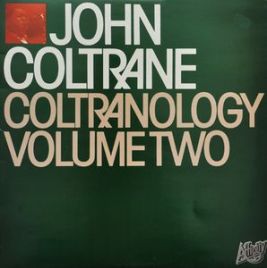
R-1141194-1254766188.jpegIn the end my decision to bring Coltranology Volume 2 to Record Club was sealed by my reflections on Rob’s offering at the previous round. I was so taken by Buddy Holly’s greatest hits that I more-or-less immediately acquired a copy of his second album; an album which is spectacular in its raw, unfettered simplicity. I have listened to it a lot since I bought it, becoming dangerously addicted in the process. But, as our themed night grew ever nearer, I had to go looking through my collection for an instrumental album (we had to find some way of stopping Mitchell singing along) and I thought the fact that John Coltrane was making music so complex and demanding at roughly the same point in time that Buddy Holly was releasing his music would make for a neat comparison. So I chose the second volume of Coltrane’s little known 1962 live album, Coltranology. Coincidentally, I also really like it!
In comparison to today, music must have seemed to offer so little choice back then – looking back it seems as though the options were rock’n’roll, easy listening or jazz. And whilst I can now appreciate the skill and innovation of Holly’s simple tunes, I am sure I would have gravitated towards jazz if I had been consuming music at the turn of the 60s, drawn to its outsider attitude and thrilling  unpredictability, whilst simultaneously sneering at the ridiculous sappy pap on offer elsewhere. But, funnily enough, my 2015 self and jazz have a far less easy relationship than I imagine I would have had had there been so little to choose from and I have numerous jazz albums in my collection that I have no desire to go near again, with or without barge pole.

I recall Graham writing, in his response to Fiona Apple’s The Idler Wheel…, that he either likes an artist to stick to the rules or completely break them, suggesting that Ms Apple did neither. I guess I’m the opposite, preferring those who tinker, bend and shape their music away from the familiar, whilst still providing a safety net of familiarity. That’s probably why I am drawn to this live album from 1962 rather than Coltrane’s slightly safer earlier output or the cacophony he whipped up on his later, perhaps more heralded, albums. The four tracks on Coltranology Volume 2 constantly teeter on the brink of collapse but, crucially for me, Coltrane reins in his instincts to go entirely stratospheric just enough to provide sufficient structure to give the listener something to hang on to, to look forwards to, to recognise! Maybe it’s not as groundbreaking as what was to come next, but I know what I would rather be listening to! Coltranology Volume 2 was the first John Coltrane album I acquired and, whilst I have gone on to add Meditations, Giant Steps and A Love Supreme to my collection, it is the runt of the litter that I find so hard to resist, offering, as it does, just enough light and shade to make it captivating, thrilling and, to my mind at least, accessible enough.

Rob listened: I know where Tom is coming from. Much as my own musical devotions have mostly been shaped by the lean, brutal simplicity of rock and roll, had I been around when the form was being hewn out then I would probably have been too much of a jazz snob to have given it any headspace whatsoever. Which would presumably have left me a jazz aficionado who missed out on ‘Sister Ray’ and ‘Trout Mask Replica’ and yes, even the Haxan Cloak. As it goes, I dabble a (very) little in Jazz, but with a gleeful lack of knowledge, which I value in this context.  Some of it I really like, some of it I would like to like, some of it I admire, some of it I can’t take seriously. I heard an edition of Sound Opinions recently that offered ‘A Rock Fan’s Guide To Jazz‘. Therein, John Corbett talked about his breakthrough with Jazz being the moment he realised there was nothing to ‘get’. From that point he just went with it, dived deeper into the stuff he liked and stayed away from the stuff he didn’t without trying to figure any of it out. I can dig that. At the same time I can totally buy Steve Albini’s famously dismissive views on the form. However i’m feeling on any given day, what never fails to amaze me is just how wild some of this stuff still sounds, 50 or 60 years after it was recorded.

The first side of this record was as crazed as the most wilfully abrasive black metal or disembodied electronica. The second side was a bit more beautiful. Put together, they made a fine listen.

Nick Listened: Writing this months after the fact – my own fault – makes remembering what I thought of this record pretty difficult. I remember it seemed pretty muddy in terms of sound quality (old live recording, vinyl), and that I thought this probably detracted from its impact a little. Bits, as Rob suggests, of the second side were really quite beautiful, bits of the first side had that jazz thing that I don’t always quite get, where it genuinely sounds like people are playing entirely different things from each other, and I’m not – despite owning and loving a lot of jazz – quite musical enough to get what they’re doing. Interestingly, Miles Davis (who I rarely suffer from that problem with) described Coltrane (in an interview in about 1982) as a ‘selfish’ musician, something which made sense to me. I’ve always preferred Miles to Coltrane; the latter seemed to quest further and further into himself, looking for new intensities, while the former seemed to be always moving outwards, looking for new canvases to paint his trumpet over.

Dawn Of Midi – Dysnomia: Round 82, Nick’s choice

dysnomiaThis record immediately jumped into my head on the term ‘instrumental’ being suggested as the theme for our next meeting, and no matter how much I’ve thought about it, or what else I’ve listened to, nothing else has come close to dislodging it. Apart, perhaps, from …Endtroducing by DJ Shadow, which is too long to play.

I first saw mention of Dysnomia in the comments underneath my review of Open by The Necks for The Quietus some 18 months ago, where someone name-checked it as another modern, minimalist jazz album worth checking out. In an uncharacteristic move, I listened to a chunk of it online straight away, and was impressed, so hunted down the CD and ordered it the same day. It’s been in semi-regular rotation ever since.

Dawn of Midi are based in Brooklyn (isn’t everyone these days?), but formed at Cal Arts, and are called Qasim Naqvi (drums), Aakaash Israni (upright bass), and Amino Belyamani (grand piano). The music they play is ostensibly instrumental jazz, but you could easily hear it as closer in tone to minimal electronic music; they produce incredibly taut, repetitive, and satisfying grooves that put you in mind of intricate clockwork machinery, simple shapes arranged in complex patterns that overlap, interlock, and affect each other in subtly developmental ways.

Dysnomia was recorded live and the nine tracks, which run to a total of 46 minutes, segue seamlessly into one another like a single improvised composition. I’m aware that those two words together are oxy-moronic, but for a long time I genuinely have no idea whether these three musicians played completely off the cuff or whether they micromanage what they do in advance; it could have been either and I’d still have been impressed. As it happens, this really interesting interview with them reveals that it is micro-composed and rehearsed to within an inch of its life; three rehearsals a week for two years, until they played “like three people from the same village playing folk music their whole life together”. The interview also gives fascinating insight into their backgrounds, methodologies, and influences.

In terms of layman comparisons, The Necks are an obvious one, as is Steve Reich, but so are Tortoise, Portico Quartet, Nicolas Jaar, La Dusseldorf, Four Tet, and plenty of other people. Basically anything repetitive and minimal, but they also remind me of Fugazi, somehow, if Fugazi were a minimal, repetitive jazz / pseudo-electronic outfit rather than ragingly progressive post-hardcore punks.

Dysnomia is an alluring, intriguing record. It reveals everything it has to offer within the first few seconds, pretty much, and yet I’ve found myself going back to it endlessly over the last 18 months, playing it over and over, even just thinking about it and feeling a desire to play it at moments when I couldn’t. It lures you into a trance, compels you to move, creates a structure within your mind that allows other thoughts to occur even as it seems to occupy your attention. It feels very pure to me; Platonic, I guess, like an essence of an idea.

Rob listened: This was lovely, an intricate, ever-shifting machine set up and set off just for our wonder and pleasure. The sounds themselves were solid, meaningful, shaped and balanced. The slowly extending and contracting patterns were utterly fascinating. The idea that these three guys rehearsed to the point where they could play this stuff live is incredible, and gives this precise, abstract and delicately balanced piece an underlying sense of joyful humanity.

Tom listened: Firstly I’d like to get the obvious out of the way. This was a beautiful, intimate, addictive listen, with just enough variation along the way to keep me hooked in and fend off those ’emperor’s new clothes’ demons that often come calling when things get a little too minimal.

Almost as fascinating for me as the music itself is the fact that this and John Coltrane could fall under the same genre title. If you were an alien and were told that both these records (that is, Dysnomia and Coltranology Volume 2) were this thing known as ‘Jazz’, you’d surely head off home thinking this species were crazy. But the odd thing is that, however faint, you can just about hear the links, and can appreciate how, over time, one may have led (albeit via a very circuitous route) to the other; something to do with the innovation, the precision, the realisation of a singular vision..and the fact that they are not obviously anything else!

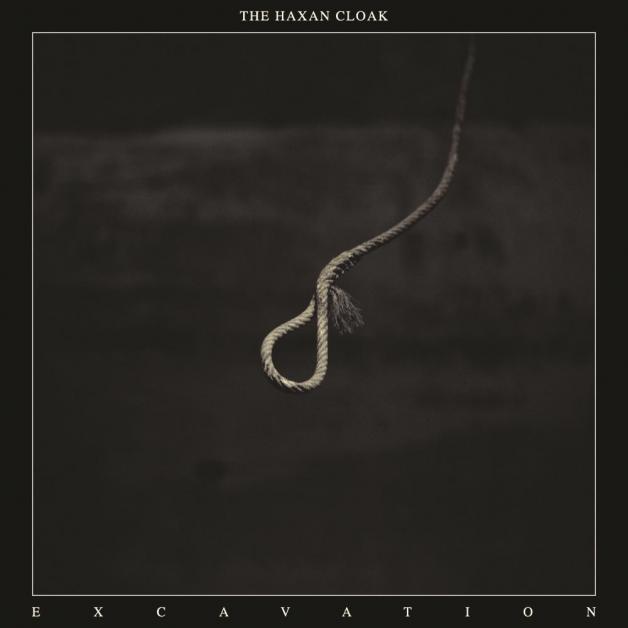
The Haxan Cloak – ‘Excavation’: Round 82 – Rob’s choice

the haxan cloak - excavationThe Haxan Cloak is Bobby Krlic, a musician, composer and producer from West Yorkshire, by way of Brighton. His eponymous debut album was recorded in his parents shed, with Krlic playing every instrument, a remarkable feat considering the end result which is the sound of a strong quartet performing a sludge metal opera based on a Dennis Wheatley novel.

2013’s ‘Excavation’ is a thematic continuation of that first record. Krlic has talked about them as a pair of concept albums over the course of which a central character moves from life through death and into something beyond. If death is the final frontier, then judging by ‘Excavation’ its territory is utterly unrecognisable. Where the debut record could have been a dark and foreboding piece of contemporary chamber music, this sequel is an entirely different experience.

It’s black as pitch, a chasm with a floor that can only be detected by the echo of bass depth charges as they ripple up from below. The palette is electronic, and throughout are scattered semi-familiar sounds that serve partly to lull the listener by presenting something familiar, before casting it into the void. There are beats, emerging and enveloping, but rather than convey motion or structure they drift in like the sound of a slowly extibguishing heartbeat, or the skitter and scratch of twitching neurons.

It’s difficult to describe ‘Excavation’ as a listening experience. The sense of both space and detail that Krlic creates is overwhelming. Listening to it on a system with significant bass output, as we did this evening, the record seems to surge out into the room and construct an entire world around you. There are sub-structures being built just below the range of normal hearing, entire sections of the music that play out in the bones and the skin and the walls and the floor.

The intention may be dark, but it’s beautiful too. If you buy the concept, then there is comfort to be drawn from staring into the abyss. If you don’t, then this is still a compelling and overwhelming achievement.

Tom listened: Well, I’m not sure the word ‘enjoy’ can really be used in the context of Excavation, but I came to within a whisker of it, especially as the album progressed (in some of the later ditties, the sounds of the record began to mix with something akin to a tune…in the loosest sense, admittedly).

In my response to Nick’s record from this round, Dawn of Midi, I compared it to John Coltrane…and I thought I may as well extend the comparison to this. Because it struck me on the night that both The Haxan Cloak and Coltrane are/were primarily interested in challenging their audience, and themselves, by pushing the boundaries of what we previously have perceived music to be. But whereas Coltrane looked to stretch the music beyond what had come before, Krlic is using sound and texture and a kind of lack of musicality to much the same effect. So whilst Coltrane played loads of notes – too many for some perhaps (according to Nick, Miles Davis struggled with Coltrane’s later output), The Haxan Cloak play next to none and, whilst this would normally be a bit of a turn off for me (and, to be honest, it was at times), Excavation reminded me of music just enough to keep me interested.

That said, if it had those horrible throaty death metal vocals over the top, I would have run a mile!

Green Day – Dookie: Round 81, Nick’s choice

Green_Day_-_Dookie_coverI interpreted the theme as “wtf is this doing here?”, and decided that the pick had to be something both stylistically incongruous and without clear reason for existence in the collection. This ruled out lots of potentials: I know exactly why Sugababes albums are in the collection, for instance, and they’re not incongruous because I won several. Even the solitary and very incongruous Will Young album is there because of a fantabulous single that I just had to own (“Switch It On”). There are, of course, lots of records that I can’t remember why I bought them, but very few of them also seem incongruous stylistically (“let’s buy some more minimal faux-jazz/techno/whatever”).

Which left this, the third record by Green Day, which came out just before my 15th birthday and was gifted to me, by my older brother, shortly after that birthday, and which seems completely incongruous sitting in between Al Green and Grizzly Bear. 14 songs, 39 minutes, lyrical concerns as diverse and deep as masturbating and smoking pot. I listened to it intensely for a few months, and then put it away and got into other stuff that sounded nothing like this, and I haven’t listened to this in the intervening 20+ years.

I remember my friend Adam being very impressed by the drummer when I was a teenager, and not really understanding why: I recall being told many moons ago that playing music, like driving, was much easier to do quickly, and much harder to do slowly, so as fast as Tré Cool’s drumrolls were, they never really impressed. (Not playing an instrument, I dunno if that car analogy is true; it’s certainly more awkward to creep along on the clutch than it is to cruise at 55mph, though.)

Why this was in the collection I wasn’t sure; although I can remember its origin, I was sure I’d purged the copy my brother gave me aeons ago, but maybe the fact that it was a gift compelled me to hang on to it. I certainly never intended or expected to listen to it again.

Was it worth listening to again? Not really; I stopped identifying with it and finding it amusing within a few months when I was a teenager, and the intervening decades have done nothing to redress that chasm which opened up between who I thought I was and who this record seemed to be about and for. In my 30s Dookie sounds even more puerile and one-dimensional than it used to, even if that dimension is one of snottily good fun. My hobbies – bikes and boardgames and football and CDs – may still be adolescent to the core, but this wasn’t going to appeal even to a guilty-pleasure-centre in my brain. There are some nice melodies, but it is very, very samey, and tied strictly to an aesthetic that I never really liked anyway.

Green Day, it should be noted, have sold 75 million albums over the last 21 years. That’s seventy-five million. 75,000,000. More than the population of the United Kingdom. Wtf?

Rob listened: Nice to hear this on the same evening as Bob Mould. I liked ‘Basket Case’ when it came out but the rest of it seemed cookie-cutter and just uninteresting on some way. The music, the attitude, the performance all seem to have taken just half a step back from the point of being different, dangerous, enticing. Whereas Mould and Husker Du worked an arguably similar furrow (much earlier) they had edges and hooks and burrs and despair and fights and joy all of which allowed their songs to grow into my heart. Green Day seemed instead like something pre-packaged to pluck from a shelf I don’t need to visit any more.

Tom listened: Having never knowingly listened to Green Day before (unless they were the ones who did that Teenage Dirtbag song?) and having never felt the urge to, I came into Dookie with low expectations and a sinking heart. The dreadful album cover doesn’t help either!

It was alright I suppose.

But, as a result of losing my Green Day virginity, I am more confused than ever about music and my relationship with it, as in:

What were Green Day doing so right that they could sell millions and millions of records whilst countless other bands who sound similar (as in guitar based American indie) but better (Huskers, Replacements, Pixies, Buffalo Tom, Fugazi, Girls vs Boys) could only attract a fraction of their audience?

And what exactly were those other bands doing differently in terms of songwriting, musicianship and production that means they appeal to me so much whilst Green Day really don’t?

These are rhetorical questions!