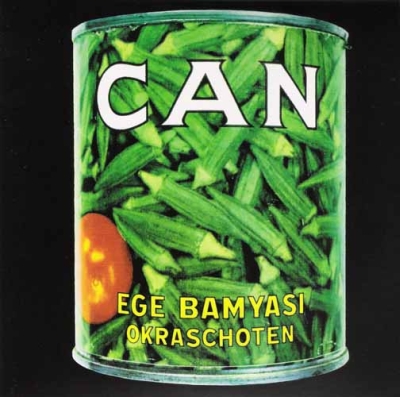
CAN – Ege Bamyasi: Round 24, Nick’s choice

So, at long last, the motherlode of Devon Record Club; the artist we’ve spoken about more than any other.

Before recording Ege Bamyasi in 1972, Can scored an unlikely pop hit in the German charts with Spoon, which sold some 300,000 copies due to being the theme tune to a television program. They used the earnings from Spoon to buy an old cinema, which they both lived and recorded in for the next few years; prior to that they’d recorded in a castle, because the owner of the castle thought they were great, or something. Recording Ege Bamyasi was fractious – two of the band obsessively played chess during the sessions (if you can call them sessions), driving the rest of the band to distraction, and a shortfall of finished material meant they superglued Spoon to the end of the album in order to flesh it out to 40 minutes and seven tracks in length.

Ege Bamyasi is my favourite Can album, I think, possibly because it’s the first one I got, some 15 years ago as a wide-eyed 18-year old, and possibly because it’s also the most fun. I played it at a party once, years ago, and everyone else complained that it was weird. It’s Can’s poppiest album, even though it sounds like aliens hearing the entirety of 20th century music at once and mashing it all together to make their own music, which contains everything (German youth post WWII desperate to split from their country’s past and create something absolutely new). So you end up with something that borrows from jazz, from rock, from the beginnings of electronic music, from Vietnamese music and various other musics from across the globe, long before World Music became a section in HMV. There’s guitar as wild as anything Hendrix committed to tape, synths and electronics as innovative as anything you’ve ever heard, Damo Suzuki’s unrivalled, inscrutable vocals in any number of made-up tongues, and always, always, Jaki Leibzeit’s incredible, pulsating drumming, repeat repeat repeating into delirium, making you twitch and jerk and spasm with little, replicating jolts of percussive joy.

Pinch, the alum’s ten-minute opener, is a shuttling roll of drums and electronic squeaks, the first thing I’d ever heard by Can, and the summation of everything I’d imagined they would sound like after reading about them. I’m So Green is a liquid funk thing that got nicked by The Stone Roses. Sing Swan Song is a bona fide, blissful pop song, delicate and beautiful and oh so very strange. After 15 years I still find new things every time I listen.

Tom Listened: You have to hand it to Can, they certainly knew how to open an album! All the Can albums I own (the four biggies of the early seventies) kick off with an amazing song – Tago Mago has Paperhouse, Soon…the wonderful and, possibly, underrated Dizzy Dizzy, Future Days begins with Future Days and then there’s Ege and its opener, the remarkable, mind blowing swirl of squonk that is Pinch (squonk is a technical term for the sound that Can make on Pinch). It was my first encounter with the band and I can still remember being incredulous that the sound coming out of the speakers could be being made by (a) humans and (b) humans of the 1973 variety.

Although Pinch is undeniably incredible, there are many other outstanding moments on Ege Bamyasi and it feels disloyal to single one or two out and tedious to run through the lot. I suppose it’s easier to say that the last 5 minutes of Soup – it’s a free-form freak out (to use a phrase coined by the Red Crayola) – is the only part of this amazing album that is less than outstanding and ironically (given that I’m sure the band thought this would be, like, totally cutting edge at the time), it sounds far more dated today than any of the more conventional soundscapes that the band conjured up on the rest of the album! So to sum up: a must have album from a band that gets talked about a lot at DRC (but not as much as Talk Talk).

Rob listened: It’s not the motherlode, it’s just another record. I was both relieved and I guess disappointed that Nick, who seems intent on bring as much of the canon as he can haul to our meetings, dragged along the only Can album I know. I rarely ever go back and listen to it, but when I do it’s always a pleasure and tonight was no exception. Amazing to think they were putting this stuff together when they were, and delightful to try to trace the lines of influence down through the years. I was disappointed not to have ‘This Nation’s Saving Grace’ in my glove box so I could play Tom and Nick ‘I Am Damo Suzuki’. It’s just the two of them who have spoken about Can more than any other artist, but I’m sure they would have enjoyed MES’s gag-filled yet genuine tribute. Maybe next time.

Graham listened: First listen for me left me very confused. Nick has in one fell swoop managed to wipe out a significant portion of my musical reference points. No one told me bands were alowed to sound like this in 1972! Some parallels to the first time I heard Spirit of Eden (which is in no way a a crude attempt to get Talk Talk back to the top of the most talked about band charts, oh no…).
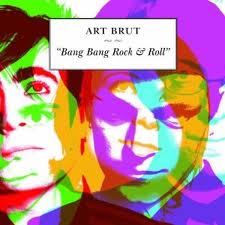
Art Brut – ‘Bang Bang Rock & Roll’: Round 23 – Rob’s choice

art brut - bang bang rock & rollOne of the recurring themes of our discussions over the past year has been intent. What were they thinking when they made this music? What did she mean? What did he want? What did they intend us to think about it? Are they serious? Are they being silly, but with serious intent? Do they even know what they’re doing, and why?

It comes up surprisingly often, perhaps a dead giveaway that we all four are music listeners rather than music makers.

No record of recent years has straddled the line between smart and stupid with such perfect, giddying poise as Art Brut’s debut album. It’s a record about being in a band and making a record which you want to express all your youthful hopes and fears and realising as you do so that wearing your heart on your sleeve is sneered at in the early 21st century and that your fellow hipsters out there might think you’re being silly and embarrassing.

And it deals with it. Brilliantly.

Whatever cheap shots you might throw at Eddie Argos and his band, from the state of his throttled singing voice, to their apparently boundless ambition to their unbridled love of people and things, they’ve already thrown their counter-punch. From the moment 50 seconds into ‘Formed A Band’ (a debut single which essentially encapsulates the band so perfectly – they could easily have split up after releasing it leaving nothing left unsaid) when Argos sneers, “And yes, this is my singing voice, it’s not irony, it’s not rock and roll, we’re just talking… to the kids” you realise they’ve thought this through much better than you and there’s no point being chippy about it.

The rest of the album is studded with in-jokes, self-reflexive digs and confessions of pure love for girls, places and even paintings. All this drilled home by an irresistible, whirling, day-glo thrash-pop without which, of course, Argos’s words would be so much pointless posturing. Every song has something, either a killer hook or a killer gag, to recommend it.

It’s fun and very funny, whilst still being clever, provocative and insightful. That’s a rare balance and those are rare priorities in these cynical times. More to the point, ‘Bang Bang Rock & Roll’ is a record about pure, uncontainable enthusiasm, that most unfashionable of emotions. It’s a minor miracle for a record so unbridled to deal with pretension so unpretentiously. It’s an almost impossible trick to pull off and, listening, one is forced to conclude that far from the knowing hipster outfit they might superficially seem, Art Brut must actually be very brilliant and very very smart.

Nick listened: Art Brut are a name I’m very aware of – plenty of people I know and respect the musical opinions of love them to bits – but they’re one of those groups I’ve enevr investigated for some reason; possibly, as I’ve mentioned before, because you simply can’t investigate everything you come across that sounds interesting or fun or worthwhile. There just isn’t enough time. Anyway, this was great, and I wasted no time in borrowing Rob’s copy to listen to again at home. Art Brut are disarmingly clever, witty, and fun, without ever being irritating or smug or smarmy, which is quite an achievement.

Tom Listened: Rob had lent me Bang Bang Rock & Roll on a previous occasion and I had had a couple of cursory listens prior to the meeting but I think it’s fair to say the record didn’t really grab me when I had played it in my own home. And whilst I certainly enjoyed its energy and the unusual lyrics this time around (and Formed a Band sounded great with the volume cranked up as loud as Rob thinks his neighbour can stand), I still felt there was something missing in the album that would prevent me from going back to it and exploring it further. I can’t put my finger on what it was though and I am perplexed by this fact.

Graham listened: Really didn’t know what to expect from this one, but quite possibly my favourite from the night’s offerings. Refreshing, funny, witty and clever and some great pop songs.

10,000 Maniacs – In My Tribe – Round 23 – Graham’s Choice

In My TribeThe soundtrack to my summer of 1987. If we had an outdoor, summer evening round of DRC, this would have been my choice. Would also have fitted have fitted nicely into an “earnest and worthy” theme night. Though not sure where I was actually going, this never seemed to be out of the cassette deck in the car that year.

Can’t really recall how I came about buying this album, it may have been the music press or even my desire to own everything REM (pre-Green, naturally), as Michael Stipe features on a track.

Natalie Merchant’s distinctive vocals, often restrained and occasionally soaring, carry you through this album, backed, in the main, by bright and jangly guitars. The subject matter of child abuse, alcoholism, US militarisation etc. etc. could be overbearing but is lifted by some joyful playing by the rest of the band. All that changes on the last track, where her vocals and the piano are simply beautiful. In fact, fellow members identified that Verdi Calls could well have inspired what later became Night Swimming, by REM. Generally you could categorise the sound as folk-rock/ pop-folk with the odd tinge of country. Though regarded as their best album, if I have a problem with any track it would be My Sister Rose, as the imagery of the vocals and style of playing, just doesn’t  seem to hang well with the rest of the tracks.

Given the general vibe of peace, love and tolerance to all, a wonderful irony was the later removal from US versions of the cover (and it’s a good one) of Cat Stevens’ Peace Train. This followed alleged statements from Yusef Islam about the Fatwa on Salman Rushdie.

This was the Maniac’s 2nd album on Elektra, and as I recall (though can’t find the CD’s at present) a lighter/poppier sound than their debut, with Wishing Chair. I’m sure we had the 3rd, Blind Man’s Zoo, knocking around as well, though I seemed to have moved on by the time the 4th, and final album involving Merchant was released. In various forms the band are still knocking around on the live circuit to this day, though I’ve not seen/heard/looked for any more of their output.

A perfect slice of summer when  its miserable weather or you’re in feeling a little down.

Nick listened: I hate to be predictable, but this pretty much passed me by, as Rob and Tom predicted; it is jangle-pop, after all. It was very pleasant, and the lyrics seemed interesting from one DRC exposure, but I think I’ve just got a big deaf-spot when it comes to jangle-pop in general.

Tom Listened: Come on Nick, you love to be predictable!

I am quite a fan of jangle-pop but I am also well aware of how often these records can pass you by on a first listen. So, in many ways I agree with Nick but at the same time I have a feeling that I may be being unfair on In My Tribe to dismiss it after just one, curry interrupted, listen. That said, I tend to like my jangle-pop to be either a bit twisted (The Bats, The Chills) or to have a seam of wistful melancholia running through it (The Triffids, The Go-Betweens). It seems as though other per-requisites are that the band have to come from the Antipodes and have the word ‘The’ in the name…unfortunately, 10000 Maniacs fail on both counts!

Rob listened: I realised listening to ‘In My Tribe’ how I subconsciously yearn for that period in the late 80s when a group, usually from somewhere in the lower half of North America, could simply jangle away at a couple of chords for a whole album and that would be just fine. There was a weird still point there where records didn’t have to do all that much to sound sweet. I guess 10,000 Maniacs really did get stuck in that still point, not quite country, not as oblique or interesting as R.E.M., not as wracked as Throwing Muses they just sort of jangled away and everyone else moved on. I enjoyed the listen.

Isaac Hayes – Hot Buttered Soul; Round 23, Nick’s choice

There was an article, some kind of ‘lost classic’ thing, on the final page of a 90s music monthly, about this album, which was the first time I’d ever heard of it. I knew of Isaac Hayes as the guy who’d done Theme From Shaft, and he might have already been the voice of Chef from South Park (which started in 1997), but I knew pretty much nothing else. The title of the album, and its obtuse cover (the top of Isaac’s bald head, his face hidden), were immediately intriguing, and the description, of an avant-garde album, made by a backroom producer and writer (Sam & Dave have him to thank for Soul Man) given complete creative control by a record label (Stax) recently split from its home (Atlantic) and floundering to find its own identity, sealed the deal. I had to have this album.

Hayes debut album, Presenting Isaac Hayes, had been a bit of a flop and he was going to step behind the scenes again, when the split from Atlantic meant Stax lost their entire back catalogue. Stax executive Al Bell decided to release 27 albums and 30 singles on the same day in a crazy attempt to construct an instant back catalogue, and Hayes used this opportunity to make an album where he had the final say on everything. It’s pretty fair to say that the resulting LP is a singular vision.

At 45 minutes long, there are only four songs, two of those spectacularly elongated covers of recent (now deemed classic) hits by other people. It opens with Bacharach and David’s wonderful Walk On By, stretched to breaking point at 12 minutes in length, lavished with an ornate, psychedelic soul orchestra, sparkling guitars and the most insistent, physically demanding rhythm section imaginable. The final three minutes or so lock into an unbelievable groove, the volume waxing and waning in intensity as the band play harder, softer, harder, but keep the pace constant. An edited version was a hit, and has been sampled countless times, but you need the full experience, really. It’s one of my favourite musical experiences ever.

Next up is a 9-minute funk / soul workout, one of two original songs, with a ludicrous title – Hyperbolicsyllabicsesquedalymistic – and another outstanding groove, this time the rhythm adorned with piano (remarkably house-like at points). Again, it’s been sampled plenty (including on Black Steel In The Hour Of Chaos, apparently). The other original is a (prototypical, but very good) soul ballad called One Woman, which plays things pretty straight and comes in at about 5 minutes long. The album closes with an extraordinary 18-minute long cover of By The Time I Get To Phoenix, the first 8 minutes of which are a spoken-word introduction, where Isaac talks about how great the song is, how he’s going to do his own take on it, and about the power of love and moral weakness. Obviously.

Our first foray into soul music at DRC…

Tom Listened: Whilst I am still a little confuzzled as to how this comes to be labelled ‘avant-garde’ (sounded pretty straightforward to my ears) I really enjoyed about 3/4 of it. The best track was Walk on By and, once I managed to put Nick’s ever more exaggerated gyrating to the back of my mind, I came to see what he was on about in his introduction to this record. An amazing slab of sound and, somehow the guy twiddling the volume knob in the studio didn’t even get in the way of my enjoyment of this track (which was almost as good as the Stranglers version). I liked tracks two and three a lot too, but found my attention wavering on the first 10 minutes of By The Time I Get To Pheonix which I felt was unnecessary and bewildering – it’s one of the best songs ever written, why would you do that to it? But, all in all, a great listen and an album I intend to pick up at some point.

Rob listened: I’m familiar with some of this record from soundtracks, and have a couple of Isaac Hayes’ later records. I love the sound and of course the sheer shameful indulgence of a guy being able to stretch his songs out over as long as he likes is somehow thrilling. I’m glad we didn’t get into a discussion about the definition of soul music. It would have done none of us much credit. However, i’m not sure something as outre as this can quite be it. But then we did get into a discussion about the definition of ‘Avant Garde’ during which I demonstrated comprehensive cluelessness, so what would I know?

Graham listened: I also struggled a bit with why this album may be regarded as ‘avant-garde’ and  “By the time ……”, was interesting, bordering on murdering a great song. But the main thing was I loved the rest of it. The extended instrumentals sounded like great  live jams that had been put down on tape, and in moderation, there is nothing wrong with that. A whole area of music I have never really consciously avoided, but just seem to have ignored. Not for much longer!

Baby Bird – Fatherhood: Round 23 – Tom’s Selection

I would hazard a guess that to most people Baby Bird means You’re Gorgeous. And much like Rob’s recent choice for record club, Dexy’s Midnight Runners, the presence of a gargantuan hit single that towers over the rest of an artist’s work has not only been misleading for those whose only exposure to the band is that one song, but has almost certainly been damaging to that artist’s critical and (possibly) commercial prospects. Baby Bird’s first four albums are nothing like Ugly Beautiful (the album that housed You’re Gorgeous) and shorn of the glossy, unsubtle production values and the somewhat overt bid for radio play, Baby Bird’s songs reveal themselves as twisted little oddities that very much reflect the (presumably) twisted mind of Stephen Jones, the man who created them.

Fatherhood is the third of four home produced albums that proceeded Ugly Beautiful and is generally recognised as being the most cohesive and consistent of the four. It’s a slow burn of an album, very dark and brooding in the main, with pared down arrangements and a vast array of vocal styles (check out the falsetto in the Spacemen 3 a-like I Don’t Want To Wake You Up). In a similar way to my last choice for record club, it may sound on first listening as though there isn’t much going on. But closer inspection reveals a wealth of variation and subtlety – melodic alterations within a song, shifts in vocal intensity and delivery, lyrics that sound throwaway but are actually unusual and unsettling (examples:  ‘And the rain comes down and it makes a fool of us. No-one sees it coming except the animals. We rely on the TV, so what does that say about us?’ or ‘Little girl that swings, watch me through your fingers. Holding on like murder to this failed old singer’ or ‘I hope all little girls will be safe when he starts to dream about fatherhood’). It’s all a far cry from ‘remember that tank top you bought me, you wrote ‘you’re gorgeous’ on it’.

Whilst introducing the record, I tried to articulate that even though I really like this record, I’m still not sure it’s a particularly ‘good’ record. And, having ruminated on my fellow members’ confusion at this statement over the past 24 hours I suppose what I meant was that the one thing I like most about Fatherhood is that, 16 years on from first obtaining it, I still haven’t come close to understanding it – I have no idea what Stephen Jones’ motivations are! Is he laughing at us, or being sincere? Facetious or heartfelt? For me it’s a conundrum. And therefore, in much the same way as Lick My Decals Off Baby, Fear of Music (the least favourite but most listened to Talking Heads album I own) or the Guardian Xmas Crossword (the actual thing, not an album title), it keeps drawing me back, challenging me to unlock its mysteries and untangle its twenty strange little songs.

Nick listened: A strange listen. I know Babybird from You’re Gorgeous, of course, but I’m also very much aware that before this he’d released a (very rapid) string of albums made up entirely of home-recorded ‘demos’ (I hesitate to use the word lest it seem like a pejorative; it isn’t), and that this was the most renowned of those records. Many of these songs felt like they would lose something – intimacy, spontaneity, diversity perhaps – if they were recorded ‘properly’ (although I was intrigued to notice that one of them was an antecedent of You’re Gorgeous; an earlier, rickety version with different lyrics, which almost prompted me to say “he’s always had a great way with a pop melody, this sounds instantly familiar” until I clocked what it actually was), but, at 20 songs and an hour long, it’s a difficult thing to take in all at once. Is it even an “album” qua album, as it were? Or is it, as I mooted, just a musical way of Babybird “showing all his workings”, like you’re asked to do in a GCSE Maths exam? I can certainly see it being fascinating.

Rob listened: I saw Baby Bird play an early set as part of the first In The City festival in Manchester. There was a buzz about him back then and I remember thinking I didn’t quite get why. I suspect, looking back, that this was exactly the effect he was after and with that one memorable slip-up, he managed to dodge expectations and attention like a slippery eel. There was much to entice in ‘Fatherhood’ and I found myself comparing it to the Big Star records we listened to a few weeks ago (much to the dismay of Tom and Nick, our Big Star correspondents). To me, both sounded like records made without expectation of an audience, like the true expressions of a singular artist who didn’t carry a care for what others might think. This also brought to mind those early Sebadoh albums, similarly crammed with songs. Although totally different in nature, those records were made by two friends in correspondence, again without thought for an audience, and there’s something pure and privileged in being able, eventually, to listen in.

Rob read: I can’t believe Nick said ‘qua’ back there.

Rob corrected: Actually, I can.

Graham listened: Sometimes you come across an tracks and less often, whole albums that seem so personal to the artist, it can almost feel intrusive to listen. The way this is put together seems to me to be more important for the artist to document his work, rather than present it to his audience. One I would  need to work my way into.

Black Grape -It’s Great When You’re Straight… Yeah – Round 22 – Graham’s Choice

After getting in to a pattern of fairly dark and humourless offerings, I felt it was time to lighten up a bit.

While fellow members maybe justifiably stressed by my continually tardy write-ups, on this occasion the subject material has been at the root of the problem. With the mythology and history of the Happy Monday’s last album, subsequent break-up and bankruptcy of Factory Records, who would have predicted that Shaun Ryder and his new rabble would produce this? Moreover, who would resource him to produce anything? How much of this was a ‘happy accident’ and how much was well-planned collaboration?

Whatever happened, the results are great and on first listen this hits you straight away. Repeated listens may reveal a few more insights in to the quips and barbs in some of the lyrics, but the hooks in the first four tracks grab you instantly and demand your attention. Apart from drunken nightclub groovin’, the Mondays didn’t do much for me. Liked the singles, but didn’t get a whole lot more from listening to the albums.

I bought this after hearing the first single, Reverend Black Grape, and never looked back. The first four tracks on this album are so rich in hooks, grooves and humour (3 out of 4 were singles) that they draw you in to the more melancholy sound of the rest of the album. Not being part of the ‘scene’ at the time, I suspect that there may have been chemical product which when taken, synched perfectly with the dynamics of this album.

Looking back I don’t know why I never investigated the second and final album, but maybe they had ticked all the boxes with this release. In fact, I wouldn’t want to tarnish memories and the impact of this as a great ‘one-off’ and unexpected comeback album (bugger, should have saved this for when those were future theme nights!) More perhaps to do with belatedly discovering Talk Talk’s last 3 albums around this time and deciding to be less flippant with my listening.

Tom Listened: I really loved the Mondays. Bummed was one of those albums that was absolutely instrumental in developing my musical tastes beyond what I had heard on the radio. The Mondays on Bummed sounded vital and dangerous…unhinged even, but totally inspired and fearless at the same time. They ruled their ‘ghetto’ and were brim full of confidence. They operated outside the established order of things, set their own agenda and wrote blistering, often unsettling indie pop songs that you could kind of dance to. And for most indie kids at the time, ‘kind of dancing’ was about as good as it got. I trawled the back catalogue, got myself 24 Hour Party People and all the early EPs. They were all fantastic. This band were genius. What could possibly go wrong?

Well….Paul Oakenfold got his hands on them, did something unspeakable to Wrote for Luck, the ‘crossover’ became clunky, obvious, no longer insidious and subtle, Bez took the wrong drugs (actually, they all took the wrong drugs) and slowed his dancing down to a slothful lope. Something was definitely wrong. For me, Pills ‘n Thrills was confirmation of this…one of my biggest musical disappointments, it seemed to lack all the elements that made Bummed so amazing. I was convinced that if I listened to it enough it would suddenly make sense, but it never did and the follow up Yes Please seemed to back up that rather than being a crowning achievement, Pills ‘n Thrills was the beginning of the end.

So…Black Grape came along and I went along with it but there were too many echoes of Pills ‘n Thrills era Happy Mondays for me – the female backing vocals, the glossy production, the lack of real edge. I liked it well enough. Driving along in my car it made the journey go that bit quicker, but I always looked forward to I Should Coco on the other side of the tape. That was the great thing about tapes…it was a perfect way of truly finding out how you felt about an album. And when you started yearning for the other side (or even rewinding to get to it), I guess you knew.

Nick listened: I know this very well, and have done since it came out when I was 16; it soundtracked the summer after GCSEs, and the summer after that too, when people started having cars – it’s a good record in the car, in summer, with the windows rolled down. I like this more than any single Mondays album I know, which isn’t many of them, for the simple fact that this came out at that peak part of my adolescence, and the Mondays were active when I was a little kid, really.

Public Image Limited – ‘The Flowers of Romance’: Round 22 – Rob’s choice

Public Image Limited - The Flowers of RomanceWe’ve spent some time together over the last year or so. I’ve played you Japanese speed metal (Melt Banana), US Drone Doom (Sunn O)))) and distressed electronica (Liars), but let me tell you, I don’t own a record more alienating and challenging than ‘The Flowers of Romance’. When I say ‘alienating’ I mean it sounds like a direct transmission from another world and when I say ‘challenging’ i’m talking about a record that gets right up into your face and asks what you’re going to do about it.

The Flowers of Romance’ was recorded in late 1980, less than two years after John Lydon, then Rotten, had left the Sex Pistols for dead onstage at the Winterland Ballroom in San Francisco. That two year period was the most productive of Lydon’s career and ‘The Flowers of Romance’ was the third of a hat-trick of radical, interruptive albums that PiL released in a rush of driven creativity.

By then Jah Wobble, Lydon’s foil since they met at school, had left, accused of stealing bass lines to use in his own solo work. This left Keith Levine and Lydon alone, corroding under a barrage of narcotics, locked together in a dread duet. They contrived a pulsating, corruscating blizzard of percussion augmented by whatever esoteric instruments they could get their hands on (a Violumpet anyone?). A gleeful gremlin’s way with the studio lead them to record backwards pianos, TV transmissions of opera and phased recordings of ticking Mickey Mouse watches. Amidst all this, the recording leaves a cavernous space at it’s black heart, big enough for Lydon’s satanic countertenor to rage around in.

It may not be structurally obtuse – it’s no ‘Trout Mask Replica’ – but the stark combination of tribal percussion and Lydon’s hellish holler is so aggressive that the temptation to turn away can become irresistible at times. The drums are startling, pounding, tumbling, booming. Perhaps most frightening of all they were said to have inspired the sound of Phil Collins’ later work. Lydon’s vocals are as stark and acidic as he ever managed.  At times he defeats himself, losing his breath and failing to finish phrases, so swept up in the anger of the music that his own voice gurgles and seethes away into a bubbling, incoherent gas. At others his voice is a razor scimitar, unwavering and undeniable. Looking back it strikes me that this is the only record Lydon ever made where the music was the powerful equal of his vocals. Perhaps it’s this clashing collaboration that creates the flames.

The album is by turns repulsive and gripping, crazed and savage, devastating and ludicrous. Still after 30 years it’s like nothing i’ve ever heard. ‘The Flowers of Romance’ has a reputation as the least commercial album ever delivered to a major record label. I’m not sure about that (RCA released ‘Metal Machine Music’ six years earlier) but it’s bracing and almost baffling to reflect that this singular record reached number 11 in the UK album charts. It remains PiL’s highest charting long-player.

Public Image Limited, with their single ‘Rise’, changed the music I pursued fundamentally when I was 15. I bought this the year after that and it’s a key part of my musical hinterland. I’m fascinated to find out what the others think of it.

Tom Listened: Despite the fact that Rob’s offerings are often puzzling and perplexing, Flowers of Romance stood out for me as being particularly difficult to assess. I liked aspects of it – the drumming was great (reminiscent of Liars I thought), the lack of conventional verse chorus verse song structures, the risk taking. But I found the brutality of the sound, the harshness of the aesthetic (I’m acutely aware of the irony of using that word in this context) too much. And then there’s that voice. I just can’t stand it!

I think that, on the whole, Rob and I have pretty similar taste. On most occasions we are both very fond of the same awful singers – Will Oldham, Will Sheff, Bill Callahan…although, having listed the first three that came into my head, maybe we only like them if their first name is William! But every so often a voice will come along that we just can’t agree on. I gave Rob my free download of Future Islands’ In Evening Air a couple of years ago. He couldn’t listen to it as he found Sam Herring’s vocals indigestible. They’re not my favourite vocals either, but they don’t get in the way of my enjoyment of the record. For Rob, the record was a non-starter. Well, I feel the same way about John Lydon. Even his speaking voice sets my teeth on edge. Oddly, it’s something about the same phoney theatricality in John Lydon’s singing that Rob dislikes in Sam Herring’s vocals. I don’t think I’ll ever warm to it and unfortunately (and despite owning Metal Box, on vinyl, in its metal box) I don’t think I’ll be spending much more time with either PiL or The Sex Pistols. It’s probably my loss!

Nick listened: What a voice. Whether he’s hollering about her majesty or blathering about butter, Lydon’s tonsils are exceptional. Shorn of his squealing, The Sex Pitols are basically just a classic rock band with a dirty guitar sound. PiL, though, are something else. I bought Metal Box at uni and thought it was great and important, though I’ve not listened to it in years. I’ll dig it out soon. Flowers of Romance itself was fascinating on first listen – I know how much Rob loves it, and can see how his opinion on These New Puritans stems from his relationship with it. The percussion, the synths and sounds surrounding them, all compelling and exciting. But then there’s Lydon on top, snarling and skronking and sneering. He’s bloody horible, and a big stumbling block…

Graham listened: Showing my age, sometime in the past I’m sure I had a remix/12inch of the title track and single. Loved it at the time but was shocked by how stark and itense this album really was. I’ve never really investigated PiL to any degree, but there was something almost primeval about this that took hold of me and demands I dig deeper.

Beastie Boys – Paul’s Boutique: Round 22 – Nick’s choice


I’ve been amassing a pile of albums that I want to bring to Devon Record Club – old favourites, new crushes, canonical bugbears, sound-qua-sound obscurities – over recent weeks, and there’s now a stack of 20+ CDs on my shelves, enough to power through a whole year of meetings, unless we get theme-happy. Even then, I reckon I can probably gerrymander something from the pile in somehow.

Paul’s Boutique was pretty much at the top of the pile. My favourite Beasties album (just eclipsing Check Your Head and then Ill Communication), I bought it when I was about 16 or 17, after a rash of bands I liked at the time (95/96) seemed to namecheck it an inordinate amount – Noel Gallagher, The Charlatans, The Chemical Brothers, reams of other pseudo-funky quasi-Britpop also-rans. I knew Fight For Your Right To Party, obviously, and was aware that Beastie Boys had a certain cache amongst very, very cool people, but by and large I didn’t really get why.

After the obscene success of Licence To Ill, the Beasties ran away from NYC, scared of what they’d achieved and become at such a young age (lest we forget the go-go dancers in cages on stage), and holed up in LA with The Dust Brothers, DJs who’d been making sample-based, instrumental hip hop tracks which the trio had become fans of. The Dust Brothers thought the tracks they’d been making were too dense, too busy, too layered with crazy samples and juxtapositions to be rapped over, but the Beasties insisted that they didn’t want anything more minimal; they loved the sound collages, and wanted to weave themselves into them.

The result is an album which is essentially a love song to the Beasties’ estranged home city of NYC, from the sleeve to the samples to the innumerable lyrical references to the places and people and pop culture they’d grown up with. The rich, heavy, sample-woven music, which the Beasties’ voices are intricately intertwined with, is a pretty psychedelic experience, like a beat-heavy, hip hop, spot-the-reference recreation of the second side of Abbey Road, mixing hugely familiar moments of music (from Johnny Cash to Curtis Mayfield to The Isley Brothers to The Beatles to Sly And The family Stone to so much else) with the sounds of every day city life, ping pong matches, drive-by robberies, skits about eggs, stories about New Yorkers. It’s the opposite of Tom’s choice; so dense that half a lifetime later on I’m still catching new lyrical references, googling names I don’t know, recognising samples from old music I’m newly familiar with since the last time I played it.

There isn’t much out there like Paul’s Boutique – Endtroducing and Since I Left You use samples in a similar way, but do something different in spirit; for the Beastie Boys, the samples and lyrics perform the same bewildering function. Changes to copyright law regarding sampling mean that no one can ever make an album like this again; but the sheer quality of the record makes it unlikely that anyone would be abloe to, anyway.

In short, Paul’s Boutique is a trip, it’s got a funky beat, and I can bug out to it. Perfect.

Tom Listened: For me, at some point during the 90s The Beastie Boys went from being an annoyance to a possibility to a treasure. I can’t quite remember the chain of events but, as usual, I think the catalyst in my change of mindset must have been the overwhelming acclaim that Check Your Head and (belatedly) Paul’s Boutique were getting from the press and from fellow artists. So I decided to buy my brother Check Your Head for his birthday. Curious to hear an album but not enough to get it for yourself…buy it for someone else’s birthday and then ‘borrow’ it, for a long, long time.

Well, I loved Check Your Head and it is still my favourite Beastie Boys album. Listening to Paul’s Boutique at record club made me realise just how much more accessible it is. The songs on Check Your Head are more straightforward – there are fewer unexpected twists and turns and it’s less packed in with everything and the kitchen sink. I’m not saying CYH is the better album but I know it much better (although I have had PB in my collection for probably a dozen years I have never felt I really know it) and that certainly helps. With this in mind, it was great to hear Paul’s Boutique the other night and I will certainly be pulling it out aplenty in the forthcoming months and attempting to unpick its bizarre tapestry of sound.

Rob listened: My brother handled hip-hop in our house. ‘Licensed to Ill’ was pretty important for him and I have fond memories of rotating it with ‘Yo! Bum Rush The Show’ and ‘Album’ by Public Image Limited whilst we played darts in his room. By the time ‘Paul’s Boutique’ came out we’d both moved on. It’s worth recalling that it arrived to no real fanfare, to general bafflement in fact. My sense is that it was only with ‘Check Your Head’ that commentators began to recognise the trajectory the Beastie Boys were on and the give them the credit they deserved as innovators and creative spirits. Still, I didn’t come back to them until ‘Ill Communication’.

I’d never heard ‘Paul’s Boutique’ until this evening because, if i’m honest, whilst I admire what they do, I never find myself reaching for them. I don’t know why. I do find that the constant yapping voices create a wall of interference between me and the often compelling music. I guess I also find them a little too hipster. I dunno. Feel srtangely guilty even writing this. I’m extremely glad that the Beastie Boys exist. I enjoyed hearing the album and totally understand why it belongs in the canon. But once again, I can’t imagine i’ll invest much time in it. I might go back and listen to ‘She’s On It’ again though.

Graham listened: I’m old enough to vaguely recall jumping about in nightclubs to the singles from the first Beastie’s album. But to badly quote Public Enemy, “I didn’t believe the hype”, which put me off the band for many years. I’ve heard this before and it didn’t fit with what I expected then, but listening again this is so deep and multi-layered that it simply demands I spend more time with it. If I finally get this one, who knows where it might lead?

Young Marble Giants – Colossal Youth: Round 22 – Tom’s Selection

As a ‘no theme’ evening, I had no idea at all what records Rob, Graham and Nick would be bringing. As it turned out, my offering couldn’t have provided a greater contrast to theirs. But then, Colossal Youth offers a stark contrast to pretty much everything else in recorded music – though it may have been an influential album, its sound has never (to my knowledge) been replicated and, now that we live in very different times and produce records in very different ways, I guess it is unlikely ever to be. Colossal Youth is certainly not one of those ‘timeless classics’. It was made in 1980 and it sounds like a record that couldn’t have been made at any other point in time. It’s all hushed tones, intimate, yet strangely dispassionate vocals, chopped guitar notes, cheap ‘n nasty organ sounds and the occasional, relatively frantic (as in a snail in fifth gear), bass run. When listed, it sounds as there there might be quite a lot going on. There’s not! I described Colossal Youth at the meeting as one of the most ‘undense’ records ever. I stand by that. Though sonically very different, I am minded to reference Nick Drake’s Horn as the only music I know of that conjures a similar feel…and that’s much less of a trick to pull off when you consider that its an instrumental, played on two strings of an acoustic guitar. But Colossal Youth’s shares its sense of space and intimacy and is equally intriguing.

My relationship with Young Marble Giants’ sole album has been a long running and ever evolving affair. I bought it with a vague expectation that it might be something I liked having seen it mentioned from time to time in the music press. This was prior to Kurt Cobain’s championing of the record and Hole’s butchering of Credit in the Straight World (a prime example of something becoming infinitely less powerful as the…well, power, I guess…is ramped up). I hated it at first. It sounded like mopy bedroom music. I found Alison Statton’s vocals to be cloying in the extreme sounding like something the Grange Hill school band might come up with on an off night. And the music had no momentum, at all. And that bothered me, a lot. So it sat on my shelf, gathering dust….

But every so often I would try it out again. You know how it goes. Gradually it wheedles it way in and before you know it, it’s one of your favourite records. Now, I love it all. I treasure the cheesy bits (the song Colossal Youth, Wind in the Rigging), no longer embarrassed by their lack of backbone but in awe of the restraint and bravery in making music that sounds so limited and fragile when your peers were playing with noise, feedback and distortion. And whilst there are jewels scattered throughout this record the run of Choco Loni through to Brand-New-Life is, for me, just breathtaking.

So, twenty(ish) years on, my conversion is complete – I am a Young Marble Giants devotee, an apologist no longer. I’m not sure whether this has been caused by my own maturation, the changing times we live in, or two decades of getting acquainted. Probably it’s a combination of all three. Perhaps my three fellow club members will shed some light on this.

Nick listened: I’ve heard of Young Marble Giants before, but only vaguely – they got mentioned quite a lot in relation to The XX’s debut album in 2009, as a touchstone for stripped down minimalism – but I didn’t really know what to expect when Tom unveiled his choice. And boy, is it minimal – maybe not ‘spacious’, as the vocals are quite closely mic’d – but there’s so little going on, and so much restraint. I really enjoyed it, especially the juxtaposition between some exceptionally childlike moments and occasional instances of something a little darker, almost more abrasive. I think I’ll be investigating further, not that there’s much more to check out…

Rob listened: Young Marble Giants were spoken of in appropriately hushed tones by the time I began my NME-scouring phase in the mid-late 80s. Somehow, inexplicably, I got them mixed up with Cowboy Junkies circa ‘Caution Horses’ and so when I finally got around to listening to ‘Colossal Youth’ a couple of years ago I found myself with more questions then answers. What a strange and rather wonderful record it is, sitting somewhere in the hitherto undiscovered and unsuspected territory between Low and Billy Bragg. One of the recurring questions at DRC is whether a certain record could be made now, or whether it was of its time. This is one that probably could only have been made in a specific 18-month window and that’s no bad thing.

Graham listened: A complete unknown for me. But I cannot recall a DRC offering when I have hung on every note, vocal etc as much as this one. I was always interested to know where each track was going, probably as the sound was so minimal. Some parts sounded like they were heading in the direction of ‘dodgy’ 6th form bands (believe me I should know), but there was always a  mini-drama/humour/ironic touch that demanded you keep listening. Like Rob said, probably of its time, but nothing wrong with that. Left thinking how the band could possibly follow that with another album?

Cocteau Twins – Head Over Heels – Round 21 – Graham’s Choice

As a 17 year old in 1983, the choices of new emerging talent to follow seemed endless at the time. There was also a rich seam of mainstream dross to be avoided with numerous New Romantic/Synth Pop rubbish still around. Then I heard this for the first time.

Simply put, Liz Fraser sounded and expressed herself like nothing I had heard before. The instrumentation ranged from rich and lush to sparse, and sometimes playful, from track to track. Influences of Joy Division and Siouxsie are there, but the fact I was not familiar with either of them at the time just meant this was a whole new experience.

I’d initially chosen Treasure (3rd album) as my pick, but listening back to their 2nd album after maybe 20 years, I was amazed how familiar it sounded and quickly recognised this as a stronger offering. There are moments of introspection sitting side by side with what I can only describe as a “wall of gothic/post punk sound” that Mr Spector might have been proud of. Soaring vocals of unrecognised meaning, given weight and emotion by Fraser’s possibly unique style. Fair enough I had a few friends that responded, “what the **** is this” when I tried to convert them at the time.

Seeing them live at the Royal Festival Hall sometime around 83/84 was a magical experience. Fraser just hypnotised the audience and their sound filled the venue perfectly.

Not as dark as their first album and less ethereal than subsequent releases, this feels like their highpoint to me. I collected all the numerous EP’s from their early days and the 4AD compilations on which they featured just to get my fix. After Treasure I began to lose interest, probably more about me looking for new influences, though the overall sound didn’t seem to going anywhere new.

Maybe a bit of “you had to be there” album, as people became freer to experiment and push boundaries as the 80s/90s progressed.

Tom Listened: I have a very vague and depressingly distant memory of seeing the Cocteau Twins on The Old Grey Whistle Test in about 1985 and thinking to myself ‘this sounds great, but I’d never get it (as in ‘purchase it’ as opposed to ‘understand it’) as it’s far too weird’. Fast forward five years, the Dire Straits, Queen and Elton John records had been ditched (possibly literally), to post Husker Du epiphany (as in ‘music that sounds great is great irrespective of whether it sounds weird or not’) and I was ready to check out the Cocteaus properly. So I did. And, during the seemingly endless Summer of 1990 my C90 of Treasure and Blue Bell Knoll rarely left my Sony Walkman (if it did it was only to be replaced by something similar – AR Kane’s 69, Kitchen’s of Distinction’s Love is Hell etc etc).

I suppose I’ll always have a soft spot for those two Cocteau Twins albums in particular, not because they are that much different to (or better than) the others but because they immediately transport me back to good times. Nostalgia is such a powerful thing and certainly obfuscates objectivity. I did have a copy of Head Over Heels but by the time I obtained it I seem to remember feeling I had all the Cocteau Twins stuff I needed and it was all pretty similar, so I didn’t really bother spending much time with it.

Listening again at DRC, I was surprised by how varied it sounded in comparison to Treasure and Blue Bell Knoll, as if Guthrie and Fraser hadn’t yet quite nailed the aesthetic and were still in the process of appropriating their influences. So you can hear echoes of Joy Division and Siouxsie and Magazine (perhaps) and other great post punk bands and for some that could be a strength but for me I think I’ll always slightly prefer the more homogeneous albums that succeeded it – or maybe I just prefer the memories they evoke!

Rob listened: I bought ‘Blue Bell Knoll’ having heard ‘Carolyn’s Fingers’ on the radio and ended up taking it back to the shop. Money was tight for a teenager and I just hadn’t found anything else in the album to get to grips with. I’ve no idea what I swapped it for, but now, having bought hundreds of albums with just one decent song, and those not a patch on ‘Carolyn’s Fingers’, I regret it. I’ve since managed to accrete copies of ‘Head Over Heels’ and ‘Victorialand’ at student second hand sales, and I thought I remembered little about them, other than that I preferred the latter’s more abstract, ambient sound (i’ve no idea if it’s either, but that’s the impression i’ve retained).

I was surprised how much of ‘Head Over Heels’ I knew and I enjoyed hearing it again. I’m afraid for me they remain a band to be admired rather than loved. There’s something a little too cold and mannered in their music. Fair enough for them, but I prefer mine more instinctive and restless. Nothing here quite matches the brio and bubbly joy of that first Cocteau’s song I really did fall for, but never managed to hang on to.

Nick listened: I’m pretty sure I own this; I certainly know Sugar Hiccup, and I bought a handful of Cocteaus Twins remasters a few years ago when Robin Guthrie redid their entire catalogue. Obviously, this isn’t the Cocteaus album I’m most familiar with – that title goes to Treasure, followed by Heaven Or Las Vegas and Victorialand, which were the three I bought at university when I was introducing myself to them – but I enjoyed hearing it again thoroughly. As we discussed on the night, no one else has ever really got near to emulating the sound the Cocteaus produced, which, even though it did get varied slightly across their albums, is always instantly identifiable and, once you’ve bought into it, gorgeously enveloping.