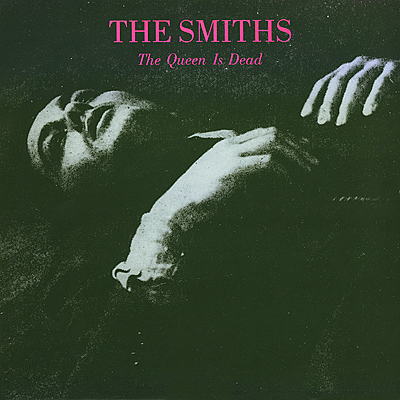
The Smiths – The Queen Is Dead: Round 78, Nick’s choice

The-Queen-is-Dead-coverI was absolutely convinced that Rob had brought another Smiths album at some point (specifically, I thought, Strangeways Here We Come), but as soon as I pulled this out of my little knapsack I was informed that I was wrong, and that in fact it was Graham, who had played their eponymous debut. Serves me right for not researching.

But whatever; it still meant that I was OK to play The Queen Is Dead, which is my favourite Smiths record, if only by virtue of the fact that it was the first one I heard. Too young to be into them at the time (I’d just turned 7 when it came out, and was far more interested in Lego, I imagine, than Mancunian miserablism), I didn’t own a copy of this until I was 19 or 20 and at university.

One of the things that first struck me about The Queen Is Dead, and by extension The Smiths, given that I’d only heard a handful of tunes by them beforehand, was how funny they were. In the 90s when I was getting into music for the first time they were talked about as being impossibly dour and miserable, and despite the fact that I was probably at the height of my own personal miserablism during university, it was the theatricality and wit of Morrissey’s lyrics and delivery, rather than their angst-soaked pain, that appealed most.

Actually it was the melodrama that got me first, and I guess melodrama is the interface of angst and wit. The opening lines of “I Know It’s Over” – “oh mother I can feel the soil falling over my head” – so overwrought and adolescent and reaching, signified a self-awareness that I was only just becoming able to deal with, but which felt profound in its mocking of profundity, if that makes sense. There’s nothing quite as ridiculous as an over-earnest young man convinced of the import of his own, solipsistic emotional turmoil, and Morrissey at his best managed to both acknowledge and express that emotional turmoil and the ridiculousness at the same time. Did he know he was doing this? The answer, of course, doesn’t actually matter, but I doubt it was an accident. (Of course, as I became more familiar with The Smiths, I realised that this sense of humour had always been a key part of their genome, and that the people who’d claimed they were nothing but miserable were missing the point entirely.)

There’s a great story about how Johnny Marr, in the studio during the day with Joyce and Rourke, wrote and recorded what he considered to be one of his most beautiful tunes – a graceful, weaving, floating melody with the lightest of touches – and that he returned to the studio the next day to find that overnight Morrissey had written the lyrics, recorded the vocal, and called it, in an act of near blasphemy, “Some Girls Are Bigger Than Others”, royally pissing Marr off in the process.

The thing is, of course, that the reason The Smiths are so good, is precisely because of that awkward dynamic between Morrissey and Marr; the awkwardness, the cool, the humour, the miserablism all jumbled up together in a confusing but logical mix.

Graham listened: As we are at round 78, its getting difficult to remember why we brought some albums years ago. As I recall I was tasked with bringing something from 1984, which is why I brought the debut. But there is no debate in my mind about which is the better album. Though I’ve not played this for years I was reaching for my black polo neck and daffodils within seconds. Every lyric and riff came flooding back, as to me this will always be the ‘sound’ of The Smiths.

Rob listened: I was that miserable Mancunian and although I found them plenty funny, it was the mordant self-pity that got to me first. I found that completely over-powered and, to a great extent, I inhaled it, internalised it and built a sense of identity around it. Lots of us did. Due to age-constraints, The Queen Is Dead is the first Smiths album I heard (I was 15 when it came out and Andrew Nuttall, the class Cramps fan, lent me the record so I could tape it. Come to think of it, this might have been the first time anyone ever lent me a record…). And so, for me, it’s still the heartbeat of this most precious band. I love the luscious sound of ‘Meat Is Murder’, and that’s a record that arguably changed my life more than this one. I adore the spartan energy and somehow modern vintage sound of ‘Hatful of Hollow’, the urgent sound of four men inventing and inhabiting a world before your eyes. The beautiful shriek of ‘The Smiths’ will never lose it’s lustre and, although I never brought it to Record Club, ‘Strangeways…’ is a fine, fine record too. But this one, this is the bomb that started the war.

Tom listened: I can’t recall the circumstances now but I do remember buying The Queen Is Dead for my wife, Karen, thinking that she was a big fan. Having handed it over excitedly, she immediately took the wind out my sails by informing me that it didn’t have any of The Smiths songs she liked on it. As I was far from being a fan myself, it sat in a glove compartment for a number of years unlistened to and unloved.

That was until Graham played us The Smiths at record club and I realised that maybe, having hung on for 20 odd years, my aversion to Morrissey and co was cutting off my nose to spite my face. So I dug out The Queen Is Dead, dusted it off, and actually played the thing. And, of course, it is pretty magnificent. What’s more, now even Karen admits that, perhaps, the songs included on it are just as good, if not better, as the ones she cherishes so much from the group’s first flush of success. The icing on the cake is the fact that both the children love it, Tess for the stately majesty and doomed romanticism of There Is A Light That Never Goes Out…and Kit because it has the line ‘flatulent pain in the arse’ included.
Shudder To Think – Pony Express Record: Round 78 – Tom’s Selection

downloadAlthough nine times out of ten a record played by someone else at record club is the record I would have chosen by that artist, occasionally an album has been produced that has elicited a gasp of surprise, perhaps (read as ‘hopefully’) only internally, as in, ‘you brought that one?!?’ I thought it might be ‘fun’ to put the cat well and truly amongst the pigeons and set the ‘Anything You Can Do I Can Do Better’ theme. It turned out on the night, somewhat disappointingly it has to be said, that the moggy in question had had its claws removed, its teeth blunted and its pigeon hating gene well and truly modified. It all went off without a hitch – it transpires we are a far more laid back bunch than I had previously thought and nobody really fought for their former choice.

When I went through the list of albums we have played at record club (a mind-boggling 300 or so records now), many of the records I have selected would now be replaced by something else from that artist’s catalogue. Rob was right with his rejection of Imperial Bedroom – but Trust is the keeper as far as I am concerned, not This Year’s Model. Hejira is a very fine record but I now prefer The Hissing of Summer Lawns and Court and Spark (probably the latter album would be my pick), their spellbinding complexity only becoming apparent over the course of the squillions of listens I have given them in the last couple of years. Strange Mercy was a bit of a hobson’s choice – an album of the year in a year when I bought very few albums. Actor is still St Vincent’s high water mark as far as I am concerned. I would also replace Barafundle with Spanish Dance Troupe, Knock Knock with either Supper or A River Ain’t Too Much To Love and maybe even Ekstasis with Loud City Song (although I am still getting to know the latter it sounds pretty amazing to me).

The others too have occasionally produced something other than the record I would have brought. Admittedly sometimes they have been hampered by a theme but in the case of Shudder To Think (coincidentally the same evening PJ Harvey’s Let England Shake was played) there was no such excuse. Rob was just plain wrong!

I can see why he would go for Get Your Goat as it panders to a more indie lo-fi scuzzed up aesthetic (without really being any of those things). It’s a bit more definable I suppose. Pony Express Record is a slippery fish, its modus operandi seems to be to try to meld as many genres as possible into every song, fly off at a tangent both melodically and lyrically whenever you think you’re getting a handle on things, in general to be as willful and annoying as possible. It shouldn’t work, it doesn’t really for the first ten or so listens (as Nick and Graham will no doubt confirm) and it very nearly doesn’t work at all. But somehow, and God only knows how people manage to write songs that do this, after a certain amount of work on the part of the listener, the mists clear, the sun beams through and all you can hear is one glorious hook after another after another.

And that’s why I think Pony Express Record is a notch above its slightly more accessible predecessor. But, then again, PER was my first Shudder To Think record and, having acclimatised to its bizarre structures and Craig Wedren’s preposterous singing voice and lyrics, maybe Get Your Goat just sounded a bit safer because I already knew what to expect. So maybe, just maybe (whisper it) I have been wrong all along!! Rob?

Graham listened (and for at least 20 mins was thinking “what the **** is this all about”): But sorry to disappoint Tom, because by the end I was firmly on board.  It would require many listens to fully enjoy the hugely intricate mix of hooks/riffs/structures/time changes/lyrics (and not quite sure I’m ready to submit myself to that yet) but it was all there after one listen. An amazing album.

Rob listened: First, a disclaimer. I’m going to write this without reference to my write up for ‘Get Your Goat’ which means I may be wrong when I say I brought that to just our second meeting and also that I may, in a few words time, be repeating myself when I go on about Craig Wedren having a voice like a raygun. If I didn’t say that last time, I should have.

Everything Tom said, but ‘Get Your Goat’ is better. One of the recurring themes in our discussions, sometimes explicit, often not, is the relationship between supposed ‘career peak’ records and those that lie either side of them and how both intersect with the maps of our own tastes and the geo-musicological forces that shaped them. Long may that continue. Trying to tease out of each other why we like one thing more than another is one of the great things about this club. The fact that we never quite nail any of it down is one of the great things about music, art and life. This themed-round was particularly fine in this regard. Bravo Tom.

‘Get Your Goat’ was my first Shudder To Think record. I was given it to review by an uninterested editor who saw me as the guy who liked noisy american music. He pretty much had me banged to rights. Because I had to write about it, and because at that stage I was a conscientious reviewer, I listened to it over and over and over, because I had absolutely no idea what was going on. And then, out of the conflicting vectors and topographies, shapes and relationships began to emerge until I had the measure of it. It probably took 20 or 30 listens. We’ve spoken before about records that ‘click’ and I’m generally happy to remain confused by those as once they click that seems like a puzzle solved with no need to return to it. Shudder To Think aren’t like that. Their songs are repetitive, melodic, hook-driven, poppy. It’s just that they’re working from a shattered set of rules. It just takes patience to get what they’re up to, and you’re away.

So, I love ‘Get Your Goat’ like a first love. When ‘Pony Express Record’ came along, It made sense straight away. It’s a fine, fine record and I totally get why it is considered their masterpiece, but for me it is a ramping up and honing down of what they were already doing. It’s their perfect statement and I like a little imperfection. I guess I also have to say that it is quite a lot closer to some of the Math Rock records it helped to inspire. That’s not it’s fault, but if a step towards ‘Get Your Goat’ is a step away from Tool, then i’m taking that step.

Anyway, I’ve written too much already, but let me tell you about Craig Wedren’s voice…

PJ Harvey – ‘Rid Of Me’: Round 78 – Rob’s choice

PJ Harvey - Rid Of MeThere is something to be said for stripping things down.

Plato believed that essential attributes make an entity what it fundamentally is. Bernard Edwards and Nile Rodgers believed that every song they composed as The Chic Organisation had to have a DHM (Deep Hidden Meaning) without which no song could endure. And if it’s good enough for both Plato and Chic…

Both were talking about the central core without which any being or endeavour was insubstantial, unreal, worthless. Plato and Aristotle tried to define the fundamental Forms, the eternal and unchanging qualities from which earthly beings could be constructed. Chic worked hard to incorporate Deep Hidden Meanings in every song and then, in order to further investigate the elements of which great music consisted, they took the breakdown from the stage onto vinyl and out into the clubs of New York, deliberately stripping down tracks for their listeners, then reconstructing them just to show what Forms they were made of.

We all feel the fundamental truth at the core of these ideas of fundamental truth. We either know or, through conditioning, are made to feel, that there is an elemental being made of simple, pure components, burning strong at the heart of our particular stew of physical, emotional and psychological characteristics. Somewhere, we assert, I can find the real me, the fundamental me. If only I could get far enough away from the rest of you. If only I could get even closer to the rest of you. If only it were quieter. If only it were louder.

Since the Enlightenment, when God fell from the heavens and landed badly, we’ve been working towards a conception of a human spirit that we are certain, bristling as we tend to with self-impressed confidence, can burn just as brightly as He once did. We have become more important to ourselves and as this has happened we have sought, generation after generation, to know ourselves better, to strip away the meaningless garb we hide ourselves beneath and find the true, essential us, the us that we believe must be the best us.

It took more than 300 years but, in 1978 we seemed, as a species, to be getting very close.

Firstly, Chic, those philosophers of the essential, released ‘C’est Chic’ which contained both ‘Le Freak’ and ‘I Want Your Love’. It doesn’t get all that much better than that.

Secondly, Elvis Costello released ‘This Year’s Model’, which I love and listen to lots and like better than ‘Imperial Bedroom’ which I have heard once.

I also like PJ Harvey’s second album, ‘Rid Of Me’ more than I like her last album, ‘Let England Shake’. ‘Rid Of Me’ always seemed to me to be one of the closest approximations we have of an artist’s true heart. It’s raw, sometimes literally. It’s direct, both in content, construction and sound. Its intent, in part, is also to say, ‘this is me, and this is how that feels’. I think it’s one of the most important records, if we can consider any records important, of the last 30 years. If we can’t, then i’ll settle for it being one of the most telling.

‘Let England Shake’ is a work of art. It’s impossible not to admire the deft skill and sheer brute creativity that went into it. It should, as an aside, have been soundtracking the last 12 months as we commemorated the 100-year anniversary of the Great War. In hindsight it seems surprising to me that it didn’t. I must write some more ‘Disappointed of Devon’ letters…

It’s a great, great record and one of the records I would be happy to put forward as evidence that rock music can be as mighty an expression of what it is to be human as any of high culture. But, it’s an artist creating a piece of art for us to stand and look at. ‘Rid Of Me’ is an artist creating herself. I love them both, but if ‘Let England Shake’ is PJ Harvey’s finest expression, then ‘Rid Of Me’ is PJ Harvey’s essence.

Graham listened: Having not been about for ‘Let England Shake’ in Round 2, I can’t comment on any comparison. But after tonight I suppose I can best summarize by saying, “The buggers have finally worn me down, can I borrow some PJ Harvey please?”

Tom listened: Having listened to Rid of Me on a mate’s crappy car stereo not long after it was released (and never again), I was convinced it was an album I did not care for. Too abrasive and harsh for my tastes, I was much more drawn to PJ Harvey’s parched and spindly third album ‘To Bring You My Love’, which I owned on cassette and enjoyed immensely…until we no longer listened to cassettes any more (when did that happen?).

Well…for the first half of the record I sat there all smug and relieved that memory had not played tricks on me and that the album was almost exactly as I recalled. Really raw and uncompromising – just the sort of thing Rob loves but a bit too much for me. However, flip the record over and a very different beast is revealed – at least that was how it seemed to me. By the end of the listen, I was more or less converted and thought that I could probably even learn to love the more raucous songs on the album over time…in fact, I would probably agree with Rob that this album is probably much closer to the soul of the person that is PJ Harvey than any of her other albums.

Julia Holter – Ekstasis: Round 77 – Tom’s Selection

ekstasis I guess, if truth be told, I have put off writing up my blog on Ekstasis, mainly because I don’t really know what to write about.
I could write about the music itself, which is exquisite; complex in structure yet often simple in sound, it conjures up, almost exactly, the image on the cover of the album – opaque, stately, almost classical, and calming in a monochromatic way. This is not music that grabs you by the lapels and demands your attention. No, this is music that creeps up on you, ekes its way into your affections bit by bit until you realise, one day, that you are in love. But writing about music is boring, so I won’t do that.

I could write about Holter herself; about how she grew up in Los Angeles and then went to university in the same goddam town (who does that?) to study musical composition. But if I were to do that, you would all be thinking, ‘surely she isn’t feeling it for real, surely it all sounds like some anodyne textbook exercise, unemotional, distanced, detached’. And in some ways, you would be right, but you would also be so, so wrong. And I wouldn’t want you to get the wrong idea about Julia Holter because:

a) She’s lovely.

b) She makes unbelievably beautiful music.

So I won’t be risking you getting the wrong impression about Miss or Ms (don’t think it’s Mrs) Holter by writing about her either.

I could write loads about the first track off the album, Marienbad, which is, it turns out, a spa town in the Czech Republic. But nothing I write about this incredible piece of music could do it justice – even if I could find a way to adequately describe the way it twists and turns and segues and never repeats and has a breathtaking hook that takes her four minutes to get around to – well, you would still need to listen to the thing because it’s much, much better than my words can do.

So I’m going to leave it at this: Ekstasis is a brilliant, amazing, magnificent, stupendous, exquisite, spellbinding, fragile, innovative album….and, by my reckoning, is one of the very best albums that I have heard this decade/century/(hell, let’s go for) millennium. And I know this as it is just about the most difficult record to listen to that I own. ‘Hang on’ I hear you cry, ‘haven’t you wittered on before about Trout Mask Replica and Sun Ra and The Red Crayola and John Coltrane. Surely Julia isn’t in the same ballpark?’ And I’d have to agree with you, because Ekstasis is nothing but a pure pleasure to spend time with. ‘So what do you mean?’ you’d remark, somewhat exasperatedly. So, I’d chuckle a bit and go on to explain that with four short sides of 45rpm vinyl, Ekstasis takes more effort to tee up and play through than almost anything else in my collection bar A Gilded Eternity by Loop…and I can’t remember the last time I bothered to listen to that! The fact that Ekstasis regularly finds itself on my turntable is surely proof enough that this is a remarkable work of art, one that I can not recommend highly enough and one that I have found very difficult (as I am sure you’ll agree) to describe.

Buy it.

Rob listened: As Tom worried about being unable to write about this for a week and a bit, my memory of it has faded sufficiently that I too now have very little to write about it. I did really enjoy it at the time. We talked a lot about who it sounded a little like, or more who it seemed to share a compositional palette with. The names mostly bandied around were those of artists whose work I tend not to connect with quickly and over time either come to dislike, or to admire as exhibition pieces, rather than living, breathing music. I thought ‘Ekstasis’ sounded divine though, and somewhere, off at some wild perpendicular, it created a hitherto un-noticed overlap in my musical venn-diagram, just between Oneohtrix Point Never and Grouper. And there it will stick until I have time to love it properly.

Nick listened: It’s much easier to listen to on CD; you just put it in the machine and press ‘play’ once, and 60 minutes later you’re feeling content and blissful.

I bought this after Tom played “Marienbad” at us a couple of years ago, but I must confess I’ve not listened to it a huge amount since then. I should do; it’s lovely. As is her follow-up, the slightly earthier, brass-tinged Loud City Song, which I listened to quite a bit more. I’ll go back to this; I want to go back to it. It’s beautiful.

And slapped wrists for Mr Rainbow for once again suggesting, in a roundabout way, that studying something and being trained in it somehow means you don’t have, or somehow lose, ‘soul’ or ‘authenticity’ or ‘passion’, which is crazy talk, you old punk. (I’m aware that Tom is about the least punk person I know. And also not old.)

My Bloody Valentine – Loveless: Round 77, Nick’s choice

mbvlovelessMany years ago I convinced someone I knew to buy Loveless, and their first reaction on playing it was to tell me they thought they had a ‘warped’ copy. I replied that they almost certainly didn’t, and that it sounding warped was kind of the point.

I’ve owned Loveless for the best part of 20 years now; I think I bought it in early 1996 when I was 16 and going through a very serious period of musical exploration. A lauded ‘classic’ even then, Loveless already carried a near mythical aura with it when it was barely 4 years old. I had no idea what to expect. Over the years since people have written reams and reams of verbiage about Loveless – it’s one of the few records I own a book about – and I still don’t know that anything anyone’s said would quite prepare you for what it sounds like on first listen.

Thinking about it now, I suspect Loveless might just be the album I’ve listened to the most over the last 20 years (and probably, therefore, in my life), which is weird, because I don’t think I would ever claim it was my favourite album. But maybe it is, by default? Maybe that’s what ‘favourite record’ means; the one you listen to the most. It’s been a go-to choice throughout mine and Emma’s 13+ year relationship, and it’s a go-to now that we have a baby daughter; the sheets of woozy noise and feedback and the simple, driving rhythms are perfect for lulling an infant to sleep. (As is a lot of sparkly, repetitive electronica. And Disintegration Loops.)

Tom played Isn’t Anything for us at record club a few years ago, and I said back then that “it has a physicality, a bass, a drive, which I think, on some days, makes me feel it’s a better record than Loveless, which can feel one dimensional and rhythmically staid at times. Isn’t Anything is no less rhythmically staid, but that physical dimension adds an enticing brutality.” I still agree with that, but facts can’t be ignored: I reach for Loveless a lot, far more than Isn’t Anything.

That one-dimensionality is actually one of Loveless’ strengths a lot of the time though; it may not cover the same degree of sonic terrain as Isn’t Anything, but the valley it does explore is exquisite. The way the segues between tracks help it coalesce; the way it has radically different effects depending on how you listen to it (a soothing balm when played quietly, a baffling, chaotic miasma when played loud); the way moving the position of your head makes those guitars phase in and out of sync with each other even more than they already do; the way the very simple, almost laughably linear song structures make you lose your place in the chronology of the album; even the way the lyrics, which Shields and Butcher apparently spent even more time perfecting than the music, can’t actually be discerned 90% of the time because they’re buried and overwhelmed in the mix: it all adds up to a blissful, intensely-textured, swooning sameyness.

I know “Soon” first and foremost as the closing track here rather than as the (indie disco) hit single it was 18 months or more before Loveless was released, so to me it doesn’t sound tacked-on (which is often suggested); it sounds like a tantalising signpost towards a future that took another 22 years to arrive. Brian Eno described “Soon” as “the vaguest music to ever be a hit”, and that’s a great word to apply to the album as a whole; ‘vague’. It sounds almost exactly as the cover looks. Wonderfully vague. I’ve never got tired of it.

Rob listened: I’ve never got into it.

I like My Bloody Valentine, and I like ‘Loveless’ some of the time, but I’d be lying if I said that I feel anything much more for it. It’s like a kid you knew at school who you always thought would be good to be friends with, but try as you might you only ever had fleeting, inconsequential conversations with. Years later, you find out he was killed in a fire at an ice rink and you realise you’re not all that bothered that he’s not around anymore. Maybe you miss the ice rink more, now you come to think of it.

You know. Like that.

I’ve tried, and over time I’ve heard all the things Nick talks about here, particularly that deftly disguised simplicity, swathed in blankets and fog, but unmistakeable. I hear them all, but those things just don’t add up to all that much for me. I really enjoyed listening to it again this evening. It sounded great through Nick’s fancy gear and he’s right that the volume adds texture and nuance, but the main thing for me was that I couldn’t leave. Because try as I might, over the years I’ve found ‘Loveless’ such an easy record to leave. If it’s the record Nick has listened to most over the last 20 years, then it must be the record I’ve wandered off in the middle of listening most during the same period. I like plenty of foggy records, and I love plenty of records that have never ‘clicked’ for me, their foreign mystery is part of the attraction. I guess I should be bold enough to admit that whilst I love ‘You Made Me Realise’ and ‘Feed Me With Your Kiss’ and I really like a bunch of other MBV tracks, I think that might be it. If I was bolder I’d stand here and tell you I think ‘Loveless’ is over-rated. But I’m not and anyway, who the hell am I to tell you that? I’m only bold enough to tell you that I don’t love it.

Tom listened: Nick has always attested that Loveless is,ostensibly, two different records: when played quietly it has the capacity to soothe and caress yet when the volume is turned up, it can pummel and disorientate and impress. I see what he means but I don’t think I quite get the record as he does – in its quieter state I find it too soporific and distant to be anything other than aural wallpaper. I like it much more when it’s loud but still have never quite clicked with it in the way I did with Isn’t Anything, no matter how high the volume level!

At record club Nick played Loveless in its ‘barely there’ state, so I have listened to it again tonight, turned the dial up and waited to see what would happen. It sounded much better to me and I really enjoyed it, but I still can’t quite get rid of the annoying nagging feeling that something is missing…just not sure what exactly. The melodies are there for sure; they are, if anything, even sweeter than on Loveless’ predecessor. There are moments of bliss, moments of brutality, and plenty of weirdness. Guitars are amazing throughout, obviously.

I think…and it feels strange to say this to a record that Nick has brought along…that my biggest single problem with Loveless is the production. No doubt it was a deliberate decision by Shields and Moulder (and Scully?) but, for me, the washed out waves of noise have the effect of producing an album that is a bit flat, and I miss the peaks and troughs, the light and shade of MBV’s output from the two or three years prior to Loveless. In the words of my daughter, who is unburdened by the weight of critical acclaim the album has received over the past 20 years, ‘I am indifferent to it – it sounds a bit like background music’…and this was whilst it pounded out of my speakers at ‘neighbour bothering’ volume! But I’ll keep returning to it every now and again and, who knows, maybe one day I’ll see the light.

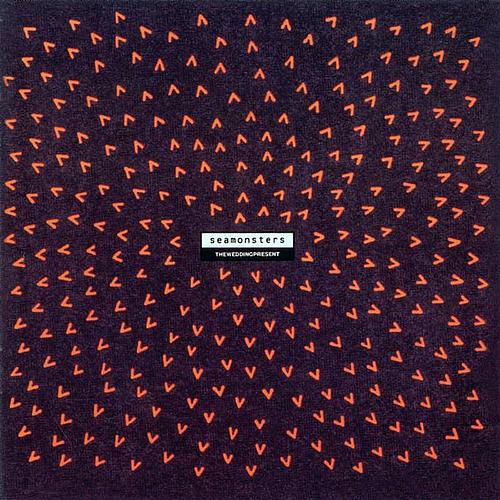
The Wedding Present – ‘Seamonsters’: Round 77 – Rob’s choice

the wedding present - seamonstersImmediately I feel as if I have to start making excuses for The Wedding Present and, after some further consideration, I begin to realise that every time I feel this way it says a great deal more about me than it does about the music I’m inappropriately apologising for.

But here I go again.

The Wedding Present are one of the great British bands of the last 30 years. It’s my feeling, possibly misguided, that they have fallen from the pantheon and that at least one of the things that made them so distinctive initially and that really does make them remarkable, was responsible, erroneously, for their fading from such watery limelight as UK indie rock affords. Put another way, I think that the general sense was that they were a band with one trick and that, once experienced, it wasn’t worth sticking around to see the same trick performed all that many more times. I may be wrong but, if we assume for a second that I’m not, here are the problems with that:

1. They really weren’t a one-trick act.

2. Even if they were, it was a really, really good trick. The sort of trick that has seen respected playwrights in, through and out the other end of lauded careers, their reputations made, cemented and then maintained.

But they weren’t.

Let’s look at them as a musical outfit to start with. ‘George Best’, the debut album that established them in 1987, is a frenetic updating of the mid-80s jangle-pop template, bringing back the speed melodies of Buzzcocks and adding Gang of Four guitars that shredded fingers and eardrums. They may have come out of a scene that boasted The Field Mice and Tallulah Gosh, but The Wedding Present were hard and fast and different.

Then, rather than repeat this successful formula, they developed at an impressive pace. Their second record, 1989’s ‘Bizarro’, updated the formula, adding in extended, often drifting, structures and stuttering-stumbling rhythms often still played at breakneck speed but now creating foundations for songs which more closely echoed the awkwardness of their protagonists.

And then they went to Pachyderm Studios in rural Minnesota to record ‘Seamonsters’ with Steve Albini. Listening back to the album now it’s easy, and lazy, to conclude that they were grabbing onto the coat-tails of the increasingly prominent US underground scene and trying to ride them all the way to an updated sound and new audiences. Certainly the music they came back with now seems relatively well-worn and familiar in it’s tone and structure, 20-odd years down the line. That’s not how it went down back then, as I recall it, and I remember just how jarring and unexpected the ‘Seamonsters’ material sounded back then. However my recollections are extremely partial, so let’s pause for a moment to look at the timeline.

The band started working with Albini in 1989, basically off the back of ‘Surfer Rosa’ a record that David Gedge judged to have the balance between rock power and pop hooks that he was looking for. One of the first things they recorded together was a cover of ‘Box Elder’ a track by the then genuinely unknown Pavement. The Wedding Present version was released as a B-side 4 months before the release of Pavement’s second EP and fully 2 years before we were all wearing out ‘Slanted and Enchanted’ and considering ourselves cutting edge.

‘Seamonsters’ itself came out within a few weeks of Slint’s ‘Spiderland’ and a few months before ‘Nevermind’. So, the move from parochial Leeds to wild and widescreen USA was a heartfelt, radical and visionary move for a band who could quite easily have stayed home and ploughed their existing furrow for all it was worth.

Musically it’s a complete statement, raw and yearning, aggressive and unhinged, nuanced, powerful and evocative. Whilst it’s never more than four guys bashing away on guitars and drums, and it boasts none of deliberate artfulness or formal experimentation of some of the other landmarks of the period, it surpasses many for commitment, and instinctive execution. The record rocks and rolls and surges and howls and has speed freak-outs and stunned silences. There is emotion in guitars and drums, and by this point The Wedding Present knew how to wring it out.

So what about that one trick of theirs? How was that bearing up by 1991?

David Gedge is one of the truly great lyricists in rock history. That he chooses to use an apparently restrictive form is no matter (and no constraint for him) and ditto that he sings almost exclusively about the intimate, internal moments in the lives of ordinary people. His approach – he most commonly sings one half of a real or imaginary dialogue, leaving the listener to fill in the other speaker’s words – sounds disarmingly simple, (it isn’t in the slightest – just try it for yourself) but it creates such rich poetry. Take the chorus to ‘Corduroy’. How much of life and love is packed into these words and how many scenes spin away from them?

I’ll make you laugh / When you see this photograph
It’s not from that day / I threw all those away
It’s just some boy / Probably dressed in corduroy
He grew up fast / But you’ve not changed at all

What’s most immediate about Gedge’s words on ‘Seamonsters’ is how obscured they are. He adapted his singing voice in the run up to this album and the result was challenging, and then, additonally, his vocals were placed way down in the mix. Even now, after 24 years, words and phrases are only just coming to the surface. There’s something strangely fitting about that. For words which were written as if stolen from private, often imagined, conversations, having them emerge as if coalescing from the fog of memory makes them more powerful still.

It’s only dawned on me recently just how unflatteringly Gedge painted his protagonists/himself (the songs are in the first person, so we have to assume) in these early records. Regardless of how you may remember them, the songs on these first three albums are not about the unrequited love of dorky dreamers. Instead they’re about jealousy and petty, bitter jealousy at that. If you looked at these half-conversations from a neutral distance, he wouldn’t be the Lovelorn Hero, he’d be the Weird Outsider, almost the Stalker.

Even the snatches of studio dialogue that were included in some of the ‘George Best’ era releases seem deliberately chosen to make Gedge appear snippy and defensive. It’s also interesting to note that for a songwriter for whom lyrics were such a distinctive and important element, his words are not reproduced for the listener. This makes a release like ‘Seamonsters’ all the more mysterious and unfathomable, but it also speaks to Gedge’s self-effacement.

Ultimately, I wonder whether it was this very modesty and unassuming nature that made it relatively easy for us to move on from The Wedding Present. We should have been raising them to the rafters.

Footnote: Readers who are familiar with the band’s career will of course note that ‘Seamonsters’ was in fact their high water mark in terms of both sales and critical acclaim, rather than a neglected work. I did tell you I was wrong before I started.

Nick listened: I’d never knowingly listened to The Wedding Present before, and was pretty ignorant of their narrative; by the time I was getting into music properly and reading the weekly music papers they seemed like they were irrelevant, a spent force, a leftover from a previous era (that had only been about 18 months before; the way we experience cultural time fascinates me). Which is crazy, because a; so were Nirvana and My Bloody Valentine, amongst others, and b; The Wedding Present were still releasing records in 1994-1997, which were my peak ‘wow’ years.

With no expectations, I enjoyed this quite a lot. I suspect the songs are of the sort that take a while to unfurl and dig their grubby hooks in – Albini’s recording and mixing, and Gedge’s mumbling and misery, being the key reasons why that’s the case – but the sound – caustic, low-key, quintessentially Albini – is one of those things that just work as catnip to me. Would like to hear again.

Tom listened: I really wanted to go back and spend a bit more time with Seamonsters before writing about it..but I haven’t got round to it, so my initial reactions are all I have to go on.

I really didn’t get a handle on this at all. That’s not to say that I didn’t like it, far from it in fact! I sensed that this could have been great, but the relatively low volume at which it was played on the night coupled with the ridiculously low in the mix vocals meant that it felt as though I was listening with an upturned bin full of cotton wool over my head.

I wanted to hear David Gedge’s words (they’re always worth hearing, in much the same way as Alex Turner’s are – that straightforward Northern bluntness and humour runs through his songs and elevate them) and enjoy the bluff tones of his wonderfully flat singing voice. And it was a shame I didn’t because although this was an album full of fine pop tunes, The Wedding Present have always offered more than that and, on the night, I just couldn’t make that extra bit out!

Timber Timbre – Hot Dreams: Round 76 – Tom’s Selection

Timber_Timbre_Hot_Dreams

Like Nick, I find the whole ‘Album Of The Year’ thing a bit hard to get my head around – it’s not so much the process of choosing a favourite from the albums I own as much as thinking about all the albums I haven’t heard, or even heard of, that I am supposedly placing below my chosen one. I always thought that album of the year lists would be much more informative if the producer of the list were to indicate just how many albums they considered when making their list. After all, non-inclusion of an album could mean it’s a stinker…or, more probably, it simply hasn’t been taken into account. The thought that my number one (out of five!!) would be weighted just a highly as someone who has got to know a hundred albums in 2014 makes the process flawed to such an extent as to surely render it worthless.

To illustrate my point, I thought I would bring Timber Timbre’s fifth album, Hot Dreams. It was released on April Fools Day yet I only became aware of it for the first time when I saw it in The Drift’s album of the year list in November(!)…at number 100. And that was it as far as I could tell (my interest in the album was actually piqued sometime later upon listening to an enthusiastic review by Anthony Fantano at his website, The Needle Drop) – having kept abreast of the majority of better known websites’ end of year lists, despite the misgivings I outlined earlier, I failed to find Hot Dreams in any other ‘best of’ list (even The Guardian newspaper, who gave the album top marks in their review and described it as a Lynchian masterpiece overlooked it in their albums of the year list). Which must make it just about the ‘least successful album of 2014 that featured in an end of year list’! Quite an accolade!

But listening to Hot Dreams reinforces to me just how arbitrary the whole thing is. Whilst not top of my list (FKA Twigs’ LP1 is head and shoulders above anything else I’ve heard this year), Hot Dreams is a fine, fine record. Cinematic, beautifully constructed, cohesive and supremely atmospheric, it is surely worthy of a bit more attention than it got. I’m not making any grand claims for Hot Dreams, it won’t change your life, I doubt you will be naming your kids after the band members and it is unlikely that it will come to be seen as the wellspring of a new genre ten years down the line but, as Nick wrote when he was commenting on Buffalo Tom’s Let Me Come Over, music doesn’t always have to shift the world off its axis; sometimes providing the listener with what is, ultimately, just an enjoyable, transformative and captivating forty minutes is enough. And that’s something that Hot Dreams does for me in spades; from the leaden, ominous opener of Beat the Drum Slowly, to the ever evolving and creepy Run From Me, via the towering peaks of The Grand Canyon, The Low Commotion and, perhaps the most beautiful song I heard in all of 2014, the album’s title track, the only thing that stops Hot Dreams being a stone cold classic, for me, is the final instrumental track, The Three Sisters, which has, so far, failed to capture my imagination in the way the rest of the record has.

But, minor quibble aside, Hot Dreams is surely an unlucky record from an unlucky band that deserves greater recognition than last place in the ‘Great 2014 EOY Lists Competition’ (especially when you consider how said competition was won by a fine sounding, but pretty unremarkable, album of guitar based rock music).

Rob listened: Loved it. Also, I shared Tom’s confusion as to why this record didn’t get more plaudits and wider coverage during the year. I assume it’s something to do with Timber Timbre trading in well-established tropes and genre-signifiers. (SARCASM ALERT!) Understandably this would put them way behind The War On Drugs. It’s a shame because sometimes bands try new things for the sake of doing so when, judging by the outcomes, they probably shouldn’t have bothered, whilst others find some new angle through which to approach well-worn surfaces and in doing so make those shine anew. So well done Timber Timbre for breathing dry, desert air into Lynchian balladry in the Tex Mex dramamine dancehall, producing a work that sounds like John Barry soundtracking Jim Ballard’s ‘Earth Is The Alien Planet: The Musical!’

I liked it a lot.

Nick listened: I’d never heard of Timber Timbre before tonight, and I imagine that was part of the problem in terms of end-of-year plaudits; some stuff gets pitched at critics (and audiences) as potential end-of-year-bait from the moment “Auld Lang Syne” dies down, and other stuff just doesn’t get talked about at all. I received PR emails and Jiffy Bags full of promo CDs and photocopied press releases for years (I still get the damn emails) and I still don’t fully understand the mechanics by which our collective tastes are made. There’s a PhD thesis to be written on the cultural mechanics and social psychology of it. (There’s also the simple mechanic that album reviews are written by individuals, and lists are compiled by groups who often simply haven’t all heard the same records; the freelancers writing for The Guardian don’t sit around sharing an office, for instance; I doubt many of them have ever even met.)

Anyway, I’m not sure I got all the subtleties of the Tex Mex signifiers – to me this was kind of like early Portishead (in terms of atmospheres and partial sonics, if not post-hip-hop mechanics) transposed to anywhere in the States. I enjoyed it, but it’s not so much of a catnip-y sound for me as it obviously is for Tom and Rob. What I did love was the saxophone – I wish there’d been more of Colin Stetson. But nonetheless, an intriguing, well-crafted record that I enjoyed listening to, and which didn’t deserve to be ignored the way it seems to have been.

Tanya Tagaq – Animism: Round 76, Nick’s choice

tanya-tagaq-animismThe ‘album of the year’ concept always troubles me. I’ve already played the two records (Owen Pallett and Wild Beasts) that would probably occupy the slot of my ‘favourite’ from 2014, and didn’t want to repeat, so I decided to play something that I like a lot and think deserves wider exposure. It’s not my favourite from the year, or probably even in my top five favourites, but I do admire it massively.

Although I already own an album featuring Tanya Tagaq (she guests on Björk’s Medulla), I wasn’t aware of her as an individual musician in any conscious way until September 22 this year, when Animism, her fourth solo album, won the Canadian Polaris Prize – an award that, to be reductive, is roughly equivalent to our Mercury Music Prize.

The Polaris is considerably more esoteric and generally rewards more creative music than the Mercury, though; although past winners include stadium-indie behemoths Arcade Fire and Apple-ad star Feist, they’ve also included scatological Dungeons & Dragons chamber pop star Owen Pallett, jazz & psyche tinged electronica darling Caribou, and anti-establishment post-rockers Godspeed You! Black Emperor. No M People or Alt-J in sight. It’s tempting to use this as evidence that Canada is some kind of cultural nirvana, but Bryan Adams and Celine Dion prove this isn’t quite the case.

So it’s not that much of a surprise that an album of orchestral and electronically enhanced Inuk throat singing should have won in 2014. It was Tagaq’s triumphant performance at the Polaris gala that caught my attention, and that of plenty of other people, judging by the way a YouTube clip of it feverishly seeded around social media in the days afterwards; an 11-minute improvisation wherein she led an orchestra, someone doing something with electronics, and a choir of throat singers through ecstatic and anguished guttural howls, percussive interludes, and an absolute gamut of emotions and vocal approaches. The performance was in front of a projected list of the names of hundreds of missing and murdered Inuit women. It was genuinely unlike anything I’d ever seen or heard. The presenter guy, astonished, could only manage to blurt out: “I mean HOLY SHIT! Was that something else or what? That was fucking… My God! Amazing! That was amazing!”

I ordered Animism pretty much on the spot.

And it didn’t disappoint, although it pretends it might; the opening track, “Caribou” (which Rob and Tom identified as a cover of the Pixies tune, which I hadn’t realised), is a bait-and-switch, offering the listener an almost by-the-numbers orchestral pop song, albeit beautifully recorded, wherein Tanya sounds a little like Lauren Laverne. There are hints in the closing moments that things might not be as you’d expect, but it doesn’t prepare you what happens across the rest of the album, as orchestral flourishes, percussive climaxes, semi-ambient vocal passages, and Tanya’s extraordinary throat singing explore a huge range of musical territory and texture. The strings, drums, and breathy yowls of “Fight” perhaps get closest to the Polaris performance, while “Uja” starts like a piece of minimal, reverberant electronica.

The album is dedicated to those missing and murdered Inuit women, and also contains a song called “Fracking”; despite having very few lyrics, it’s a pretty explicitly political work, about the literal rape of women and the figurative rape of nature. Combined with the varied and experimental sonic palette it makes for quite an experience. And that’s without really describing Tanya’s voice…

Tanya’s voice is an incredible thing. I’m not at all familiar with Inuit throat singing, but to Western pop-familiar ears what she does sits somewhere between Mercedes McCambridge in The Exorcist, the ‘Cookie Monster’ growl of some death/black/doom [delete as appropriate] metal, and the performative, ecstatic moans and cries of pornography. I’m pretty sure these three analogues aren’t in any way influences on what Tagaq is doing here, but when confronted with something so absolutely different to what you’ve heard before there’s little you can do but scrabble for comparisons.

The sleevenotes suggest that Animism‘s recording was at least partly paid for via crowdfunding, making it feel emblematic of 2014 even as it stands apart from almost every other piece of music I’ve heard this year. It’s not the record I’ve listened to or thought about most often this year, but there’s something about its strangeness (to me), about Tagaq’s deeply personal motivations, that I find really compelling.

Rob listened: I hadn’t heard of Tanya Tagaq until Nick, who heard of her a day before me, started talking in ecstatic terms about her Polaris performance. I smiled politely but never watched it (still haven’t, really should, but my tolerance for sitting and watching things is at an all-time low these days). So I came cold to this and found it impressive. I didn’t pick up on the political or philosophical overtones (neither did Nick – he was extrapolating from what he’d read into what he was hearing, which is perfectly fine) as the only words I could make out were written by Charles Thompson almost 30 years ago, but I did get some shape-shifting sounds some of which reminded be of other things (The Knife, Bjork) and some of which seemed to come from other worlds. In all, the record sounded as packed with genuinely interesting and intriguing stuff as any I’ve head this year.

Tom listened: Little did I realise that before tonight I had heard Tanya Tagaq’s dulcet holler on our copy (technically it’s Karen’s) copy of Bjork’s, rather too challenging for me, Medulla. So whether she is singing or throat singing on that LP…I don’t know, as I would estimate that I have listened to Medulla less than five times and can only recall the impression it gave rather than the sounds and songs. I have, however, heard the fine Inuit art form of throat singing on many occasions…every time I watch The Simpson’s movie and the Boob Lady section is on!

So, Animism turned out to be exactly, and nothing, like I expected…in that it was as challenging, difficult and abrasive as I thought it would be (once Nick had introduced it to us – like Rob I had no idea it existed until now), but it was also, at times, propulsive, catchy and beautiful. I preferred the latter  sequences/songs but imagine that with repeated listens the parts of the album that were harder to take on first acquaintance would begin to make more sense and provide an intriguing, as opposed to discombobulating, contrast.

St Vincent – ‘St Vincent’: Round 76 – Rob’s choice

St Vincent - St VincentMy album of the year. More than anything, just because we should be cheering the very fact of its existence. When something as perfectly formed, as carefully worked and just as damned flawlessly good as this comes along, we should be stopping what we’re doing and declaring national holidays. Instead, it seems somehow, as if this record has been strangely sidelined, as if the tastemakers are reaching the end of 2014 and saying ‘oh well, of course the St Vincent record is incredible. After all, she’s always been incredible, so why wouldn’t she produce an incredible record. And therefore, it doesn’t really count. Stick it somewhere half way down the list.”

Well, it does count. It counts for all sorts of reasons.

It counts for what she does with a guitar. She chops it, slices it, shreds it, chunks it, skings, kapows and blams it. She is, as far as I can tell, the most devastatingly brilliant guitarist currently playing this most played of instruments. She turns her guitar into a buzzing, blatting, beeswarm machine-gun, chopping out riffs and runs that sound like no-one else. What she does with a guitar is simultaneously so surgical, so acidic and so twisted as to sound barely like a guitar at all. I don’t care about musicianship in and of itself, but she makes me stop being so stupid and care about guitar playing. She is, let us be in no doubt, an absolutely unbelievable guitar player.

It counts for what she does with a pop song. Having started her career taking avant-garde headscapes and mashing them through the blender of her fender (Editor’s note: She actually plays a Musicman) she has, like some of my favourite artists of the last couple of years (hello Wild Beasts, Vampire Weekend) found ways to compress all of this wildness and willfulness into the boundaries of the three minute pop song. In doing so she has shown just how much more we could and should be expecting from everyone making records. The tracks on ‘St Vincent’ reference contemporary pop, rock and RnB left, right and centre, but they are simultaneously as challenging, other-worldly and head-mashing as the best of those genres. About half of them are just total bangers too.

It counts for what she does with sound. Not just what she does with the sounds of her guitar, but right through this record lie scattered gorgeous details. Her voice breaks into grains, toughens up, ascends and dives, as wild yet expertly controlled as her guitar. Sometimes we’re left with a ticking beat to luxuriate in, at others we’re overwhelmed by a tornado of noise. Everything in between is deliberate and perfectly placed. One of my moments of the musical year is when ‘Digital Witness’ really boots up heading into its chorus and sweeps you off your feet. It’s like to moment you step onto the moving walkway in an airport. There’s a tender but forceful whoosh. The more you listen, the harder it is to say how she does it, but she does it, every time.

It counts for what she does with a composition. ‘Bring Me Your Love’ brings together an amazing drum performance with numerous dizzyingly brilliant flavours of guitar playing and then adds in a vocal cadence which seems initially to make no sense, then turns out to be perfect, plus, for good measure, some incredible voice performance (“I thought you were like a dog…”). Every single element of this piece is amazing. Brought together, they make a super-amazing song. Which is mega-amazing.

We should be grateful that there are artists out there making music quite as accomplished as this. Which is not to say that this is merely an impressive achievement in some abstract technical terms. It’s the real deal. Smart, affecting, dazzling, accessible, funny, funky, rocking, rolling, riding. A record we can all be proud of. Sometimes, someone just gets it so right that all we can do is step back and cheer. This is one of those. A solid gold, back-of-the-net winner.

Nick listened: I’ve been a fan of St Vincent since Actor, and think this record is fabulous for all the reasons Rob has outlined. It’s easily one of the records I’ve enjoyed most over the last 12 months. It’s an immaculately-crafted piece of artful pop; clever, fun, interesting and full of brilliant ideas at every turn, and it feels like an important and significant levelling-up of an already really, really good musician. And yet… and yet… I can’t quite bring myself to ‘love’ it enough to call it my favourite. Annie Clark’s always been a little performative and arch, knowing and subversive, and I wonder if this translates, to my ears, as a slight emotional reserve, which, while it doesn’t temper the obvious musical brilliance on show, does affect my ability to connect. The Sharon Van Etten album, for example, is nowhere near as exciting to me musically, but I feel much more connected to it emotionally. (I probably do prefer St Vincent though, just.) Thinking about it, though, I feel much the same about her other records; they’re wonderful objects, brilliant things, like beautifully-designed chairs or fabulous bits of architecture. Which is great (I love beautifully-designed things), but leaves me just a little unsatisfied for some reason.

Tom listened: I’ve been a fan of St Vincent since Actor too but, mainly due to the astronomically inflated price of the vinyl version (£27 when I last checked), I hadn’t bothered with her latest offering. I was also put off a little by the fact that Strange Mercy and me never quite hit it off. Then there were those lyrics from lead single Birth in Reverse which seemed too calculated, too considered, too ‘let me shock you’. I was a little weary and more than a little wary that Annie Clark’s fourth album would be another step down from the triumph that was Actor.

Well, I couldn’t have been more wrong. In my opinion one of the only missteps of ‘St Vincent the album’ has been the choice of singles – they seem to me to be a little St Vincent by numbers, echoing past melodies too closely and not really doing that much different sonically from what had come before. The deeper cuts in the album, however, were often astonishing and, crucially, took me a long way away from the standard St Vincent song template that I heard in the singles. So, I started off listening sceptically but by the end of the album the combination of Annie and Rob had almost completely won me over.

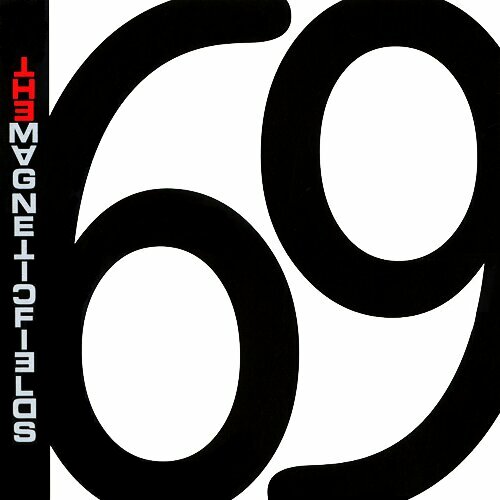
The Magnetic Fields – ’69 Love Songs’: Round 75 – Rob’s choice

The Magentic Fields - 69 Love SongsBring ‘not an album’ pleaded Nick. To me that sounded dangerously close to an invitation to bring another personal grab-bag compilation. I thought about bringing a rubber duck instead, but I’m out of practice, and anyway, for a while I’ve been wondering how it might be possible, indeed whether it would be wise, to bring ’69 Love Songs’ to Record Club.

Even as someone who has forced my fellow clubsters through the hellish collapsing drones of Sunn O))), the abrasive electronic power tools of emptyset and the exquisite hyper-extension of ‘Disintegration Loops’, the thought of playing a joker and making them sit through the whole of this 1999 album seems, well, a bit much.

That’s not to suggest that it’s a difficult or testing listen. Far, far from it. One of the most striking things about the collection is just how easily it slips across the ears. Sure, some of the tracks are sub-60 seconds, and there’s a marginally higher-than-average percentage of ukulele-strummed numbers, but nothing on the record feels like it was dashed off just to provide one more tick in Stephin Merrit’s self-created quest to write 69 love songs. Take any selection of 12-15 of these songs, jumble them up and you’d have a perfectly delightful album. That Merrit chose not to do that and instead to put what for most other musicians would equate to a career’s worth of music onto one single release, is perhaps the most remarkable aspect of this project.

Understandably, variety is key. There are twirling whirlers like ‘Absolutely Cuckoo’, mournful waltzes like ‘I Don’t Believe In The Sun’, campfire ballads like ‘All My Little Words’, charming metaphorical foot-tappers like (trust me) ‘Chicken With Its Head Cut Off’, oblique geographical allegory’s like ‘Reno, Dakota’ and perfectly weighted indie pop like ‘I Don’t Want To Get Over You’. All in the first 6 tracks.

The rest of the record lays out an almost endless banquet of all things in between, from the heartfelt to the pastiche, from experimental digressions to direct hits. Throughout Merritt displays his cool wit and sophistication, and mastery of those disparate styles he chooses to adopt. He has famously said that “’69 Love Songs’ is not remotely an album about love. It’s an album about love songs, which are very far away from anything to do with love.” That’s a cute point, but it just about holds. There’s a knowing distance maintained as he sings about how we sing about the way we feel about being in love, either never approaching his own heart or, if in fact he does, hiding it very well.

’69 Love Songs’ is comfortably the longest album I own, clocking in at a good 50 minutes (e.g. another full-length album) longer than ‘Have One On Me’. It feels to me like one of the great occluded landmarks of modern alternative music, a record most people know exists but few have journeyed to see. That’s a shame. It wears its conceptual foundation very lightly. I’ve never listened to the whole thing in one sitting, but rather than a feat of sheer quantity, it’s the consistency and care that comes over each time. ’69 Love Songs’ could have been a dumping ground. Instead it’s a treasure trove.

Tom listened: Although we listened to 69 Love Songs from Graham’s ever more distant dining table, I managed to hear enough to be intrigued. After all, I didn’t get Jens Lekman’s ‘Oh You’re So Silent, Jens’ at all on first listen and that ended up being one of my top listens of the decade. And so, listening to one third of 69 Love Songs and hearing many echoes of Mr Lekman (in fact Karen guessed it was Jens upon stumbling into the house half way through) and really liking it very much indeed, it struck me that 69 Love Songs could be the biggest single treasure trove of music available, especially if the songs endure as well as those by his Scandinavian soundalike. Lashings of Okkervil River too, which is no bad thing in my book. But, don’t forget, this pre-dates both, and maybe was the blueprint for a sound and modus-operandi that was quite prevalent throughout the noughties.

But, for me, the most impressive feature of 69 Love Songs is that it really doesn’t sound at all like it should. I always imagined that this would be like an elongated bed-fellow of Alien Lanes or The Commercial Album; charmingly messy with gems appearing every so often, peaking through the chaos; attention deficit disorder indie. That couldn’t be further from truth. These songs are fully formed, laboured over. Time has been spent getting them ‘right’. It’s a monumental effort and one that would, surely, have left Stephin Merrit thinking ‘where do I go from here’. I have no idea what he did before or next. And, unfortunately for him, I imagine that those who own 69 Love Songs probably think that this is more than enough Magnetic Fields for one lifetime (and I mean this as a statement of fact rather than, in any way, a criticism).