Studio – West Coast: Round 47, Nick’s choice

studio-west-coastI put this on a few times the other week whilst working from home (it’s good for that kind of thing) and ended up writing about it for my 00s project over on my blog. Which made me wonder, would this go down well at record club? At 55 minutes it’s longer than I’d normally pick, but when Graham pulled out of our last meeting due to illness, this jumped to the top of the pile of things to play on un-themed evenings. So I did.

Ostensibly part of the “Balearic revival” (you may not have heard of this phenomenon) that about a dozen people on various music blogs and messageboards got excited about circa 2006/2007, Studio are a Swedish duo who make music that sits somewhere between twitchy postpunk and sophisticatedly smooth European dance, and West Coast is their only proper studio album. (There are a couple or three compilations, which bring together the various remixes they did for other people.)

I’d never thought of it before, but on the night Tom and Rob pointed out that, on the vocal cuts (especially “Self Service”), whoever it is who’s singing sounds a LOT like Robert Smith. You know, that guy from The Cure. And he does. I’ve subsequently found reference (on Wikipedia no less) to them being “the missing link between Lindstrøm and The Cure”. Which makes a lot of sense, because that’s pretty much exactly what they sound like.

West Coast has only six tracks, but the opener is a 15-minute instrumental sunshine roadtrip, and the closer is a 12-minute ambient twilight headtrip. Tracks 2, 3, and 4 are postpunky things with vocals and track 4, “Origin”, has some of my favourite ever guitars, painting dirty shapes into the corners of a great groove. I could listen to it forever.

I’m not making and great claims for West Coast; it’s not life-changing, no masterpiece, no great artistic statement particularly, but music doesn’t always need to be that. Sometimes it’s absolutely fine for it just to be incredibly cool and good to listen to, which is what this is.

Tom Listened: Nick, in response to Well..by Swell (round 34): ‘I wasn’t blown away by Swell (who I hadn’t heard of prior, I don’t think), but I did enjoy listening to Well, and sometimes that’s enough’. Substitute ‘Well…’ for ‘West Coast’ and ‘Swell’ with ‘Studio’ and my feelings towards Studio have more or less been encapsulated.

This was a pleasure to listen to from start to finish – it didn’t place any great demands on me as a listener and so I doubt it would go on to reveal much more but, much in the same way as Swell’s record (and my choice for tomorrow night’s meeting) an undemanding but enjoyable 50 minutes is sometimes exactly what the doctor ordered. In fact, having listened to Studio I was minded to pull out Our Ill Wills by The Shout Out Louds partly as it is a similarly ‘easy’ listen and partly because it sound like the Cure (although in the case of the latter it’s ‘In Between Days style Cure’ rather than ‘A Forest’ style Cure).

Rob listened: I’d never heard of Studio and a couple of minutes into ‘West Coast’ it felt like a major discovery. The opening half of the opening track was muscular, lithe, funky, gripping and thirst-making and then… it just seemed to dissipate. The rest of the album sounded real pretty, but never quite managed to get its claws into me again. Perhaps repeat listens would expose more, and I can see that I may go back, but first time around it felt a little bit like being jilted at the altar.

The Beatles – Abbey Road: Round 46, Nick’s choice

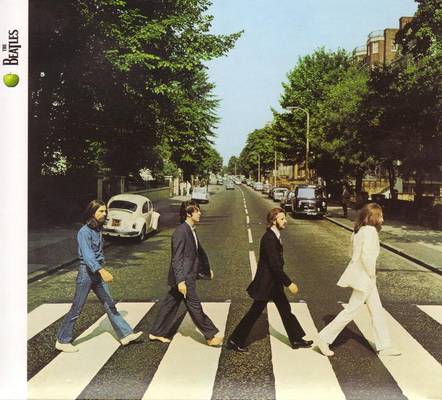
TheBeatlesAbbeyRoadFor a swan song to really be a swan song, the artist in question has to know that this is the end, don’t they? In which case, this has to be the ultimate swan song album; it was certainly the most often mentioned when I threw the idea out to Twitter. Hell, it even finishes (sort of) with a song called “The End”.

It took me a long time to get round to Abbey Road; my Beatles fandom pretty much started with “Day Tripper” and Rubber Soul and ended with The White Album when I first got into them in my early teens. Let It Be was a bad aftertaste, and something about Abbey Road (probably “Maxwell’s Silver Hammer”) put me off getting to grips with it for quite a long time. While isolated tracks jumped out and did it for me, it probably wasn’t until the remasters in 2009 that I properly started enjoying the whole record. Bar “Maxwell’s Silver Hammer”, of course. I think my friend James claimed Abbey Road as his favourite Beatles album when we were both discovering them, and I was happy to let him have it.

So I’m probably alone in having known George & Ringo’s stomping groove in “The End” from “The Sounds Of Science” by Beastie Boys before I knew it was The Beatles. Likewise “Come Together” and “I Want You (She’s So Heavy)” were bizarre, groove / drone based rock diversions from what I understood as The Beatles’ palette when I finally got around to them, a million miles away from both the early pop days and the psychedelic dandies era. Hell, some of the guitar lines on this album are almost as spidery and jagged as Slint…

Then there’s the second side. You could view the half-songs and sketches and segues presented here as filler or as some kind of final expunging of all the ideas left in George Martin’s big bin of Beatles bits. I didn’t get the concept of the medley for ages. Is the whole of the second side (from “Here Comes The Sun”) part of it, or just from “Sun King”, where the songs get really short and start segueing into one another? It doesn’t really matter, of course; the whole 23-odd minutes are dazzling. I once heard a mix of “You Never Give Me Your Money” which eliminated everything but the bass guitar, and even just that was extraordinary.

It’s remarkable to think that so many amazing melodies, grooves, and studio ideas were recorded in just a month. The way “I Want You (She’s So Heavy)” gets consumed by sheets of white noise and then just stops. The way “You Never Give Me Your Money” moves through so many sections and arrangements and styles but maintains melodic cohesion. The control and mimimalism of the groove to “Come Together”. The fact that George wrote his two best songs. Even Ringo’s moment is beautifully played and arranged. Apparently, with a sense that this would be the final Beatles ‘product’, the four members agreed to put their (many and considerable) differences aside and go for broke. You can tell.

Rob listened: Fairly pleasant. This brings to 4 the Beatles studio albums i’ve listened to in their entirety in one sitting. Feeling pretty pleased with myself. I’m guessing they didn’t make many more so I’m pretty much a total expert on them now. But enough about me. I thought this was okay. ‘Come Together’ is a yawn-fest and some of the other stuff passed me by, but I did find myself singing ‘The End’ for a couple of days after the meeting, so these boys must have had something going on when it came to writing earworms.

Tom Listened: My Dad sorted out a TDK C45 of Abbey Road (backed with Boney M’s Greatest Hits) for my 11th birthday present. For the first few months I almost wore the tape out…rewinding it so I didn’t have to suffer Abbey Road on the way to Boney M induced nirvana. But, you know how it goes, gradually The Beatles earwormed their way in (probably via Maxwell and Octopuses’ Garden) and soon all the rewinding was in the other direction.

Abbey Road was my second Beatles album (after Sergeant Pepper’s) and whilst I have fallen out of love with the latter’s overcomplicated arrangements and over-considered song-writing, Abbey Road just about hangs in there…some of the songs suffer from being too familiar (I have nothing left to discover in Here Comes the Sun or Come Together or Something), some are a bit naff, but there are others that stand up with the best in the band’s catalogue. For me, Abbey Road is some way off Revolver’s spontaneous brilliance and if push came to shove, I would chose The Beatles or Hard Day’s Night (or maybe Rubber Soul) over it but it is one of those records that is always a pleasure to hear and it has probably stood the test of time even better than Boney M’s greatest hits!

Graham listened: Well Rob has listened to 3 more Beatles albums, in one sitting, than I have. I have a mental block when it comes to the Beatles. To me they inhabited the dull Radio 2 playlists of the late 70’s which I wanted nothing to do with, as I began the search for my own musical inspiration. The fact that my journey stopped at Marillion at one point, clearly means that I, and my opinions, are not to be taken seriously. I was genuinely surprised at the bluesy/rocky numbers on this album. Even so, I tried to bait the Beatles fans by suggesting that Led Zeppelin were doing a better job of that sort of thing in early 1969. I somehow felt as awkward about Paul McCartney “rockin’ out” in 1969, as I do when I see him on TV today. Weird!

Boredoms – Super Roots 7: round 45, Nick’s choice

Boredoms_-_Super_Roots_7Boredoms started life in the mid-80s as some kind of crazed punk band, and the word ‘Japanoise’ has been used in relation to the sounds they’ve made since on numerous occasions. Of their early music I only own Pop Tatari from 1989, which is nuts – unintelligible (to me anyway, though I suspect even Japanese speakers will struggle to decipher it) screaming, ragged guitars, head-snapping changes of pace, direction, and texture.

Slowly but surely, though, Boredoms, lead by the literally inimitable Yamantaka Eye, have transmogrified into something else – over a decade and a half they’ve incorporated elements of shoegaze, techno, prog, tribal drumming, jazz, and, seemingly, every other genre ever, into their music. The result, at its best, is a seething, molten mass of momentum that reaches absolutely transcendent peaks. (Live shows like 77 Boadrum have featured mass phalanxes of drummers and been quite the spectacle / phenomenological ‘listening’ experience, I gather.)

1998’s Super Roots 7 is, oddly enough, the sixth in a series of experimental EPs released by Boredoms in-between and around their studio albums ‘proper’, wherein they explore new textures and ideas. 7, of the four Super Roots releases and five full Boredoms albums I’ve heard, is perhaps the most successful realization (whatever that means) of their middle phase. Which is to say, that it’s a pretty astonishing krautrock riot, 33 minutes of slashing guitars, driving rhythms, and crazed sound FX.

Comprising three different versions (a 20-minute ‘Boriginal’ and two ‘remixes’) of the same song, the sleeve gives “Special Big Respect and Super Cheers” to The Mekons, Leeds’ finest punk survivors, whose song “Where Were You?” is the inspiration behind the original. It’s NOT a cover, though; if you listen to The Mekons’ original, you can detect a similarity in the thrashing chords, but Boredoms do something radically different.

The first 20 minutes of the EP (the first remix and the first 16 minutes of the ‘Boriginal’) are unrelentingly rollicking and crazed, a succession of drum rolls and motorik pulses and punk guitars that continually ramps up the excitement. The final five minutes of the ‘Boriginal’ beatifically switch pace though, to a tranquil, crepuscular cicada groove, which is bucolic and serene. The final remix takes all those crazy breaks and motorik pulses and slashing guitars of the first 20 minutes and, somehow, calms them down into something pseudo-ambient, the beats now soothing and calm even when occasional bursts of jet-engine-noise spike through the mix.

Rob listened: Boredoms and I missed each other. There was a period when I was waving goodbye to Sonic Youth and Pavement and dallying with much that was free and noisy, from Truman’s Water to Beefheart and back to God Is My Copilot, when they were right in the middle of my radar screen. Despite this, I somehow never managed to lock onto the target and, as such, they remain almost totally unexplored. This sounded unexpected and terrific, essentially striking me as a souped up freakadelic Stereolab, but without any of the annoying digressions, explorations and noodle nightmares that might have befallen it. The middle track particularly was pulsating and driven. Tom and I had fun hopelessly trying to guess which Mekons track these were based on and in the end it didn’t matter. Loved it.

Tom Listened: I suppose it is what happens when listening to records that basically consist of an extended groove, but about half way through this thing really took hold and I found myself feeling the effects long after the play had finished. It was fun, energetic, slightly bonkers and totally unpretentious as far as I could tell – definitely reminded me of some of Neu’s noisier offerings (crossed with Sister Ray/Roadrunner) but I preferred it as it felt more visceral and human. Judging by the amount of wrong guesses I made regarding the original Mekons’ song, it also highlighted how many of their songs on Rock ‘n Roll (the only Mekons album I own) emanate from the same source!

Graham Listened: Whacky is not a word I use lightly but seems appropriate in this case. Despite suffering the takeaway slot, this kept my interest throughout. In Jilly Goolden terms, rather than school desks and raspberries, I was tasting Hawkwind and Ozric Tentacles, at times. Great full-bodied groove.

D’Angelo – Voodoo: Round 44, Nick’s choice

dangelo_voodooI decided to play this whilst we were listening to Frank Ocean at Rob’s house last week; despite my comments about that record, the one R&B full-length that has got me from start to finish (almost), is D’Angelo’s Voodoo from 2000.

I don’t like the myth of the ‘romantic artist’, the idea of musicians or poets or painters being magical individuals blessed with talent; I could talk about why not for ages. But Michael Eugene Archer, AKA D’Angelo, born in Richmond, Virginia in 1974, started playing piano age 4, self-produced first solo album aged 20, masterminded Voodoo age 25, then (seemingly, allegedly) went crazy and disappeared because he objected to being objectified for his abs rather than revered for his music and who hasn’t released an album since and only just started playing live again last year, seems like he might be the real deal. He’s certainly not your everyday common or garden pop star.

Voodoo is a strange beast. I bought it almost as soon as it came out, intrigued by salivating hyperbole emanating from critics who talked about it as being an instant soul/jazz/funk/roots/R&B/whatever classic, who placed it in a lineage with Marvin Gaye and Isaac Hayes and Aretha Franklin and Stevie Wonder and Prince and Sly & The Family Stone and Funkadelic and Miles Davis and Jimi Hendrix – no expectation or pressure there then.

The copious sleevenotes, and even more copious musicological analysis you can find online, explain exactly how much of an influence the likes of Sly, Prince, Jimi, Stevie, and Marvin etc were on D’Angelo during the record’s gestation, but for the most part Voodoo sounds like nothing so much as itself. For a start, it’s a record very much about vibe and groove rather than about tunes – I was expecting melodies like Stevie Wonder’s on first listen and was confused and disappointed when they didn’t emerge. D’Angelo absorbed the musical lessons of his idols, and used what he learnt to create something different. As a result, Voodoo is hard to categorise; I think of it and use it more like a jazz album than a collection of songs qua songs.

Recorded on vintage analogue gear at Hendrix’s Electric Lady studio, musically Voodoo is comprised of languid, behind-the-beat drum patterns (courtesy of ?uestlove) and languorous basslines, which are up front and centre like hip hop beats. Above and behind this there are taut, high-up-the-chest guitar lines and riffs, woozy horns, indolent piano and organs, plus scratching, studio FX and chatter. The instruments were apparently recorded almost entirely live in a room, with barely any overdubs.

There are plenty of overdubs on D’Angelo’s vocals, though, as his voice floats over the top of everything else, harmonising with himself almost impenetrably, lyrics hard to discern but mood pretty easy to ascertain. He sings about sex, faith, and love, admonishes the greedy, prays for this son, the vocal melodies less recognisable as songs than understandable as blissful incantations.

Voodoo is world away from the modern digital R&B it was contemporaneous to. Is it better? Not necessarily – the likes of Aaliyah produced some sublime, heart-stopping music – but it is different. As indulgent as an album can possibly be, it is incredibly long, focussed to the point of myopia, obsessed with intangible notions like authenticity and spirit and soul. I go through periods where I get obsessed with it, with unravelling its secrets (and it does feel like it contains secrets), and then I put it away again and forget about it for a year or three or five. Because how often can you find the time and space and mood to listen to a record like this?

“Untitled (How Does It Feel?)”, the penultimate song and big single (with the abs-featuring video that seemingly ruined D’Angelo’s psyche for a decade), is like the ghost of a Prince ballad, the tune so clearly beautiful but so hard to touch that even as you’re listening to it you feel like you’re remembering it rather than experiencing it. It’s the only song to build to a climax, to feature bona fide hooks and a chorus, but it just stops dead, cutting to silence apros of nothing before it ever reaches the ecstatic plateau it’s been teasing you with for seven minutes. For a long time, the fear was that D’Angelo’s career might have done the same.

Tom Listened: In the past two days I have sat through the whole of The Age of Adz and I Can Hear The Heart Beating As One – gargantuan double albums by Sufjan Stevens and Yo La Tengo respectively. And I have experienced almost exactly the same thing as I did when listening to Voodoo at Nick’s house. The albums begin wonderfully, plateau a little and then my own failings kick in and I just want to move on, listen to something else, change the mood in the room and in my head. Sufjan’s and Yo La Tengo’s albums I know well and I thoroughly enjoy both in smaller doses (in the case of the Age of Adz I know I’m probably not supposed to but, for me, it’s a much more enjoyable album than Illinois). But over the course of 70 minutes plus, I find it hard to sustain interest in an single (double) album.

Voodoo suffered a similar fate – right up to about the 50 minute mark I found this wonderful – vital, sharp and intriguing, I certainly see where Nick is coming from in his categorising Voodoo as jazz as it has that freedom and ability to surprise that the more rigid structures inherent in many forms of more traditional pop music discourage. But, to be honest, I could have lived without the last 15 minutes. Like almost all the double albums I know (and many that I love), to my ears, a bit of judicious trimming would probably have improved the work!

Graham listened: I must admit I settled down to listen to this thinking it would be a fairly testing experience. For around about the same time as Tom mentions, I was incredibly surprised to find myself toe tappin’, boppin’ and noddin’ (my best efforts at R&B slang) along. An effortless and restrained jazzy groove and vibe had me hooked. But after three quarters of an hour or so my attention began to fade. I not sure if I had heard enough, the style became closer to what I was expecting originally or the arrival of a Lebanese takeaway played its part? Still, in the right mood and with a little trimming in places, I would happily listen again.

Rob listened: I’m afraid I failed to sustain any interest in ‘Voodoo’, so Tom and Graham have done extremely well by comparison. I knew a little of the backstory, and have read some of the glowing reviews, and I love spending time with many of the record’s apparent reference points, Miles Davis, Stevie Wonder, Prince. After about ten minutes, I could feel the jazz influence coming in and thought the record was going to grow into something as twisting and beguiling as I was hoping for. Instead it seemed just to plod on, one long groove after another. Played beautifully, assembled lovingly, and clearly concealing genuine depths, i’m afraid ‘Voodoo’ left me with two predominant thoughts: ‘I fancy a snooze’ and ‘Where did I last see my copy of ‘Jazzmatazz Vol 1?’

Radiohead – In Rainbows; round 43, Nick’s choice

in-rainbows-radioheadTess, Tom’s daughter, came into the room we were listening in last night about halfway through Tom’s choice, and pointed at Rob’s copy of the In Rainbows discbox on his shelves. “You should get that, Dad,” she announced, apros of nothing as far as I could tell. “Nick would probably argue that,” said Tom, to which I asked why (as well as expressing surprise that Tom didn’t own In Rainbows already). A short discussion about Radiohead ensued, in which Tom revealed that he’d never ‘got’ OK Computer despite all the hype, and thus hadn’t investigated further, before I said “Funny Tess should mention it, because look what I’ve brought along to play,” and pulled In Rainbows out of my knapsack.

I’m not meant to like Radiohead much – I’ve spent a good chunk of the last 15 years moaning about them not being as good as people say they are – but I’ve been thinking about bringing In Rainbows to our little club for some time now. Because, I’ve come to realise over the last four or five years, I really like it.

Like Tom, I was largely nonplussed by OK Computer way back when – some of my friends went gaga for it, but I was smitten by Spiritualized and Orbital and Aphex Twin and DJ Shadow and Björk, which made Radiohead’s 1997 output seem a little prosaic, even as it was lauded to the very highest heavens by people keen on canonical rock albums and desperate to anoint something of their own (remember that Q readers poll in 1998 which voted it the greatest album ever?). (I did, and still do, love “Airbag” and “Paranoid Android”, though.)

Three years later, at university, I’d fully embraced Miles Davis, been extraordinarily excited by XTRMNTR, explored Warp Records’ 90s output even further, tasted Fugazi, read Debord and Deleuze, and basically had my horizons stretched massively, which seriously diluted the impact that Kid A had on me, even as it seemed to seismically realign other people. Over a dozen years later, though I love “The National Anthem”, it still feels like a strange beast to me, neither fish nor fowl – nods to avant-garde and experimental music and electronica and jazz, but still sounding and feeling and touching and smelling like a rock record. (I’m convinced that, were it sequenced differently, without “Everything In Its Right Place” and the title track and “Treefingers” so frontloaded, that people wouldn’t think Kid A is quite as weird and radical as its reputation suggests.)

Later, Amnesiac struck me as the outtakes record many criticised it as being (albeit quite decent outtakes), and though Hail To The Thief contained some songs I loved instantly (“Where I End And You Begin”) and others I grew to love (“There There”), it felt long and unfocused, oddly sequenced and incomplete.

So I wasn’t excited when Radiohead announced the imminent “pay what you want” release of In Rainbows in the autumn of 2007. I’d been swept up in Caribou and LCD Soundsystem and Battles and Patrick Wolf and Spoon and a dozen other things that year, and so I paid 1p for the Radiohead album, gave it a cursory listen, picked up the CD out of a sense of obligation when it arrived, and put it to one side.

I liked “Reckoner” from the off, heard it as a compressed, consumable version of Talk Talk’s mystically beautiful “New Grass”, and I enjoyed the rush and push of the opening pair of tracks, which felt physical and enervated and almost, for once, vital, which Radiohead had never felt to me before. The rest of it, I didn’t much care for at all. But slowly, over the years, I’ve found myself going back to it a lot, often picking it up as I walked out of the door to play in the car. Which isn’t my usual optimum listening situation, but, y’know. It’s practical.

And In Rainbows is a very practical album, somehow. It’s very listenable, very functional. Utilitarian? Possibly. I’ve often daydreamed about finding a ‘perfect album’, which would obviate the need (the desire?) to ever listen to anything else ever again. This is a crazy, pointless daydream, but occasionally, I wonder if In Rainbows might almost be that record – it has a little bit of almost everything I like about music, its songs and structures are listenable and rewarding without ever seeming to become predictable or over-exposed.

I never feel like I get tired of or fed up with In Rainbows. I can put it on regardless of my own mood, and enjoy where it takes me; which is nowhere, almost, in some ways. I don’t get transported by it like I might by, say, The Seer, but I do get distracted by it, in a good way – I want it to distract me, to involve me, but maybe not too much. I don’t love In Rainbows, it doesn’t strike me as a radical and amazing piece of art, or even as a catchy and appealing piece of entertainment; but it is a rewarding and compelling thing in its own right, somewhere in between. Neither fish nor fowl again, but in a good way.

In terms of the actual music, I haven’t a clue what Thom Yorke is singing about here, and don’t really care – he uses his voice much more effectively and with greater understanding here than he has before, layering it beatifically on “Nude”, finding jitteringly compelling space on “15 Step”, edging towards sublimation on “Reckoner”. The influence of electronic music melds truly symbiotically, at last, with more organic approaches; songs and textures and rhythms are in pretty equal balance, and it works amazingly well.

And oh, those rhythms – Phil Selway and Colin Greenwood are the stars of this album, for me. In fact, it’s on the tracks they’re not overtly (or at all) present on (“Faust Arp”, “Videotape”) that I feel the record wanes. On the other eight songs, though, Selway plays almost jazz-y, nervously ticking hi-hat patterns and propulsive motifs, and Colin Greenwood smashes huge waves of bass through the foundations of the songs.

For a long time I think I objected to Radiohead on the ideological grounds that they got more attention, despite making less interesting music, than a lot of the artists and musicians that they talked about, many of whom I adored. As I get older and more pragmatic, I’m starting to think that, actually, what they’re able to do is take the music they love, and build something different and accessible with it; that they act like both a gateway drug to and publicist for (rather than exploiter of) their own influences. Getting Four Tet to remix them, dragging Caribou on tour, sounding a bit like Talk Talk, name-dropping DJ Shadow… it’s not who you steal from, it’s how you steal?

So I might not love In Rainbows the way I love Laughing Stock or Ladies And Gentlemen We Are Floating In Space, or Ege Bamyasi, or In Sides, or any of many other albums I could name, but I do almost certainly listen to it a hell of a lot more frequently these days, which has to count for something.

Rob listened: inevitably we spent at least a portion of the duration of this record discussing the band’s innovative/cynical/indulgent approach to making their music available over their last few albums. It seems to me that the less it potentially costs to buy a Radiohead album, the more I end up paying for it and, almost directly in correlation, the less I listen to it. Slipping the ,big boxed vinyl and double cd version of ‘In Rainbows’ off my shelf, where it gathers dust next tithe newspaper edition of ‘King of Limbs’ I was forced to concede that I’ve listened to both no more than half a dozen times.

I like Radiohead. I like the fact that they exist and that they do that they do while occupying their particular position in the culture. I also like a lot of their music. We talked a lot about whether they were a band of phases and in doing so we established that Tom never liked them when they were a rock band and that Nick was never really convinced that their abstract electronica phase was anything of the sort. I can see that ‘In Rainbows’ and ‘King of Limbs’ are possibly the records which synthesise the bands different facets most convincingly and perhaps in doing so are the two records on which Radiohead actually define and occupy new territory. However, the tale of the tape tells us that, whilst I like them when they’re playing, I never go back to them. In my time I’ve just prefered ‘OK Computer’ and ‘I Might Be Wrong’. Which I probably am.

Graham listened: One of the many, many joys of DRC is to remind you to listen to bands and albums you knew well and somehow just put to one side. I own this and simply never listened to it properly. I didn’t conciously stop listening to the band for any particular reason but one listen to this has renewed my interest. Everything, which Nick has put far more eloquently than I could, is there to be re-discovered.

Tom Listened: As revelations go, this was just a notch or two below Frank Ocean! Shorn of the weight of melodrama and po-facedness (not that it’s Ian Dury or anything) that I found so suffocating on OK Computer, In Rainbows was a delight – beautifully played, beautifully arranged and wonderfully sung, this sounded like a top band at the top of its game. It seems to me that Radiohead have finally found themselves, no longer concerned about what’s expected of them, what might sell or what might be the next grand artistic statement, they are now making that sweet soul music that comes from being in either a position of total security or perilous despair.

Grizzly Bear – Shields: Round 42, Nick’s Choice

Grizzly-Bear-Shields

And lo, our end-of-2012 meeting is upon us, and we all have to bring a record from the waning year. The best? Our favourite? What do these superlatives even mean? I’m not sure if Shields by Grizzly Bear, the Brooklyn four-piece’s fourth album, is either, but it’s certainly one of the records I’ve played and enjoyed the most over the course of 2012, even though it only came out in September. (Two of the others – Liars and Field Music – I’ve already played.) I know Tom and Rob are both fans of the band, but haven’t heard this record yet, and I suspected that Graham would have heard of them but not heard anything by them, so it seemed like a sensible, if obvious, choice, to finish off this year’s sessions.

Shields is, on first contact, the most direct Grizzly Bear album to date. 2006’s Yellow House (confession – I’ve not heard ostensible debut album Horn of Plenty, which is essentially, I understand, home demos by a near-solo Ed Droste rather than a full-band album) is an unusually structured, dream-like record which inhabit a strange space between alt.rock, folk, jazz, prog, and psychedelia. Songs take strange turns, disintegrate before your ears, ghostly repetitions of gossamer melodies which sound like they (to paraphrase Tom last night) were discovered in a dusty attic of an abandoned house. 2009’s Veckatimest firmed things up slightly by delivering a couple of bona fide singles and some driving, spiralling, physical psychedelia, but many songs still drifted in beautifully unpredictable directions. They’re the kind of records that reward repeat listens, where familiarity doesn’t breed boredom but revelation.

Shields, on the other hand, starts with three of the most rollicking, melodically and rhythmically direct songs Grizzly Bear have ever conjured (interspersed, of course, with an acoustic coda and ambient diversion or two). Things aren’t entirely straightforward, though – “Yet Again” dissolves in a firestorm of guitar noise, “Sleeping Ute” collapses soporifically into the aforementioned coda, and “Speak in Rounds” slowly coalesces into the ambient-interlude of “Adelma” – but for the most part, Grizzly Bear sound consistently like a proper rock band for possibly the first time.

Across the record their songwriting seems more focused, their instrumentation more forceful, but there’s still amazing subtlety on show, too; “The Hunt” and “What’s Wrong” display almost as much delicacy as anything they’ve done previously, while “Gun-Shy” pulls them in new directions I’m not familiar with. Which is to say that, even though Shields is undoubtedly more direct than its predecessors, it’s absolutely just as richly detailed and full of depth, too. I put it away for a few weeks when we moved house, wondering if I’d explored all there was to find within its coffers, and was pleasantly surprised when I dug it out again and realised I hadn’t.

I’ve liked, admired, and been intrigued by Grizzly Bear for an age, but this year I’ve fallen for them hard, and Shields is a big part of that.

Tom Listened: My entry point to Grizzly Bear was Yellow House and, once I had worked out what speed to play it at (after about a month of listening to it at a grizzly, funereal 33rpm) I was drawn to its otherwordly sound and haunting songs. I think it’s fair to say that I admired it rather than loved it but I was intrigued by something that sounded so unusual yet didn’t stray too far from the norm – it was, after all, guitar, bass and drums primarily but it certainly managed inhabit an unusual world quite unlike anything else.

And this was where Veckatimest fell down for me. The individual songs sounded great but, for some reason, the overall sound of the record didn’t draw me back very often – it just sounded like four accomplished human beings playing their instruments really well – and I haven’t listened to it for an age. The video of Ready Able though is amazing and me and my children have spent a disproportionate amount of time trying to guess what the story is.

I digress…I didn’t bother with Shields because, even though it had garnered great reviews, so did it’s predecessor. It would be bound to be another disappointment right? Pretty enough but not much to bring you back for another listen. Well, how wrong I was! Sure, Shields sounded fantastic. You’d expect it to. But this has an energy, a vibrancy that, for me, Veckatimest lacks. At times it sounded almost tempestuous – a million miles away from Yellow House but none the worse for it. Nick opined that the initial burst of vitality would soon ease but to my ears it was maintained through the course of the album. I loved Shields and am very glad indeed that Nick was so predictable!

Graham listened: Again, like Perfume Genius, I knew I had to have Shields as soon as I heard it and it went straight on Xmas list. While Rob’s choice knocked me over, I just found  Shields hugely enjoyable to listen to. It hasn’t arrived yet but I’m looking forward to listening again to see if some of the more bizarre reference points I found on first listen, still hold true.

Rob listened: Nick has been pulling ‘Shields’ out of his little knapsack at every meeting for the last four months or so, just waiting for an excuse to play it. I’ve been hoping he’d hold off until Christmas, as it’s the one record I was pretty confident i’d find stuffed up my festive stocking and i’ve been trying to avoid it. I was right in that respect, Santa sorted me out, with a little help from The Drift, but hearing it for the first time at DRC was a pleasure all the same.

I’m drawn really strongly to Grizzly Bear, and can relate to much of what Tom and Nick have said above. I have all their other records and have given lots of time to them, but I still don’t know whether I really get them. I’m not the sort of listener who will listen over and over to records waiting for the ‘click’ to happen. I like lots of impenetrable music, often simply for its impenetrability. Records change over time, but in most cases they give up their riches quickly and then the vitality slowly drips away with each subsequent listen. ‘Yellow House’ and ‘Veckatimest’ both seem like luminous mysteries to me, like a W.S. Burroughs novel or a David Lynch movie. I’m not sure I ever want them to click.

‘Shields’ sounded great and i’m desperate to get back home to listen to my gorgeous vinyl copy. I hope its so-called immediacy isn’t a sign that it will give up the goods too easily. I suspect in fact that its just a little louder, just a little faster, just a little spikier than their previous records but that there are still dark hidden spaces in there. Hope so.

Jane’s Addiction – Ritual de lo Habitual: Round 41, Nick’s choice

c‘Discipline’. Another vague, tossed-off theme that caused me trouble. Not wanting to buy King Crimson’s 1981 album Discipline, and not being able to find the 2010 remaster of Throbbing Gristle’s 20 Jazz Funk Greats, which includes the singles “Discipline” in the bonus material, I had to wrack my brains. Searching iTunes revealed no songs with the words ‘discipline’ or ‘punishment’ in the title. I half-heartedly flicked through CDs I’ve not uploaded. Nothing.

So my thoughts turned to disciplined bands. Maybe I could play something else by The Necks, or infamous straight-edgers Fugazi? But that didn’t seem right either. How about ill-disciplined bands? Surely few groups have exhibited less discipline with regards to any part of the aphorism “sex, drugs, and rock ‘n’ roll” than LA’s notorious Jane’s Addiction? Pornography, hard drugs, and extravagant guitar solos. A song about being apprehended (and presumably punished) for shoplifting. And what’s ritual if not disciplined?

Side 1 of Ritual de lo Habitual is, after a brief female voice welcomes us in Spanish, an adrenaline-charged rush through LA funk-punk-metal, the first three tracks all played at breakneck speed, nonsense lyrics (“Bumped my head / I’m a battering ram / I goddamn took the pain”) juxtaposed with allusions to racial inequality (“My sister and her boyfriend slept in the park / had to leave home because he was dark”) before the 6-minute repetition of “Obvious” hints at the weird, disconcerting voodoo to come on side 2.

Before you flip the record (I’ve only ever owned this on CD, of course) though, you get “Been Caught Stealing”, massive student-disco hit from the dawn of the 90s, like a Californian take on Happy Mondays. It is, purely and simply, about the joys of stealing things from shops. There’s literally no other way to interpret it. There’s a barking dog and some of the most outrageous riffing you’ll ever hear.

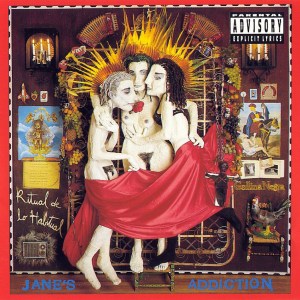
Side 2 is a different kettle of fish. It opens with the 12-minute voodoo-metal paean to the ménage-a-trois depicted on the album’s cover (in a papier-mâché sculpture by Perry Farrell) that is “Three Days”, somehow both profound (“Without game / Men prey on each other”), blasphemous (“Erotic Jesus lays with his Marys / Bits of puzzle / Fitting each other”), and ludicrous (Dave Navarro’s extraordinary guitar abuse).

“Then She Did”, an acoustic-Zeppelin-alike with woozy, disconcerting electric violin, documents the heroin-overdose death of a female friend of Farrell’s, and also the suicide of his mother when he was 4, while “Of Course” is a strange European-sounding folk dance with lyrics about man’s inhumanity to man. “Classic Girl” closes the album gently, a lovely tune with words about being cocooned from LA gang violence by being in love, and about what dicks men are.

I expected most if not all of DRC to be familiar with Ritual…; how wrong I was.

Graham listened: I was intrigued to listen to this as it’s a band I always felt I should have found out more about when this was released. Whatever preconceptions I had were wiped out with one listen. I was expecting something much grungier and darker, frankly this plain “rollicking”.

Rob listened: With the notable exception of ‘Been Caught Stealing’, which is a proper unhinged pop fusion classic, the less I hear Jane’s Addiction, the more I like them. Or to put it another way…

I find the idea of this band much more appealing than the actuality. I heard them a fair bit during my student days and once past the schlock shock aesthetic – Alice Cooper did it better and funnier 20 years earlier – the music is just too forced, too predictable. If they made a sound anywhere near as wild as the image they managed to flog then they might have had something but, for me, they’re just another bunch of whiny West Coast rockers. And can there be four more dread words in music than “LA punk-funk-metal”?

Tom Listened: About one third of the way through Ritual de Habitual, Nick suggested (as the rest of us wittered on about something or other) that it hadn’t been getting much of our attention. My immediate reaction was to feel a little guilty – he certainly had a point – but I think the surprising anonymity of the record was also partly to blame.

I had never knowingly heard Jane’s Addiction before having always been put off by their antics and look (and also by how they were described musically, although this was probably a secondary factor) I was expecting something quite industrial and extreme. In my mind I have had them down as precursors to Nine Inch Nails and bed fellows of The Young Gods or Einstürtzende Neubatten. I was shocked by how unshocking this was…which made me then think about the the band’s image and, by the end of the record, (by which time it had got a bit more interesting, admittedly) I was feeling somewhat piqued that their record buying public had been duped into thinking they were getting some sort of edgy, rebellious manifesto where as in actuality, to coin Rob’s phrase, they were investing in some LA punk-funk-metal. Emperor’s New Clothes anyone?

Arvo Pärt – Te Deum / Swans – Avatar (from The Seer): Round 40, Nick’s choices

I’d half-heartedly set the theme of “moving house, or home, or furniture, or newness” at the end of our last meeting, as round 40 was to be the first DRC at my new house, but without really thinking about what this might mean. I’ve already played the Fever Ray album, which could be a contender, didn’t want to pick (half of) Aerial by Kate Bush, and couldn’t think of any snappily-house-related-titled bands or albums.

So I ignored the theme, pretty much, and plumped for something I’ve been thinking about playing for a while. I explained it as being a completely new type of music for DRC to listen to at a completely new venue, but no one was biting.

I know next to nothing about classical music, and even less about modern classical music, despite the best efforts of our old neighbour (from before we moved). I recall being recommended, or intrigued by something written about, Te Deum by Estonian composer Arvo Pärt some years ago, and buying a copy as a result. I have, I believe, only listened to it once: classical is not my go-to music, and Pärt’s Te Deum is an intense, involved, enveloping listen; it’s not something you can just throw on the do the dishes to. I’ve been intrigued since we started DRC to see how we respond to something classical and unfamiliar, that we have little or no frame of reference for.

Some context, drawn shameless from the Wikipedia page because I know not what I talk about: Pärt is just one of many composers to set the verses of Te Deum, which dates from AD 387, to music. He composed his version in the 80s, and the recording I have, on the ECM label, is from 1993. It is scored for three choirs (women’s choir, men’s choir, and mixed choir), prepared piano, divisi strings, and wind harp. To my ears, it’s a predominantly choral piece which slowly swells from literally nothing into huge, almost overwhelming rolls of voices, strings, and surreptitious drones. I don’t understand it, but it does move me.

Pärt has said that the original text Te Deum contains “immutable truths,” reminding him of the “immeasurable serenity imparted by a mountain panorama”, and that it seeks to communicate a mood “that could be infinite in time—out of the flow of infinity. I had to draw this music gently out of silence and emptiness.” That pretty much sums it up.

This is a translation of the original verses of Te Deum:

We praise thee, O God :
we acknowledge thee to be the Lord.
All the earth doth worship thee :
the Father everlasting.
To thee all Angels cry aloud :
the Heavens, and all the Powers therein.
To thee Cherubim and Seraphim :
continually do cry,
Holy, Holy, Holy :
Lord God of Sabaoth;
Heaven and earth are full of the Majesty :
of thy glory.
The glorious company of the Apostles : praise thee.
The goodly fellowship of the Prophets : praise thee.
The noble army of Martyrs : praise thee.
The holy Church throughout all the world :
doth acknowledge thee;
The Father : of an infinite Majesty;
Thine honourable, true : and only Son;
Also the Holy Ghost : the Comforter.
Thou art the King of Glory : O Christ.
Thou art the everlasting Son : of the Father.
When thou tookest upon thee to deliver man :
thou didst not abhor the Virgin’s womb.
When thou hadst overcome the sharpness of death :
thou didst open the Kingdom of Heaven to all believers.
Thou sittest at the right hand of God : in the glory of the Father.
We believe that thou shalt come : to be our Judge.
We therefore pray thee, help thy servants :
whom thou hast redeemed with thy precious blood.
Make them to be numbered with thy Saints : in glory everlasting.

As a counterpart, and because Te Deum lasts for only 29 minutes, I played Avatar by Swans from their current album The Seer, which has a similarly intense, devout atmosphere, but creates this ethos in a very different way, with strikingly different tools, and heading in a very different direction.

Tom Listened: Although Nick is spot on when he said in his response to Rob’s offering from this meeting (Home by Casper Brötzmann Massaker) that Te Deum complemented it well, for some reason it did not elicit the same reaction from me despite sharing many atmospheric (if not sonic) similarities. I was already vaguely familiar with the work of Arvo Part as my parents own a few of his CDs and I have always found them pleasantly interesting whilst also being somewhat perplexed by them.  There are, for me, many paradoxes contained in his music…it’s modern yet sounds like it’s hundreds of years old, it drifts by without making much of a fuss yet it demands attention, it’s not unsettling yet it isn’t without its unsettling moments, it’s VERY quiet and then VERY loud…music for cars it most definitely is not! Unsurprisingly, I’m not really sure what I thought of it but I certainly wouldn’t be against another listen.

Rob listened: We have an Arvo Pärt record which i’m reasonably familiar with. My Mother-in-Law bought it for us. It’s the only record we both like, as far as I know, although I do recall her commenting favourably on hearing portions of Low’s ‘A Lifetime of Temporary Relief’. Our album is called, pretty definitively, ‘The Best of Arvo Pärt’ and this piece is not on it, therefore it must be one of his shitter numbers. I really enjoyed it though. What a glib sentence to write about music written with the single intention of stirring the soul and offering humble praise to a divine being. I did enjoy it though, really.

Swans have been one of my favourite bands since I reviewed ‘The Great Annihilator’ in 1995 and ‘The Seer’ does genuinely seem to be, as Michael Gira has claimed, “the culmination of every previous Swans album as well as any other music I’ve ever made, been involved in or imagined.” Coincidentally, as we met for DRC on a Wednesday evening, my ears were still ringing, not yet fully recovered from seeing this very band play in Manchester four days earlier in a pulverising, devastating, transcendental performance which, as it happened, achieved for me the pure holy intensity that Mrs Pärt’s lad was aiming for with ‘Te Deum’.

The Notwist – Neon Golden: Round 39, Nick’s choice

After three months of having my CD collection packed ready for moving, we’re now in the new house, and, though CDs are still in boxes right now, they are at least open boxes. Faced with a couple of thousand albums to pick from and no theme, I pretty much abdicated responsibility for my choice this week, and brought three records to Rob’s house. I revealed the years they were from (2002, 2007, and 2008) and asked my co-conspirators to pick. 2002, and The Notwist (pronounced not-wist rather than no-twist), won. (I shan’t reveal the other two, as I’ll probably play them soon enough.)

The Notwist started out as a grunge/metal influenced group near Munich in 1989, and have moved through various sonic identities since then. By their fifth album Shrink in 1998, Neon Golden’s predecessor, they were exploring strange territory between jazz and electronic music, far removed from their early beginnings. Neon Golden itself is a synthesis of low-key, understated indie-pop songwriting and carefully detailed and layered electronic production.

This Room, Pilot and, especially, One With The Freaks offer genuinely catchy pop thrills, whilst the title track, closer Consequence, and opener One Step Inside Doesn’t Mean You Understand are much more minimal and metronomically languid, understated to the point of almost feeling abstract. Singer Markus Acher’s voice is something of an acquired taste – he sings in a presumably deliberately flat manner, the remove of singing in a non-native language, which I often find fascinating, adding to an emotional distance which becomes strangely affecting, words as signifiers of emotion rather than delivery as signified.

It would be easy to see Neon Golden as a post-Kid A record, if it wasn’t for the fact that Shrink had mined electronic influences and textures even more fully two years before Radiohead’s giant curate’s egg. It would also be easy to see it as part of some kind of almost-scene of music that looked to bridge the gap between traditional indie rock and what one might call, in a moment of weakness, laptronica or IDM or electronica or whatever. I feel like Neon Golden, which I didn’t like initially back in 2002 but which has grown on me massively over the years, has more of a kinship with the electronic side of things than the indie side.

Because The Notwist weren’t just sprinkling electronic fairy dust over indie pop songs here, they seemed to be actively integrating different compositional techniques – looping, layering, repetition – that are common in electronic and other ‘experimental’ musics, rather than more traditional songwriting. Tellingly, predecessor Shrink is even less based around songs, with several long, predominantly instrumental tracks that owe a debt to jazz and krautrock. Neon Golden is also, to my untrained ears, mixed much more like an electronic record than a rock record; Kid A, for instance, feels much more like a rock record in terms of physical sonics and dynamics to me, whereas Neon Golden’s sound design feels much more genuinely akin to purebred electronic music.

In the wrong context I fear Neon Golden could sound very much of its time, the glitches and bleeps that make up much of the sound palette seeming like trendy affectations, but to me it’s the genuine article, a rich and rewarding record that grows in stature with every passing year.

Tom Listened: I’ve owned Neon Golden for about a year now and have listened to it a handful of times but can not claim to have got to know it well enough to make a definitive judgement on its quality. In a similar way to The Wrens, this is a noughties indie album that is mightily revered but which I came to late and have never really clicked with – maybe it’s the flat vocals that remove any sense of emotion from the songs, maybe it’s the seemingly adolescent sound of the album…That said, I enjoyed the listen at record club much more than on any previous occasion and I can well imagine that this could be one of those albums that years from now I’ll listen to and think ‘how could I have ever missed its genius at first?’.

Rob listened: Nick played a track from ‘Neon Golden’ at a previous meeting and I recall thinking it sounded great, with the sweet sparkle of indie pop lashed to the propulsive drive of Stereolab. Some months later, whilst digitizing my CDs I came across a 10 year old CDR with ‘Tony’s album’ scrawled across its back. I was delighted when my laptop IDed it as ‘Neon Golden’ then slightly disappointed when I played it. Flat electronoodles.

Happily this evening’s playback came over much better. I have no problem with deadpan vocals and in many other ways this is an album precision tooled to get under my skin. The tunes and the momentum started to assert themselves this time around, certainly enough for ‘Neon Golden’ to begin to glide back towards the top of my listen again list.

Graham Listened: Knowing nothing of their “journey” as it were, I could only go on what I heard on the night. Have to say it was great. Had that sound of a band not trying too hard and concentrating on just just getting it “right” on the record. Magnificent and understated at the same time, I may just buy it!

Talk Talk – Spirit of Eden: Round 38, Nick’s choice


Tom’s “draw a pair of random years” theme has become a favourite; there’s no squeezing something to fit a theme, no talking your way around it – something was either released in the year you picked, or it wasn’t. I drew 1988 and 1996 this time, and had to choose an album from one and a track from another, and see if I could somehow connect them.

My first instincts for albums from 1996 all proved to be too long – Orbital, DJ Shadow, Underworld, Maxwell – due to the mid-90s fetish for squeezing as much music onto a compact disc as possible, or else had already been played at Devon Record Club – Aphex Twin, Screaming Trees. My first instincts from 1988 suffered the same two fates – Public Enemy too long, My Bloody Valentine played by Tom some months ago. What’s a guy to do?

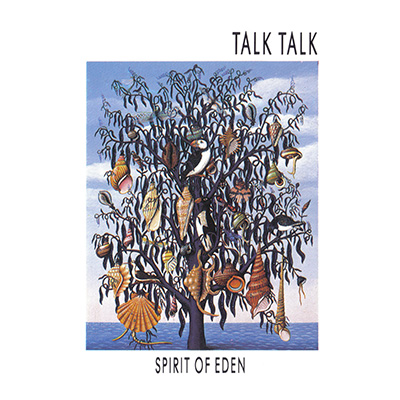
Choose the dismayingly obvious pick that he’d forgotten about, clearly, that follows on from something played at our last meeting. But it took me asking for recommendations via Twitter for me to be reminded that Spirit of Eden came out in 1988, which seems like an incredible oversight given that, at a push, I’d probably pick it as my favourite record (though I kind of dislike the idea of ‘favourite’ records, in an unequivocal, all-time-number-one way). I have, after all, written reams and reams of fawning, hyperbolic guff about this record, this strange dive headlong into the avant-garde that got Talk Talk dropped and sued by their record label for delivering a willfully uncommercial album (the lawsuit was thrown out, but inspired a clause that became common in major label record deals binding artists to the promise of producing sellable music).

Nearly ten years on from writing the above hagiography, I’m much more pragmatic about Spirit of Eden – yes, I love it, and I like to play it sans distraction, loud, in a dimly lit room, so as to get the full experience, but I’m pragmatic enough to admit that I rarely ever get around to actually engineering that kind of listening experience (once or twice a year if that). I’d also probably hold up Laughing Stock as a stranger, more rewarding, more cathartic record these days, and, conversely, The Colour of Spring as a more frequently-turned-to, easily-consumed album that gets part way at least towards delivering some of the same emotional and aesthetic payoff.

A lot of people talk about how beautiful and sparse Spirit of Eden is, but for me its about the grooves and the noise – the crazy, over-driven harmonica, the heavy blues-y guitar riffs, the thick, liquid pulse of bass and drums. Certainly, some passages are extremely beautiful (the hushed choirs that close I Believe In You), but others – the crazed, thunder and lightning drums of Desire – are incredibly powerful and visceral. I find the whole thing incredibly moving: when Hollis sings “I just can’t bring myself to see it starting” in I Believe In You, I feel like my heart’s going to explode.

Spirit of Eden, as well as being the first “holy grail” of Devon Record Club that we’ve played thus far (that is, a record that we all own), is a fantastic (almost) singular experience, and I love it to bits. But I’m not sure I’m quite as passionate about it as I was a decade ago.

(Oh yeah, for reference, I chose A Survey by Tortoise as my track from 1996. The connection? Both albums have 6 tracks, take liberally from jazz, ambient, and experimental music as well as rock, and, well, Tortoise follow on pretty linearly from Talk Talk’s influence in many ways.)

Rob listened: Well I never. Just a fortnight after hearing the Mark Hollis album for the first time, and finding in it an agreeable contrast with earlier Talk Talk, and mere days after describing ‘Spirit of Eden’ as “the most consistently disappointing record I own” lucky me to get yet another chance to approach its sweeping foothills once again. Lucky, lucky me.

As amusing as I would find it to really stick the boot into ‘Spirit of Eden’ (much as its adherents fawn and weep over it, I bet they use it more to test their hi-fi set-ups), if I’m honest, I can’t. I don’t dislike it. Bits of it are nice. Some bits of it sound lovely. On the whole though, it bores me every time I hear it. And every time I hear it, cold, hollow, I get more irritated by it, moving farther away from its supposed majesty when I’m expected to grow closer. One more listen down, one more step in the opposite direction.

Graham Listened: Like buses, you wait until rounds 37 and 38, then 2 come at once. Nick has already described much of how I feel about this record and done it much better than I ever could. One thing that I’ll never get back though, was the first (virginal?) listen to this record. I came to Talk Talk late in the day, so there was never that rush to get the new album and listen to it until you convinced yourself it was good.  In my little flat in Exeter with my newly purchased “high-end” Goodmans CD player, I played this for the first time and was truly astonished. I went through a period when I would play it only when I could dedicate 100% attention, but following counselling, I am now able to play it as background music on the rare occasion.

Tom Listened: I have always been disappointed by the way I am so easily influenced by the opinions of others. Until Nick brought Spirit of Eden to record club, I have always considered it a near perfect album. However, having heard Rob’s enthusiastic dismissal of Talk Talk’s finest moment at record club made me begin to doubt myself…and I began to hear the record in a different way. Rather than submit to its glorious soundscapes and meticulously constructed songs I caught glimpses of what Rob was hearing. And, for a moment or two, it bothered me. Until the breathtaking Desire confirmed what I had always suspected – in this case he’s just plain wrong!

Spirit – how could I have ever doubted you?