The Hold Steady – ‘Boys and Girls in America’: Round 27 – Rob’s choice

Feeling uninspired until a few days before the meeting, I glanced at the list of possible choices i’ve been keeping and The Hold Steady felt like they were edging themselves to the head of the pack.

We’ve learned over the last year or so that some types of records work better than others as DRC choices. Those with unusual structures or styles, those with a challenging sensibility tend to shut the attendees up and encourage close listening and engaged discussion. Those that sound like things we’ve heard before and reveal their wonders with time tend to do less well.

I guess the Hold Steady fall into this latter category. On the surface they’re a hard barroom rock band kicking out fists in the air anthems tuned for fraternity parties. The treasures are buried just beneath the surface.

First up you notice just how sticky Craig Finn’s lyrics are. He has a way of turning a phrase that you want to repeat and hear again and again, and i’m not sure quite how. From the moment I heard “She put five hundred dollars/on the fifth horse/in the sixth race/I think its name was Chips Ahoy” I was hooked.

After a few more listens you pick up on the narrative density of the songs. A cast of characters drift through the Hold Steady universe and by the time this, their third album, rolls around, you’re checking in on Holly, Gideon and Charlemagne and crossing your fingers that they’re straightening themselves out.

Then, when you’ve burrowed right through there’s the self-referential joy of a band who chronicle the lives of people who party too much, who adopt and adapt the blue collar of american AM rock and, ultimately, make thrilling music which could, in truth, be banging out in the background of their own stories.

So, perhaps not a great choice for DRC, but a great album by a great band nonetheless.

Nick listened: I own this, and their previous album, Separation Sunday, too. The Hold Steady are a band that I like the idea of a great deal, but I find it hard to listen to their actual records; their recorded sound is pretty prototypically mid-00s, very thick and dense and compressed in the mix and master, which really bugs me and, I think, really plays against their strengths – I’d like them to sound ragged and edgy and dynamic and like a proper live bar band. I’d like them to sound like Cure For Pain by Morphine, actually. They’re a band I want to like, but I never want to listen to their actual records, so I’ve never got to know the characters, lyrics, and situations that people their (seemingly pretty great) songs.

Tom Listened: As Rob has suggested, The Hold Steady or, to be more precise, Girls and Boys in America is perhaps not such a good choice for Record Club as it is so hard to assimilate on a first listen. I suspect that this is a classic album/band – plenty of people whose opinions I share and trust reckon so – but if it were that simple, I would have thought differently about The Wrens, TV on the Radio, Bon Iver and Jimi Hendrix! So, for now, the jury’s out.

I was surprised at how much GaBiA reminded me of Thin Lizzy. Craig Finn’s voice is a dead-ringer for Phil Lynott’s and the sound of the record isn’t a million miles away either. At other times, especially on the slower, quieter songs, the Springsteen comparisons could definitely be heard. If I were to see GaBiA on vinyl at my local record store, I would probably pick it up and look on it as a bit of a challenge (what with the horrible key change and all) and, no doubt, grow to like it but it is probably not something I would actively seek out.

Graham listened: I liked this a lot even though it didn’t get a fair hearing from me. I found that as soon as the Thin Lizzy and Brooocie references had been discussed I couldn’t get them out of my mind and just listen to the album on its merits. I also found the production style really strange in the way Nick commented. That said, I still really liked this and will need to listen again.

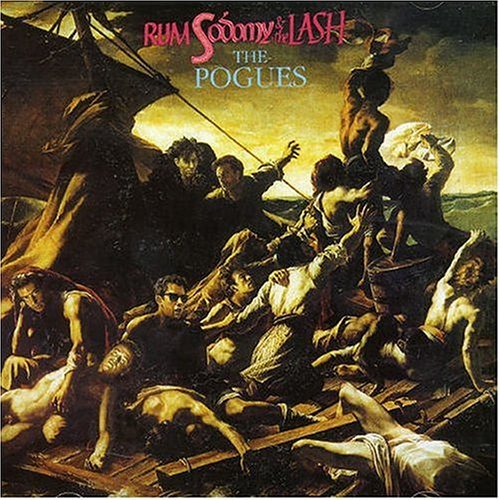
The Pogues – ‘Rum, Sodomy and The Lash’: Round 26 – Rob’s choice

I drew 1985 and 1987 in Tom’s lucky grab bag tombola and my thought process went pretty much like this: ‘Okay, it seems like half the records I’ve brought to DRC have been from one or other of these years, so where next? ‘Psychocandy’? Too obvious. ‘George Best’? Would love to but can’t find a link to another record and Tom promised bonus points…’ and then this popped into my head and the deal was done.

This seems like such a strange and improbable cross-over record now, but at the time The Pogues were habitually bracketed with The Smiths, The Cramps and the other mainstays of the high school alternative universe. Listening back, it’s hard to see why. I recall the first time I shared this record with a trusted friend (hey Rich) having chaperoned it all the way to Gloucestershire in the back of my parents car. He expressed stinging disgust within seconds and made me feel slight foolish for liking it. He didn’t stop me though.

It’s a much more traditional Irish folk album than I remembered. Pop archaeologists scratching away for clues to the vaunted punk origins will dig right through and out the other side, wondering whether they’re listening to the wrong record. It’s also bracingly rough which cements the feeling that this could be an outfit caught gigging in the King William, or busking outside Brixton tube.

The playing is energetic and infectious and the songs, whether trad (‘I’m a Man You Don’t Meet Every Day’, ‘Jesse James’) covers (‘Dirty Old Town’, ‘And the Band Played Waltzing Matilda’ – both songs that the Pogues essentially annexed for themselves) or originals (‘A Pair of Brown Eyes’, ‘Sally MacLenaane’) are rock solid throughout and form a bristling, bustling, exuberant and heartwarming whole. I would argue that ‘If I Should Fall From Grace With God’, which followed this, was their true masterwork, forging a genuine fusion of traditions and styles, but ‘Rum, Sodomy and The Lash’, its gruff, scruff of an older brother is the one that does it for me.

Nick listened: The Pogues exist in a bit of a black hole for me – aside from Fairytale of New York and Dirty Old Town all they are in my mind is Shane Macgowan’s teeth, which is probably why I’ve never had any inclination whatsoever to investigate them. (The Wedding Present are even more unknown – I don’t think I could even name a single song by them.) Rob hinted that he thought I might dislike them, but really I was completely neutral at the start of the evening. And I still am: I didn’t dislike Rum, Sodomy and The Lash, but I wasn’t struck by it, either. It was alright.

Tom Listened: We own Rum, Sodomy and The Lash (it’s more Karen’s than mine) and I always enjoy it when it’s on, but rarely feel the urge to play it. The Pogues are a funny one  – so far removed from rock’n’roll that you sense that if it wasn’t for Shane McGowan’s past in the punk band The Nipple Erectors, they would have been found nestling in the World, Folk and Jazz review pages of the Guardian. He definitely gives The Pogues their edge and, listening again to this album the other night, a lot of it is pretty close to traditional Irish folk music, especially when McGowan takes a back seat, as on the Cait O’Riordan sung I’m a Man You Don’t Meet Every Day. That said, it is thrilling and exciting Irish folk music containing as it does moments of shear beauty (A Pair of Brown Eyes for example), alongside more up tempo numbers such as Wild Cats Of Kilkenny and traditional songs (Jesse James, The Gentleman Soldier). I enjoyed listening to it at DRC and may even get round to transferring it from the dining room to the car!

Graham Listened: Not an album I have ever owned, but sure I had a copy on a C90 somewhere. Great to hear this again and tracks of almost chaotic energy and gentle beauty sit together brilliantly on this album.

Bon Iver – ‘Bon Iver’: Round 25 – Rob’s choice

Bon Iver - Bon IverI’m excusing myself from describing what this record is. If by some minor miracle you haven’t come across Bon Iver in some form or other then there are forests of deads trees and millions of fading web pages available for you to brush up.

I brought this album along for one reasonably straightforward reason. I think it’s interesting and worthy of discussion for lots of reasons (and I also think it’s terrific) but I know that both Tom and Nick have already passed over it with little intention of returning. Tom, I suspect, because he hasn’t given it sufficient chance, Nick because he’s taken an irrational dislike to Justin Vernon and has little or no intention of redressing that (nothing wrong with irrational dislikes of course, at least when it comes to art – I like some of my own dislikes very much thank you, and would hate to see them go). This record is, in my superficial view at least, very similar in some important ways to records which they both revere.

Most previous meetings have been driven by the desire of the players to present music which will surprise and either delight or challenge the others, perhaps a name they’ve heard but music they have not. So it felt a little odd to be offering an album released in the last twelve months which went on to sell hundreds of thousands of copies, topping several end of year lists and eventually scooping a Grammy.

For me, ‘Bon Iver’ works in two important ways. Firstly, it shows Justin Vernon as an artist striving to move his music into new territory. Presumably nothing would have been easier for him than to disappear back to Wisconsin to record ‘Cabin In The Woods 2’. Instead he worked with other musicians, began to craft pastoral sound sculptures with Volcano Choir and ultimately developed a new approach which combined the intimacy of his debut record with the epic scale and complexity of the landscape he grounded it in. He has a painterly technique on this second album, layering sounds to build up immersive scenes.  It’s a huge leap from his first, more than those of us who loved ‘For Emma…’ had any right to expect, and he pulls it off majestically.

Secondly, it’s a just a beautiful collection of sounds and songs. It swoons, dips and soars and even if Vernon’s lyrical obfuscations take some panning to reveal their precious metal, the way he uses his voice as an additional instrument, or suite of instruments, creates a canvas awash with raw emotion.

To summarise, I think this is a great album, I knew that the others might disagree and figured that would make for an interesting discussion. And so it proved.

Nick listened: Taste is a funny thing, contributed to by so many factors, many of which are either so irrational that they can’t be explained, or else so rational that they don’t make any sense – for instance not liking a band because you don’t like their fans and don’t want to be associated with them, even if, on an aesthetic or emotional level, you actually do respond positively to the music. It’s rational, on one level, but denying yourself the pleasure of their music doesn’t make sense. And so on and so forth.

So, Bon Iver, who I still insist on pronouncing like Ivor The Engine. The first album got raved about. I bought it because it’s named after my wife. I thought it was boring off a couple of listens, put it on the shelf, and ignored it. Still people went on about it. And on and on and on and on and on and on and on and on and so on and so forth, to the point where I refused to listen to it ever again and became irritated by the mere thought of it. Then he worked with Kanye on the monstrous abomination that is My Beautiful Dark Twisted Fantasy. Then someone bought him a Talk Talk album or something, and Pitchfork made him album of the year, and I listened to it and it was alright but why is he doing that awful thing with his voice? So I ignored it, again, and, in conversation, played up my dislike for kicks. Because its fun to irrationally dislike things with comic intensity!

I actually quite enjoyed listening to it for a second time, in record club context. If I saw it for a fiver (HOW DO YOU PRONOUNCE FIVER, EH?! IT’S NOT BLOODY FEE-VEHR, IS IT?!) I might buy it and listen to it some more.

Tom Listened: I too liked this album a bit more than I had previously on listening to it at record club, but not THAT much more. And I was a big fan of For Emma. I think there are a couple of fundamental differences here for me and I am not sure any amount of listening will enable me to overcome them.

The first is the juxtaposition of Justin Vernon’s singing and the sound of the record itself. On For Emma, Vernon’s hushed, plaintive falsetto fitted the intimate, mainly acoustic instrumentation and created a fuzzy warmth and familiarity I found reassuring and enjoyable. Whilst not pushing any envelopes, I thought that For Emma…was a natural place for Justin Vernon to inhabit and its soundscapes fitted his vocals like the proverbial glove. I can appreciate the risk Vernon has taken on Bon Iver. It is admirable  that he has looked to move on, not just make the same record again. I just feel that has looked in the wrong place. Without those warm tones (maybe Rob feels warmth in these songs, maybe he doesn’t need to), I find his voice to be faintly irritating, until Calgary that is, when he drops out of falsetto mode and, for me, it suddenly (and all too briefly)just clicks into place.

Playing Bon Iver at DRC has made me more predisposed to give this a few more listens and I am glad that Rob brought it along (I suspect he’s right in stating that I haven’t listened to it enough)…it’s just that I probably enjoyed the discussion more than the record itself!

Graham listened: By virtue of one of the minor miracles that Rob referred to, I arrived at this meeting from under my rock, with no concept of what Bon Iver would sound like. I’ve heard the name and that was it. While fellow members firmly set out their respective positions on this album, what I could hear sounded very interesting. Not that I was looking for revenge but hopefully Tom has forgiven me for my phone interrupting Calgary with news of Andy Carroll’s late winner at Blackburn.

Since the meeting I’ve listened to bits of the album again and the multilayered and complex sounds are really drawing me in. I’m finding the vocal style a major stumbling block at present, but some of that could be the influence of the discussions on the night. Time will tell…………


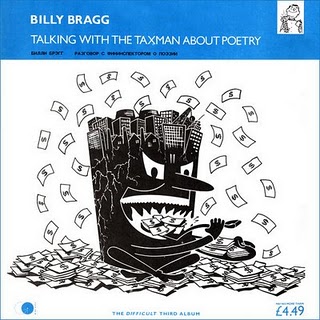
Billy Bragg – ‘Talking With The Taxman About Poetry’: Round 24 – Rob’s choice

I heard about Billy Bragg before I heard him. Someone in the school playground marvelling, snorting, about a hooting idiot hollering about a milkman on TV the night before. It sounded like a weird joke and he clearly thought it was.

Bragg doesn’t get the credit he deserves for what he was doing over those first few records. He used what he had at his disposal, a voice which would make the word ‘untutored’ blush with shame, and an electric guitar, and he made something substantial, moving and provocative from them. What he did to his guitar, slashing, chopping, fighting with it, making jagged, shattered folk music that sounded like it had been dug from a quarry, would have been lauded if Steve Albini or Annie Clarke had made the same sounds in the 90s or 00s.

His first few albums, from ‘Life’s a Riot…’ to this, his third, form a brimming songbook. Bragg’s voice masks a beautiful sense of memorable melody and dozens of his songs are fine singalongs, aligning him once more with the English and American folk traditions.

The songs switch between pamphleteering politics and adolescent love poetry. Some, perhaps with the benefit of hindsight, see these as signs of immaturity in Bragg’s lyrics. I think there is plentiful room for both. Young men will always moon after unobtainable women and men of all ages will always reduce complex politics to brut slogans. It’s interesting however to reappraise some of these old favourites and to realise that where as as 16 year old I thought they were about dangerous women who left betrayed men behind just because they were boring, now they seem to be at least as much about strong women who are rightly fed up of weak men.

Lack of sophistication (or of pretension) doesn’t always reveal lack of depth. Sometimes it’s an attempt to speak directly to the listener. In this Bragg at his best, like his hero Woody Guthrie, is a master.

Unfortunately on the night my slot came up as the takeaway arrived which means the group missed some of Billy’s choicest lines (“How can you lie there and think of England/When you don’t even know who’s in the team?”, “I wished I’d done Biology/For an urge within me wanted to do it then”) and Nick, who claims never to have heard the shattering, heartbreaking ‘Levi Stubbs’ Tears’ still hasn’t.

Nick listened: Definitely a victim of bad timing in terms of the curry arriving, I didn’t take much of this in as Rob suggests, but Billy Bragg is definitely a character I’d have time for in the future. I actually really quite like his voice, which I hear as loaded with personality, and his lyrics are about the most humanising take on political songwriting that I’m aware of. On the surface of it – broadly acoustic singer-songwriter with funny/heartfelt/political lyrics, this isn’t really my bag, and I can’t see myself rushing to buy up his oeuvre, but I definitely think of him fondly.

Tom Listened: I can recall my oldest best mate, Alex Phillips, getting into Billy Bragg when we were in our early teens (somewhat against type as he subsequently went to public school, had an all male ‘wine’ club whilst at university and generally veered strongly towards the righter end of British politics) and I remember feeling shocked that anyone so tuneless could actually manage to sell records or be given a recording contract. It took a couple of years for Levi Stubbs’ Tears to come along and make me realise that Mr Bragg had a fine ear for a tune AND the ability to pull it off on record. And said tune still sounds magnificent, even if only Rob and I managed to resist the temptations of Bollywood Spice long enough to hear it through. The rest of the album sounded fine but I can’t help thinking that, yet again, Rob’s offering suffered from being an interrupted listen and I don’t feel that I was able to listen carefully enough to the second side to make a properly informed judgement. So, another one to file alongside Macarthy in the ‘need to listen again…sometime’ drawer.

Graham Listened: I had really overlooked how much I used to like Billy Bragg. I don’t know why I stopped listening to this and his other albums. He is a national treasure, but also still hugely undervalued. This must be addressed, vote for Billy !

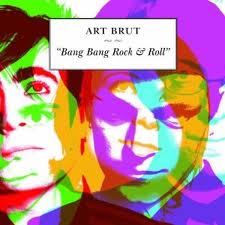
Art Brut – ‘Bang Bang Rock & Roll’: Round 23 – Rob’s choice

art brut - bang bang rock & rollOne of the recurring themes of our discussions over the past year has been intent. What were they thinking when they made this music? What did she mean? What did he want? What did they intend us to think about it? Are they serious? Are they being silly, but with serious intent? Do they even know what they’re doing, and why?

It comes up surprisingly often, perhaps a dead giveaway that we all four are music listeners rather than music makers.

No record of recent years has straddled the line between smart and stupid with such perfect, giddying poise as Art Brut’s debut album. It’s a record about being in a band and making a record which you want to express all your youthful hopes and fears and realising as you do so that wearing your heart on your sleeve is sneered at in the early 21st century and that your fellow hipsters out there might think you’re being silly and embarrassing.

And it deals with it. Brilliantly.

Whatever cheap shots you might throw at Eddie Argos and his band, from the state of his throttled singing voice, to their apparently boundless ambition to their unbridled love of people and things, they’ve already thrown their counter-punch. From the moment 50 seconds into ‘Formed A Band’ (a debut single which essentially encapsulates the band so perfectly – they could easily have split up after releasing it leaving nothing left unsaid) when Argos sneers, “And yes, this is my singing voice, it’s not irony, it’s not rock and roll, we’re just talking… to the kids” you realise they’ve thought this through much better than you and there’s no point being chippy about it.

The rest of the album is studded with in-jokes, self-reflexive digs and confessions of pure love for girls, places and even paintings. All this drilled home by an irresistible, whirling, day-glo thrash-pop without which, of course, Argos’s words would be so much pointless posturing. Every song has something, either a killer hook or a killer gag, to recommend it.

It’s fun and very funny, whilst still being clever, provocative and insightful. That’s a rare balance and those are rare priorities in these cynical times. More to the point, ‘Bang Bang Rock & Roll’ is a record about pure, uncontainable enthusiasm, that most unfashionable of emotions. It’s a minor miracle for a record so unbridled to deal with pretension so unpretentiously. It’s an almost impossible trick to pull off and, listening, one is forced to conclude that far from the knowing hipster outfit they might superficially seem, Art Brut must actually be very brilliant and very very smart.

Nick listened: Art Brut are a name I’m very aware of – plenty of people I know and respect the musical opinions of love them to bits – but they’re one of those groups I’ve enevr investigated for some reason; possibly, as I’ve mentioned before, because you simply can’t investigate everything you come across that sounds interesting or fun or worthwhile. There just isn’t enough time. Anyway, this was great, and I wasted no time in borrowing Rob’s copy to listen to again at home. Art Brut are disarmingly clever, witty, and fun, without ever being irritating or smug or smarmy, which is quite an achievement.

Tom Listened: Rob had lent me Bang Bang Rock & Roll on a previous occasion and I had had a couple of cursory listens prior to the meeting but I think it’s fair to say the record didn’t really grab me when I had played it in my own home. And whilst I certainly enjoyed its energy and the unusual lyrics this time around (and Formed a Band sounded great with the volume cranked up as loud as Rob thinks his neighbour can stand), I still felt there was something missing in the album that would prevent me from going back to it and exploring it further. I can’t put my finger on what it was though and I am perplexed by this fact.

Graham listened: Really didn’t know what to expect from this one, but quite possibly my favourite from the night’s offerings. Refreshing, funny, witty and clever and some great pop songs.

Public Image Limited – ‘The Flowers of Romance’: Round 22 – Rob’s choice

Public Image Limited - The Flowers of RomanceWe’ve spent some time together over the last year or so. I’ve played you Japanese speed metal (Melt Banana), US Drone Doom (Sunn O)))) and distressed electronica (Liars), but let me tell you, I don’t own a record more alienating and challenging than ‘The Flowers of Romance’. When I say ‘alienating’ I mean it sounds like a direct transmission from another world and when I say ‘challenging’ i’m talking about a record that gets right up into your face and asks what you’re going to do about it.

The Flowers of Romance’ was recorded in late 1980, less than two years after John Lydon, then Rotten, had left the Sex Pistols for dead onstage at the Winterland Ballroom in San Francisco. That two year period was the most productive of Lydon’s career and ‘The Flowers of Romance’ was the third of a hat-trick of radical, interruptive albums that PiL released in a rush of driven creativity.

By then Jah Wobble, Lydon’s foil since they met at school, had left, accused of stealing bass lines to use in his own solo work. This left Keith Levine and Lydon alone, corroding under a barrage of narcotics, locked together in a dread duet. They contrived a pulsating, corruscating blizzard of percussion augmented by whatever esoteric instruments they could get their hands on (a Violumpet anyone?). A gleeful gremlin’s way with the studio lead them to record backwards pianos, TV transmissions of opera and phased recordings of ticking Mickey Mouse watches. Amidst all this, the recording leaves a cavernous space at it’s black heart, big enough for Lydon’s satanic countertenor to rage around in.

It may not be structurally obtuse – it’s no ‘Trout Mask Replica’ – but the stark combination of tribal percussion and Lydon’s hellish holler is so aggressive that the temptation to turn away can become irresistible at times. The drums are startling, pounding, tumbling, booming. Perhaps most frightening of all they were said to have inspired the sound of Phil Collins’ later work. Lydon’s vocals are as stark and acidic as he ever managed.  At times he defeats himself, losing his breath and failing to finish phrases, so swept up in the anger of the music that his own voice gurgles and seethes away into a bubbling, incoherent gas. At others his voice is a razor scimitar, unwavering and undeniable. Looking back it strikes me that this is the only record Lydon ever made where the music was the powerful equal of his vocals. Perhaps it’s this clashing collaboration that creates the flames.

The album is by turns repulsive and gripping, crazed and savage, devastating and ludicrous. Still after 30 years it’s like nothing i’ve ever heard. ‘The Flowers of Romance’ has a reputation as the least commercial album ever delivered to a major record label. I’m not sure about that (RCA released ‘Metal Machine Music’ six years earlier) but it’s bracing and almost baffling to reflect that this singular record reached number 11 in the UK album charts. It remains PiL’s highest charting long-player.

Public Image Limited, with their single ‘Rise’, changed the music I pursued fundamentally when I was 15. I bought this the year after that and it’s a key part of my musical hinterland. I’m fascinated to find out what the others think of it.

Tom Listened: Despite the fact that Rob’s offerings are often puzzling and perplexing, Flowers of Romance stood out for me as being particularly difficult to assess. I liked aspects of it – the drumming was great (reminiscent of Liars I thought), the lack of conventional verse chorus verse song structures, the risk taking. But I found the brutality of the sound, the harshness of the aesthetic (I’m acutely aware of the irony of using that word in this context) too much. And then there’s that voice. I just can’t stand it!

I think that, on the whole, Rob and I have pretty similar taste. On most occasions we are both very fond of the same awful singers – Will Oldham, Will Sheff, Bill Callahan…although, having listed the first three that came into my head, maybe we only like them if their first name is William! But every so often a voice will come along that we just can’t agree on. I gave Rob my free download of Future Islands’ In Evening Air a couple of years ago. He couldn’t listen to it as he found Sam Herring’s vocals indigestible. They’re not my favourite vocals either, but they don’t get in the way of my enjoyment of the record. For Rob, the record was a non-starter. Well, I feel the same way about John Lydon. Even his speaking voice sets my teeth on edge. Oddly, it’s something about the same phoney theatricality in John Lydon’s singing that Rob dislikes in Sam Herring’s vocals. I don’t think I’ll ever warm to it and unfortunately (and despite owning Metal Box, on vinyl, in its metal box) I don’t think I’ll be spending much more time with either PiL or The Sex Pistols. It’s probably my loss!

Nick listened: What a voice. Whether he’s hollering about her majesty or blathering about butter, Lydon’s tonsils are exceptional. Shorn of his squealing, The Sex Pitols are basically just a classic rock band with a dirty guitar sound. PiL, though, are something else. I bought Metal Box at uni and thought it was great and important, though I’ve not listened to it in years. I’ll dig it out soon. Flowers of Romance itself was fascinating on first listen – I know how much Rob loves it, and can see how his opinion on These New Puritans stems from his relationship with it. The percussion, the synths and sounds surrounding them, all compelling and exciting. But then there’s Lydon on top, snarling and skronking and sneering. He’s bloody horible, and a big stumbling block…

Graham listened: Showing my age, sometime in the past I’m sure I had a remix/12inch of the title track and single. Loved it at the time but was shocked by how stark and itense this album really was. I’ve never really investigated PiL to any degree, but there was something almost primeval about this that took hold of me and demands I dig deeper.

Dexy’s Midnight Runners – ‘Too-Rye-Ay’: Round 21 – Rob’s choice

Time is short. I’m going to skip the bit where I explain that Dexy’s Midnight Runners were more, so much more, than the School disco gypsies that most of the Northern Hemisphere remembers them as. Sure, I’m handing our credits here. Fill your boots.

There’s a quote variously attributed to Nick Lowe, Elvis Costello and various other smarty pants rock stars that goes thus: “writing about music is like dancing about architecture.” It’s a peach. Plus, as a bonus, it’s pretty accurate. How then to write about Dexy’s Midnight Runners, and Kevin Rowland in particular, a band and a singer who, at their most fearsomely intense, used their music as a platform to struggle publicly, forlornly and beautifully to express the essence of what they wanted their music to be? They never reached the purity, the core that they sought and if they couldn’t express what they wanted for their music in the form of their music then writing doesn’t stand a chance. So, I’ll dance for 400 words instead.

Before we speak of Kevin and his heart of fire, let’s be sure not to skip past the sound his band made. The sound he made them make. Rowland conceived Dexy’s Midnight Runners as a hard-hitting hoodlum soul revue and he drilled them, technically, physically and mentally, until they were the outfit he needed. Then, after their first album, they all abandoned him and he started again. The band we hear on this, their second record, is almost completely new and (perhaps we shouldn’t be surprised) despite the additional adornment of fiddles and dungarees are harder, bolder, tighter and punchier than any other Runner’s incarnation. Hear how they push and push their way through ‘I’ll Show You’, piano, horns, strings, drums hitting every step, every sublime transition together and hitting them hard. Try to spot a single crease in ‘Until I Believe In My Soul’ a 7 minute gospel torch song that sweep inexplicably into a jazz pastiche and back out to a floor thumping, chapel-filling cri de coeur.

In Dexy’s Kevin Rowland fused the personal and the political then sublimated them. In this he and his band equalled, perhaps surpassed, the great testifying rock and soul acts. ‘Too Rye Ay’ is his least political and most personal record. It plays down his desire to reconcile his Black Country upbringing with his Irish heritage, which dominates much of ‘Searching for the Young Soul Rebels’ and ‘Don’t Stand Me Down’, and focusses on his urgent need to create something that will burn bright down the ages, a pure expression of abstract inner truth that will stand as no less than a monument to the beauty and the worth of the human soul. Sounds over the top? Fair enough and, by the way, screw you.

Rowland’s lyrics are remarkable. Each song is like a workout, a battle as he fights to express himself, beating down the language, beating down the constraints of the form, throwing propositions back and forth in dialogue with his band members, searching, climbing, grasping for the secret resolution he knows is out there somewhere. And the Runners go with him creating elatory music to match their leader’s fervour.

All this comes together in it’s most perfect form in ‘Let’s Make This Precious’, Rowland’s signature piece. The band kick hard, fast, joyfully, irresistibly. Rowland’s lyrics, his dialogue with the band and himself are a pure plea for purity, for commitment, for transcendence. Together they are striving, working, training and straining for something beyond the ordinary, something more, something that they can sense but cannot reach, something that will transform them, redeem them, save them.

“Pure, this must be, it has to be.
Pure, let’s make this pure,
(Do you mean it?) Yes I do,
(Then let’s sing it) Certainly, but
First bare your hearts and cleanse your souls
(And then?) Let’s try and make this precious, like this.”

Their quest never reaches it’s end. They never get there, perhaps they never could. But, my goodness, ‘Too Rye Ay’ brings them pretty close.

Epilogue: reversing the Curse of Devon Record Club, in the days after this last meeting Dexy’s announced the release of ‘One Day I’m Going To Soar’ their first album for 27 years.

Nick listened: Dexys are an odd proposition; any understanding of them for me, and for most people I suspect, is so massively overshadowed by Come On Eileen (even more so than Geno, which I’ve read about countless times but don’t ‘know’) that it’s difficult to form any kind of relationship with them and their music. I tried to, years ago, by buying Searching For The Young Soul Rebels, in the hope that it would be the white soul classic I was looking for back then (I suspect it was, but I wasn’t ready for it, for whatever reason – the reason probably being Eileen). So, I’ve read more about Dexys than I’ve listened to them, but Come On Eileen is still burnt into my consciousness more than anything else about them.

Rowland himself is a fascinating character, doing, as Rob points out, the musical equivalent of breaking the fourth wall, singing about the music he is singing, striving for something primal and honest. This was great (as was the Don’t Stand Me Down track that Rob played alongside it), and I want to know and hear more. Sadly, as ever, I think the distance of time elapsed between then and now, coupled with Eileen’s ubiquity and strangeness, will make any appreciation I come to of the rest of their ouevre just that; appreciation, rather than love. But I’m gonna keep looking out for Don’t Stand Me Down, lest it ever be around for less than £50, and try and pick this up too.

Graham Listened: Since the mammoth success of …..Eileen, I have probably been doing my best to avoid Kevin Rowland. The first album had no real imapct on me at the time, but I could recognise Geno as a great tune. But being around at the time, the success of ……Eileen categorised Dexys as just another pop band for me. I can recall listening to this album at the time of release and really “not getting it”, as it were. I was probably expecting more of the pop classics like the singles and didn’t really get all the heart and soul searching. I can hear it now but still harbour doubts.

Tom Listened: I have a friend at work who is really into early 80s ‘pop’…hell, I even caught him listening to a Heaven 17 Youtube mix the other day! I told him about Too-Rye-Ay being an offering at our recent DRC meeting, offering condolences that he wasn’t there but he replied that Dexy’s were never his thing. When I (incredulously) asked him why not, he related to their ubiquity at the time. In his words ‘you don’t come home and drink scotch when you’ve already got plastered on it in the club’. Now I suspect that with that statement he is not referring to Dexy’s, he’s referring to their crowning glory/albatross…that song…you know the one!

The thing is, once you come to properly listen to the albums you soon realise that Come on Eileen is so far from being representative of Dexy’s that it has probably done the band more harm than good. That one song is, to most people, Dexy’s. And I haven’t met all that many people who don’t like it. But I also haven’t met all that many people who have explored the band’s output beyond it. And I guess the reason for that is that the song’s album is an awkward bugger, packed with disorientating time signatures, oblique lyrics and (horror of all horrors) more key changes than you can shake a stick at. So it’s really difficult to get to grips with (at least for me it is) and yet I feel as though, six or so listens in (Rob lent me his copy), this is probably a work of genius, passion, authenticity and other good words. One that’s very much worth persevering with and although I still wouldn’t say I have clicked with it yet, I am beginning to really enjoy the ride (and none of it is remotely like Come on Eileen… apart from Come on Eileen).

PS I have also felt inspired to go back to Searching…and that sounds brilliant…and much more accessible! Definitely an easier introduction to the band.

Big Black – ‘Songs About Fucking’: Round 20 – Rob’s choice

I bought ‘Songs About Fucking’ shortly after it came out. I was 16. I had no idea what I was getting myself into. I’d read a couple of reviews and, having noted the discussion of the drum machine, the grinding bass and the cover version of ‘The Model’ I was expecting something like a heavier version of New Order.

I got the record home, snuck it upstairs past my parents, played it once and immediately hid it under a stack of much older records. I was petrified. Never heard anything like it, never even contemplated that anything like it might even exist out there. I can still remember how my room looked the day I first heard the record, and still taste the horror, disgust and fear that I was left with. I hid it away so I didn’t have to think about it and it was six months until I played it again. That was 25 years ago. It’s been one of my favourite albums for about 23 years now.

‘Loud’ is a slippery theme, but I chose ‘Songs About Fucking’ because, more than any other record i’ve ever heard, it absolutely seethes with volume. Not only can you hear the tracks straining, pushing and pounding to burst out of their own skins, but you’re left in no doubt that, if they do manage to break free, they’ll go straight for your throat (probably to give you a ‘Columbian Necktie’). I have many records which are more shouty, have more rocket-powered guitars on them, have more frenzied beats, gunshots, howls, bits of metal being obliterated by industrial machinery, but none of them possess a spiritual loudness, an unquenchable violence in their DNA, their soul, like Big Black’s second and last album.

Steve Albini used a drum machine in Big Black because he knew where he was going and he knew no human drummer could keep the beat as quickly, consistently and relentlessly as he needed. The drums on this record go off like a pounding rail gun. He played his guitar with metal picks to which he’d attached industrial metal chippings so they would give a sound like two guitars being played at once. The guitars on this record buzz, squeal, scrape, fizz and skinng (Albini’s word for the sound) like wild animals being dragged towards a meat grinder. Albini has an reputation as a misanthrope which may be unfair, but this record lays out a cast of characters none or whom you would want to meet were they to step off the vinyl.

‘Songs About Fucking’ has inspired some great lines from critics since its release, many from writers who shared my initial repulsion but realised also that to make something this effective, this driving, this brutal, this memorable is an achievement that deserves recognition. Look ’em up, google the title (no, really), they’re worth it. I think it represents the end of something. It’s not possible to take this line of attack any further than Albini and his fellow sociopaths did here.

It’s just 29 minutes long. I’ve been listening to it for 24 and a half years since I retrieved it from it’s hiding place and still, after all that time, it never fails to give off one hell of a charge. Every single time. I can’t think of any other records I own that can hold a candle to it in that regard.

Nick listened: I know Rob’s been pondering how record club would react to noise since its inception, and threatening to bring this album along every fortnight to find out… Big Black are a name I’m very aware of, but not a band I’ve ever been tempted to taste for myself, despite the fact that I’m a big fan of the sound Albini engineers in other people’s music; on finally hearing this, my hesitancy was warranted, because as much as I might love the sound of Electrelane or Nina Nastasia (and their songs) and even In Utero (as long as you tweak the bass and treble settings as suggested in the booklet), this is a very different record indeed. I’m very glad I’ve heard it, and I “enjoyed” it more than I thought I would – the fact that the noise was used as a vehicle for recognisable song shapes (and, of course, one very recognisable cover) made it much easier to consume; I guess I’d been vaguely fearful that the songs themselves might not exist at all. That it’s brief certainly helps too. I doubt I’ll be buying my own copy, but I’m glad Rob’s got his, and loves it so much.

Tom Listened: I thought this was great…and I didn’t really expect to! In fact, Songs About Rumpy Pumpy (just in case the kids ever read this) has probably been the biggest surprise for me since we started DRC. Whilst the sound of the record was not far from what I expected, there was much more space and dynamic range than I thought there would be, with barely a sniff of that heads down thrash your fingers until they bleed hardcore rifforama that has always put me off. And there were melodies. And it wasn’t terrifying in the least. Now I just need to find a way to smuggle the sleeve past the kids! Not one for long car journeys with the family.

Graham Listened: I knew this album for its reputation, and more chiefly, its cover. I prepared my self for the aural onlsaught, but hey, it wasn’t that scary at all!

The Antlers – ‘Burst Apart’: Round 19 – Rob’s choice

This was albums of the year week. When I stacked up my 2011 records, I found I only had 15 to choose from and when I weighed them against each other, divining for the collection that had given me the most succour, the most pleasure, the most warmth, it came down to a choice of two, Bill Callahan’s ‘Apolcalypse’ and The Antlers’ ‘Burst Apart’. From a short field, they have been to two I’ve reached for consistently in all circumstances, and they’ve formed the backbone of the soundtrack to the second half of the year.

Bill had his moment back in Round 5, but I was able to sneak in ‘One Fine Morning’ as one of my tracks of the year under the guise of a pub quiz question (Q: What does Bill Callahan do on this track that no-one in rock history has ever, to my knowledge, done before? A: He sings the album’s catalogue track, rather  beautifully), so I played The Antlers record which neither Tom or Nick had heard before.

It’s a beguiling album. Without the immediate emotional punch of it’s predecessor, the devastating ‘Hospice’, ‘Burst Apart’ had a tendency to drift by during early listens, but the more time i’ve spent with it, the more it has revealed its treasure. It’s a gorgeous, warm and rich collection, interweaving meticulous playing and arrangements with Peter Silberman’s icy, aching voice, which drifts through the steam like a ghost. It dawned on me recently that in both its precision and its restraint, ‘Burst Apart’ is cousin to Wild Baasts’ ‘Smother’, another favourite of the past year, but where lyrically Wild Beasts sound academic, The Antlers are raw and direct.

The delectable tumble of ‘Rolled Together’, the angelic ‘Hounds’, the yearning, heartbreaking ‘Corsicana’ and the brutally simple, staccato stab to the heart of ‘Putting The Dog To Sleep’ have drifted and swooned and billowed around my head for the past 6 months. Irresistible, transcendental, unshakeable.

Nick listened: I loved this. Or, rather, I found this completely beguiling and to my tastes immediately, and so bought a copy forthwith, and have been listening to it intensely ever since, and love it now. I wish I’d heard it earlier in the year – it would easily have cemented a position in my top ten for 2011 (whatever that means). It’s an incredibly well balanced album, finding the sweet spot between melody and groove, obviousness and obfuscation, that presses all my buttons. Em had mentioned that she’d listened to Antlers via their website a couple of months ago and liked them – I wish she’d been more effusive, or else taken the plunge and bought it, because it took until Rob played it for me to sit up and take any notice. Probably my favourite record I’ve bought as a result of hearing at DRC.

Tom Listened: When introducing this to us, Rob suggested that at first this may leave us feeling underwhelmed. Not a bit of it. I thought that Burst Apart sounded great on first listen, packed as it is with ideas, pathos and sweet, sweet melodies. I liked the fact that, unlike its predecessor Hospice, Burst Apart had range and textural variety so that it didn’t seem anything like as unremittingly bleak. Whilst there are those who may suggest that this would lessen its impact, I found it much more palatable on first listen and I suspect that I would go on to prefer the latter album over time. And whilst The Antlers don’t really go far from the archetypal ‘sadsong’ indie template, Pete Silberman’s exquisite voice, full of vulnerability and experience, lifts the music out of the ordinary. Nice choice Rob….but Apocalypse is better!

Liars – ‘They Were Wrong So We Drowned’: Round 18 – Rob’s Choice

Liars - They Were Wrong So We Drowned‘They Were Wrong, So We Drowned’ is perhaps best known as a couple of things that it really isn’t.

It was cast as a concept album (or a ‘story album’ according to Angus Andrew) about witch hunts, when in fact it simply uses related research material as it’s leaping off point. Whilst the album seeps and creeps with blood, folk horror, paranoia and devilry, this is no ‘Salem: The Musical’.

Secondly, and partly because of the focus on this first general misconception, in some circles it was regarded on it’s release as a piece of unlistenable trash. Notoriously both Rolling Stone, and Spin, admittedly not known for boosting experimental art rock, gave the album their lowest possible scores. Many more generally sympathetic followers saw ‘They Were Wrong…’ as a major misstep.

One can hear why they may have been confused. The record moves away radically from the aggressive punk funk of the New York band’s debut, creating instead a dark, dense, buzzing environment which threatens to swamp the listener. What’s hard to believe is that serious critics could have found the album unlistenable. It’s packed with ideas, and whilst some of them may seem like pat moves now, creating clattering, bass-free percussion from whatever they were able to hammer combined with subtle, disorienting electronic effects, Liars built a record which would have taught Animal Collective a thing or two back when it was released in 2004, preceding ‘Sung Tongs’ by a number of months.

If all this makes the record sound like so much formless sonic masturbation then forgive me and go listen to it. ‘They Were Wrong’ bristles with rhythm, tone, downtuned melody and inescapable atmosphere. The first time I heard it, and I was put off sufficiently by the reviews to make it the last of the five Liars albums I bought, I thought there wasn’t a bad track on it. Now I think it’s my favourite of theirs, and it works perfectly in the trajectory of a career which would take them next to ‘Drums Not Dead’, at  which point all the nay-sayers presumably swallowed something hard and jagged and realised that Liars are, and always have been several steps ahead of them and their hipster moves.

Tom Listened (a long time ago): I can just about remember being mightily impressed by this record. Sure, it’s a difficult listen (many of our recent offerings seem to have been) and it started off pretty impenetrably, but as the record wore on, its variations and diversity became apparent and there was just enough there to make it an intriguing and wholly captivating listen as opposed to a chore, a record where you sense that time invested would be paid back in spades.

I like Drum’s Not Dead, actually it would be truer to say I admire it more than like it, and I wonder whether this feeling would be replicated for all of Liar’s discography, but on listening to They Were Wrong… the other night I felt as though it would be a good place to start widening my investigation into this theory beyond its current sample size of one record!

Nick listened: I bought Drum’s Not Dead when it came out but, on first listen, was expecting something other than what came out of the speakers, and so decided Liars must be rubbish, and stuck it on a shelf where it sat, ignored and scorned. (The L section of our collection is also on the lowest shelf, by the floor – things down there seldom get picked, whilst lesser favourites at eye-level benefit from casual browsing.) But, primed by Rob’s introduction, I enjoyed this, and got more of a sense of who Liars are and what they’re for. I’ve listened to Drum’s Not Dead again subsequently, and wonder if I may have been a little harsh, and should try again. Recognising the final song (of Drum’s Not Dead) from the film 50/50, which Em and I had seen about a week before, seemed to help.