Perfume Genius – ‘Put Your Back N 2 It’: Round 42 – Rob’s choice

perfume genius - put your back n 2 itFor me 2012 has been dominated and, to some extent book-ended, by two albums, ‘Mr M’ by Lambchop and ‘The Seer’ by Swans. Both are favourite artists of long-standing who have, after many, many years, produced career-defining records. Both albums manage to distill the essence of what has made their creators so important, to me at least, and still move their music on to yet another level of beauty, brutality, virtuosity and wonder (delete as appropriate). I saw both bands play devastatingly brilliant live shows this year. Kurt Wagner and Lambchop were exquisite, care-worn and heartbreakingly beautiful at the Bristol Fleece. Michael Gira and Swans were jaw-dropping, almost jaw-breaking, in their symphonic violence, a pulverising yet ultimately sublime experience which took days to recover from. I’m hopeless at remembering past gigs, but both these shows felt like they would fit comfortably within my top ten all-time list, if only I could recall the other 8.

I’ve already presented ‘Mr M’ to the Record Club and ‘The Seer’ is pretty much twice as long as the upper limit that DRC can tolerate. Which brings me for my record of the year choice, happily, to the second album by Mike Hadreas, aka Perfume Genius, which has also been on almost constant rotation this year. Superficially, there is little to bind this record to the other two. It’s a short album, just a little over half an hour, populated by 12 concise songs, most of which are simple sketches for piano and voice. However, Kurt Wagner would surely recognise the timeless delicacy of the songs and M. Gira would certainly appreciate the existential bleakness of the lyrics.

Hadreas has an incredible touch when it comes to melody. These are such simple, delicate, still songs but somehow he manages to breath a warm and fragile life into each. They are, in essence, torch songs, as memorable and beautiful as any, but meticulously drained of melodrama and sentimentality to leave brittle bones and reverberating husks. Within these he lays bare his passion, his self-loathing, his wounds and his desolate desires.

If this year has produced a lyric as bleakly poetic as ’17’ then i’ve yet to hear it. Almost laughable set down on the inner sleeve, in the context of the record it is horrifyingly direct and distressing. If this year has produced a song as heart-stopping as the 2 minutes of ‘Hood’, a moment more vertiginous than that when the drums swell in the middle of this track, then I don’t want to hear it for fear I may swoon clean away.

Hadreas is a rare, if tortured, talent. I have no idea where he may go from here, but ‘Put Your Back N 2 It’ is an album which approaches perfection. If Lambchop and Swans built the two major musical monuments of 2012, then Perfume Genius connected the two with a frozen river of votive songs.

Graham listened: I’ve left many a DRC meeting thinking about buying what someone else has brought along and gone on to do so. After listening to this I just knew I had to have  it, and with Christmas coming it went straight on my list. Simply astonishing.

Nick listened: Two for two. Emma and I saw Perfume Genius live (albeit very briefly) at ATP earlier this month, and also saw Owen Pallett follow him onstage and enthuse sincerely about how much Hadreas’ music means to him. On first exposure, in a Pontins discotheque, his piano-lead eulogies to youth, emotion, sensation, and regret didn’t come across that well (partly down to the very drunk girl puking on the carpet in front of us), but on record, Perfume Genius’ intimate talents were much more understandable. ‘Hood’, as Rob suggests, was worth the admission price alone. Suspecting that Emma would love the record’s bleak intimacy and simplicity, I bought her a copy last week in The Drift for Christmas. I’m looking forward to listening to it again myself.

Tom Listened: I was really glad that Rob brought Put Your Back In 2 It’ as his album of the year not least because I gave it to him for his birthday! I bought it with next to no knowledge of the band – I had read a few positive reviews and had a cursory listen in The Drift (how many plugs to they get from us nowadays? Surely it’s time to sort out some sort of commission…) to the first couple of tracks and, on hearing track 2 I came to the conclusion it sounded a bit like Will Oldham and would therefore nestle happily amongst the vinyl in Rob’s collection. It turned out that Rob already knew and liked Perfume Genius, that he had already played a track from the debut album at Record Club and, therefore, that I had shown supreme lack of imagination in making my choice of purchase. It also turns out that track 2 – the (ironically(?)) named Normal Song) is a red herring, being a couple of plucked strings on a guitar rather than the piano led torch songs that populate the rest of the album.

I liked the record – it sounded like a more honest, poignant and (much) less theatrical Anthony and the Johnsons (and I much preferred it to I Am A Bird Now, the one AATJ album I own) – but I wasn’t as blown away by it as I sensed Nick and Graham were…yet again I feel this is a record I would quickly grow to love if I spent some time with it, but I wish Hadreas had placed a more equal balance of guitar and piano on the record as I am a complete sucker for a parched acoustic guitar and a plaintive vocal (see the aforementioned Normal Song).
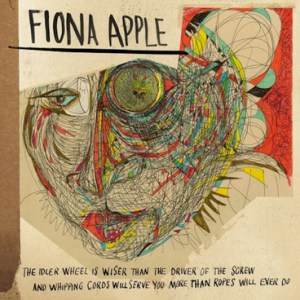
Fiona Apple – The Idler Wheel etc: Round 42 – Tom’s Selection

FionaAppleIdlerWheel600GbAs we reach the end of another paltry year of contemporary purchases for me and the end of year lists are pouring in full of albums I’ve never heard of by outfits I’ve never heard of, I’m more unsure than ever of the worth of the process. You see, I could easily come up with a list of THE top ten albums from this year but it would include the majority of current albums I’ve got to know well over the last 12 months. If I were to post said list, I’m sure any reader would assume I had devoured far more music than I actually have and would not realise that my number 10 would represent a scraping of the barrel rather than a glittering jewel plucked from a huge vault of varied and comprehensive listening. At the other end of the spectrum are those lists that are so long they beggar belief – how can anyone get properly acquainted with 100+ albums in a year? Yet you regularly see lists of this length made by a single person! Do they do anything other than make lists while sitting around their stereo all night long? Probably not. Either that or (whisper it) they don’t really know what they’re talking about.

That said, it would be disingenuous of me to suggest that I don’t avidly follow the lists at this time of year scouring them to find that undiscovered gem I had previously overlooked or been unaware of. And as this is a time of giving as much as receiving it’s only right that I do my bit to contribute to the end of year thing. So…just in case you’ve lived in a cave over the last 12 months, have not followed the reviews or just think you happen to dislike this sort of thing, Fiona Apple released an album in June…and that’s my album of 2012 (and I’m fairly confident about this). It’s called: The Idler Wheel Is Wiser Than the Driver of the Screw and Whipping Cords Will Serve You More Than Ropes Will Ever Do (not sure these album titles do her any favours). I would urge you to listen to it. You may well find it not to your taste, and that’s fine, but I think you should definitely check it out. I say this, not because I’ve listened to hundreds of new albums this year but because I think it’s a remarkable album – brutal and subtle, always interesting and unsettling even if it veers tantalisingly close to ‘kooky’ territory at times (too close for some, perhaps). This is the first Fiona Apple album I’ve owned but it will probably not be the last.

The last time I heard a solo female artist sound this confident and instinctive on a record was on St Vincent’s second album Actor. The two albums don’t sound that alike really but they share an honesty and a lack of self-consciousness that enable the songs to reach parts that more considered records (see Strange Mercy) do not.  But whereas Actor has moments of sonic assault, it seems to me that The Idler Wheel is all about space, momentum and the balance between simplicity and complexity which seem to coexist simultaneously on many of the songs. Check out Periphery, Johnathan, Werewolf, Every Single Night…that’s practically half the album already! All these songs have such spartan instrumentation, often just a piano plonking away every now and then – it’s the melody lines and Apple’s (exquisite) singing that lift the song from the ordinary to the frequently extraordinary. That and the astonishing drumming that reaches it’s zenith on the album’s breathtaking closer Hot Knife which, for the most part, is just a drum, Apple and her sister Maude Maggart. This was a joker track (songs that we have to listen to properly..although you are allowed to check the football scores during them, apparently) for which nobody needed to be instructed not to speak! It’s a cracking end to a cracking album and if you can find a record from 2012 that I (and my family for that matter) prefer you’ll be doing well. Maybe the answer lies in those end of year lists. Then again, maybe not!

Nick listened: I bought Fiona Apple’s debut album many, many years ago, I think on the advice of my older brother after enjoying her cover of Across The Universe. I quite liked it, as I recall, but haven’t played it in many years – I suspect it was a victim of the post-adolescent indie boy’s fear of women. I’ll be revisiting it soon to reasses.

Because this was awesome; several times during the playback I said “this is a jazz album!” and, with its minimal arrangements, sense of musical freedom and unusual chords, it certainly felt closer to jazz than mainstream pop. Apple’s vocals, almost scatting at points, add to the impression. I was intrigued and beguiled by The Idler Wheel, and I’ll be picking it up pretty soon, I think. PS. I did indeed pick up a copy, last week in The Drift; I also picked up Ekstasis by Julia Holter, which Tom played a track from. An expensive week’s listening!

Graham listened: Unfortunately I am a bit of a ‘Kooky Monster’ and offer short shrift to those that bend, rather than play within or completely break, the rules. An interesting listen but it fell outside my my boundaries on to the stony land of stuff I don’t try hard enough to appreciate.

Rob listened: I had Fiona Apple filed somewhere only slightly to the left of Alanis Morissette and due North of Liz Phair. To be honest, all I really knew about her was that she used to be a bit poppy, had gone a bit more left-field and kept getting mentions on Pitchfork, although i’d never really unravelled whether this was because they dug her or because she was having some sort of extended public breakdown.

I’m so pleased Tom sorted all that out for me. ‘The Idler Wheel’ clearly deserves all the plaudits it has received. Somehow both rich and sparse, it feels like creature who’s internal structures you can see working mysteriously away whilst it lives and breathes. We talked about how lazy it feels to compare female singer songwriters only to other female singer songwriters. To be fair, we’re probably equally lazy when it comes to comparing male performers too. I wonder, however, whether the reason we find ourselves invoking St Vincent and Merrill Garbus and Joanna Newsom when we listen to a record like this, is that women just happen to be making the most challenging and inventive music at the moment?

Loved it, will buy it.

Grizzly Bear – Shields: Round 42, Nick’s Choice

Grizzly-Bear-Shields

And lo, our end-of-2012 meeting is upon us, and we all have to bring a record from the waning year. The best? Our favourite? What do these superlatives even mean? I’m not sure if Shields by Grizzly Bear, the Brooklyn four-piece’s fourth album, is either, but it’s certainly one of the records I’ve played and enjoyed the most over the course of 2012, even though it only came out in September. (Two of the others – Liars and Field Music – I’ve already played.) I know Tom and Rob are both fans of the band, but haven’t heard this record yet, and I suspected that Graham would have heard of them but not heard anything by them, so it seemed like a sensible, if obvious, choice, to finish off this year’s sessions.

Shields is, on first contact, the most direct Grizzly Bear album to date. 2006’s Yellow House (confession – I’ve not heard ostensible debut album Horn of Plenty, which is essentially, I understand, home demos by a near-solo Ed Droste rather than a full-band album) is an unusually structured, dream-like record which inhabit a strange space between alt.rock, folk, jazz, prog, and psychedelia. Songs take strange turns, disintegrate before your ears, ghostly repetitions of gossamer melodies which sound like they (to paraphrase Tom last night) were discovered in a dusty attic of an abandoned house. 2009’s Veckatimest firmed things up slightly by delivering a couple of bona fide singles and some driving, spiralling, physical psychedelia, but many songs still drifted in beautifully unpredictable directions. They’re the kind of records that reward repeat listens, where familiarity doesn’t breed boredom but revelation.

Shields, on the other hand, starts with three of the most rollicking, melodically and rhythmically direct songs Grizzly Bear have ever conjured (interspersed, of course, with an acoustic coda and ambient diversion or two). Things aren’t entirely straightforward, though – “Yet Again” dissolves in a firestorm of guitar noise, “Sleeping Ute” collapses soporifically into the aforementioned coda, and “Speak in Rounds” slowly coalesces into the ambient-interlude of “Adelma” – but for the most part, Grizzly Bear sound consistently like a proper rock band for possibly the first time.

Across the record their songwriting seems more focused, their instrumentation more forceful, but there’s still amazing subtlety on show, too; “The Hunt” and “What’s Wrong” display almost as much delicacy as anything they’ve done previously, while “Gun-Shy” pulls them in new directions I’m not familiar with. Which is to say that, even though Shields is undoubtedly more direct than its predecessors, it’s absolutely just as richly detailed and full of depth, too. I put it away for a few weeks when we moved house, wondering if I’d explored all there was to find within its coffers, and was pleasantly surprised when I dug it out again and realised I hadn’t.

I’ve liked, admired, and been intrigued by Grizzly Bear for an age, but this year I’ve fallen for them hard, and Shields is a big part of that.

Tom Listened: My entry point to Grizzly Bear was Yellow House and, once I had worked out what speed to play it at (after about a month of listening to it at a grizzly, funereal 33rpm) I was drawn to its otherwordly sound and haunting songs. I think it’s fair to say that I admired it rather than loved it but I was intrigued by something that sounded so unusual yet didn’t stray too far from the norm – it was, after all, guitar, bass and drums primarily but it certainly managed inhabit an unusual world quite unlike anything else.

And this was where Veckatimest fell down for me. The individual songs sounded great but, for some reason, the overall sound of the record didn’t draw me back very often – it just sounded like four accomplished human beings playing their instruments really well – and I haven’t listened to it for an age. The video of Ready Able though is amazing and me and my children have spent a disproportionate amount of time trying to guess what the story is.

I digress…I didn’t bother with Shields because, even though it had garnered great reviews, so did it’s predecessor. It would be bound to be another disappointment right? Pretty enough but not much to bring you back for another listen. Well, how wrong I was! Sure, Shields sounded fantastic. You’d expect it to. But this has an energy, a vibrancy that, for me, Veckatimest lacks. At times it sounded almost tempestuous – a million miles away from Yellow House but none the worse for it. Nick opined that the initial burst of vitality would soon ease but to my ears it was maintained through the course of the album. I loved Shields and am very glad indeed that Nick was so predictable!

Graham listened: Again, like Perfume Genius, I knew I had to have Shields as soon as I heard it and it went straight on Xmas list. While Rob’s choice knocked me over, I just found  Shields hugely enjoyable to listen to. It hasn’t arrived yet but I’m looking forward to listening again to see if some of the more bizarre reference points I found on first listen, still hold true.

Rob listened: Nick has been pulling ‘Shields’ out of his little knapsack at every meeting for the last four months or so, just waiting for an excuse to play it. I’ve been hoping he’d hold off until Christmas, as it’s the one record I was pretty confident i’d find stuffed up my festive stocking and i’ve been trying to avoid it. I was right in that respect, Santa sorted me out, with a little help from The Drift, but hearing it for the first time at DRC was a pleasure all the same.

I’m drawn really strongly to Grizzly Bear, and can relate to much of what Tom and Nick have said above. I have all their other records and have given lots of time to them, but I still don’t know whether I really get them. I’m not the sort of listener who will listen over and over to records waiting for the ‘click’ to happen. I like lots of impenetrable music, often simply for its impenetrability. Records change over time, but in most cases they give up their riches quickly and then the vitality slowly drips away with each subsequent listen. ‘Yellow House’ and ‘Veckatimest’ both seem like luminous mysteries to me, like a W.S. Burroughs novel or a David Lynch movie. I’m not sure I ever want them to click.

‘Shields’ sounded great and i’m desperate to get back home to listen to my gorgeous vinyl copy. I hope its so-called immediacy isn’t a sign that it will give up the goods too easily. I suspect in fact that its just a little louder, just a little faster, just a little spikier than their previous records but that there are still dark hidden spaces in there. Hope so.

Jane’s Addiction – Ritual de lo Habitual: Round 41, Nick’s choice

c‘Discipline’. Another vague, tossed-off theme that caused me trouble. Not wanting to buy King Crimson’s 1981 album Discipline, and not being able to find the 2010 remaster of Throbbing Gristle’s 20 Jazz Funk Greats, which includes the singles “Discipline” in the bonus material, I had to wrack my brains. Searching iTunes revealed no songs with the words ‘discipline’ or ‘punishment’ in the title. I half-heartedly flicked through CDs I’ve not uploaded. Nothing.

So my thoughts turned to disciplined bands. Maybe I could play something else by The Necks, or infamous straight-edgers Fugazi? But that didn’t seem right either. How about ill-disciplined bands? Surely few groups have exhibited less discipline with regards to any part of the aphorism “sex, drugs, and rock ‘n’ roll” than LA’s notorious Jane’s Addiction? Pornography, hard drugs, and extravagant guitar solos. A song about being apprehended (and presumably punished) for shoplifting. And what’s ritual if not disciplined?

Side 1 of Ritual de lo Habitual is, after a brief female voice welcomes us in Spanish, an adrenaline-charged rush through LA funk-punk-metal, the first three tracks all played at breakneck speed, nonsense lyrics (“Bumped my head / I’m a battering ram / I goddamn took the pain”) juxtaposed with allusions to racial inequality (“My sister and her boyfriend slept in the park / had to leave home because he was dark”) before the 6-minute repetition of “Obvious” hints at the weird, disconcerting voodoo to come on side 2.

Before you flip the record (I’ve only ever owned this on CD, of course) though, you get “Been Caught Stealing”, massive student-disco hit from the dawn of the 90s, like a Californian take on Happy Mondays. It is, purely and simply, about the joys of stealing things from shops. There’s literally no other way to interpret it. There’s a barking dog and some of the most outrageous riffing you’ll ever hear.

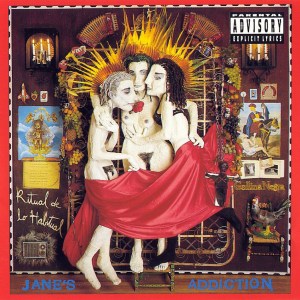
Side 2 is a different kettle of fish. It opens with the 12-minute voodoo-metal paean to the ménage-a-trois depicted on the album’s cover (in a papier-mâché sculpture by Perry Farrell) that is “Three Days”, somehow both profound (“Without game / Men prey on each other”), blasphemous (“Erotic Jesus lays with his Marys / Bits of puzzle / Fitting each other”), and ludicrous (Dave Navarro’s extraordinary guitar abuse).

“Then She Did”, an acoustic-Zeppelin-alike with woozy, disconcerting electric violin, documents the heroin-overdose death of a female friend of Farrell’s, and also the suicide of his mother when he was 4, while “Of Course” is a strange European-sounding folk dance with lyrics about man’s inhumanity to man. “Classic Girl” closes the album gently, a lovely tune with words about being cocooned from LA gang violence by being in love, and about what dicks men are.

I expected most if not all of DRC to be familiar with Ritual…; how wrong I was.

Graham listened: I was intrigued to listen to this as it’s a band I always felt I should have found out more about when this was released. Whatever preconceptions I had were wiped out with one listen. I was expecting something much grungier and darker, frankly this plain “rollicking”.

Rob listened: With the notable exception of ‘Been Caught Stealing’, which is a proper unhinged pop fusion classic, the less I hear Jane’s Addiction, the more I like them. Or to put it another way…

I find the idea of this band much more appealing than the actuality. I heard them a fair bit during my student days and once past the schlock shock aesthetic – Alice Cooper did it better and funnier 20 years earlier – the music is just too forced, too predictable. If they made a sound anywhere near as wild as the image they managed to flog then they might have had something but, for me, they’re just another bunch of whiny West Coast rockers. And can there be four more dread words in music than “LA punk-funk-metal”?

Tom Listened: About one third of the way through Ritual de Habitual, Nick suggested (as the rest of us wittered on about something or other) that it hadn’t been getting much of our attention. My immediate reaction was to feel a little guilty – he certainly had a point – but I think the surprising anonymity of the record was also partly to blame.

I had never knowingly heard Jane’s Addiction before having always been put off by their antics and look (and also by how they were described musically, although this was probably a secondary factor) I was expecting something quite industrial and extreme. In my mind I have had them down as precursors to Nine Inch Nails and bed fellows of The Young Gods or Einstürtzende Neubatten. I was shocked by how unshocking this was…which made me then think about the the band’s image and, by the end of the record, (by which time it had got a bit more interesting, admittedly) I was feeling somewhat piqued that their record buying public had been duped into thinking they were getting some sort of edgy, rebellious manifesto where as in actuality, to coin Rob’s phrase, they were investing in some LA punk-funk-metal. Emperor’s New Clothes anyone?

The Beat – ‘I Just Can’t Stop It’: Round 41 – Rob’s choice

the beatTo beat: to discipline. Geddit?

The rupture caused, or at least symbolised, by punk rock not only persuaded a thousand kids that they could be musicians without conservatory educations, but it also cleared space for styles and genres which had not previously troubled the mainstream to break through in their own rights or, in some cases, in thrilling new combinations.

The Beat formed in Birmingham in 1978 and, in the words of their angle-cheeked frontman Dave Wakeling, combined reggae drums, pop guitar and punk bass, all finished off by the warm vocal interplay between toaster Ranking Roger and Wakeling himself. They weren’t alone in blending such apparently disparate influences and although The Specials seemed to retain the hipster vote (baffingly to my ears) and Madness went on to become bona fide pop alchemists, The Beat were at least equal to both over their brief five-year, three-album career.

‘I Just Can’t Stop It’ is their 1980 debut, featuring the restless, spiky pulse of ‘Mirror in the Bathroom’, the irresistible rushing reggae of ‘Hands Off… She’s Mine’ and ‘Best Friend’, which takes their saxophone strut and strays deliciously into what I guess would later be called indie pop territory, to be populated by Orange Juice (contemporaries of The Beat) and Lloyd Cole and the Commotions.

‘Best Friend’ was my favourite song for about six months in the late 90s when ‘BPM: The Best of the Beat’ was released. I’m increasingly drawn back to the music that I absorbed via the radio as a child. I assumed it would always be there, and most of it is still lodged somewhere in my head. When I started to buy my own records I looked forward relentlessly, leaving the likes of The Beat along with XTC, The Associates, Elvis Costello, The Jam, Joe Jackson, The Police, Ian Dury and the Blockheads almost completely unexplored, beyond the Top 40 singles which remain firmly embedded. It’s only recently that i’ve begun to go back and collect albums by some of these artists and, in some cases, it has felt like unearthing beautiful hidden treasure.

The Beat went on to tour the US with REM as support. I recall hearing Michael Stipe bracket them with Gang of Four and Wire as influences on his early records and, listening to ‘I Just Can’t Stop It’, it’s possible to hear murmurs of the chiming, restless guitar sound which would come from Athens, Georgia over the next few years. When the Beat stopped, Wakeling and Ranking Roger became General Public, whilst Dave Steele and Andy Cox formed Fine Young Cannibals. The Beat have reformed in various competing combinations over the last decade or so, both here and in the US where they were known as The English Beat and where they have, even more confusingly, gone on to share a bill with the US outfit who had the name The Beat before them.

Regardless of what they’re up to now, those first few records were as sharp as pop gets, and they deserve to be held in the highest company.

Tom Listened: This was splendid! As Rob says, it’s a little bewildering that nowadays The Specials should be just so lauded and The Beat never get a mention. Listening back to The Specials, I have to concede that whilst they have a few killer tunes (and Ghost Town is one of those perfect songs that don’t some along all that often) their song-writing just doesn’t seem as consistently high quality as The Beat on I Just Can’t Stop It. Reminiscent of all sorts (it’s so long ago that I can’t remember many specifics although I was reminded of Costello’s Get Happy on quite a few occasions as the record played) yet very much with its own sound, this was a real treat. Cheers Rob, made up for your last offering! 

Nick listened: Tenuous linkage at best, Mitchell. This was great though, so I’ll let you off. I’ve never knowingly heard The Beat before, though I’ve heard of them plenty, and while I think The Specials are unnecessarily derided here (the debut is great!), I can see why you’d prefer The Beat.

Graham listened: What a treat! Rob managed to remind me of a band which, at the time, I always thought deserved far more credit for their work. Just as sharp and spiky as I remembered.

Depeche Mode – Songs of Faith and Devotion – Round 41 – Graham’s Choice

depeche_mode_-_1993_songs_of_faith_and_devotionReflecting local weather and transport issues, the last 2 rounds of “da Club”
have been subject to some early finishes and late arrivals. I missed most of Round 40, however in the brief period I was there, views were being aired whether themes were being well observed. Despite not being there long enough to play it, for once I had actually been compliant myself. Seeking more “discipline” amongst the members, an awkward theme for round 41 was born.

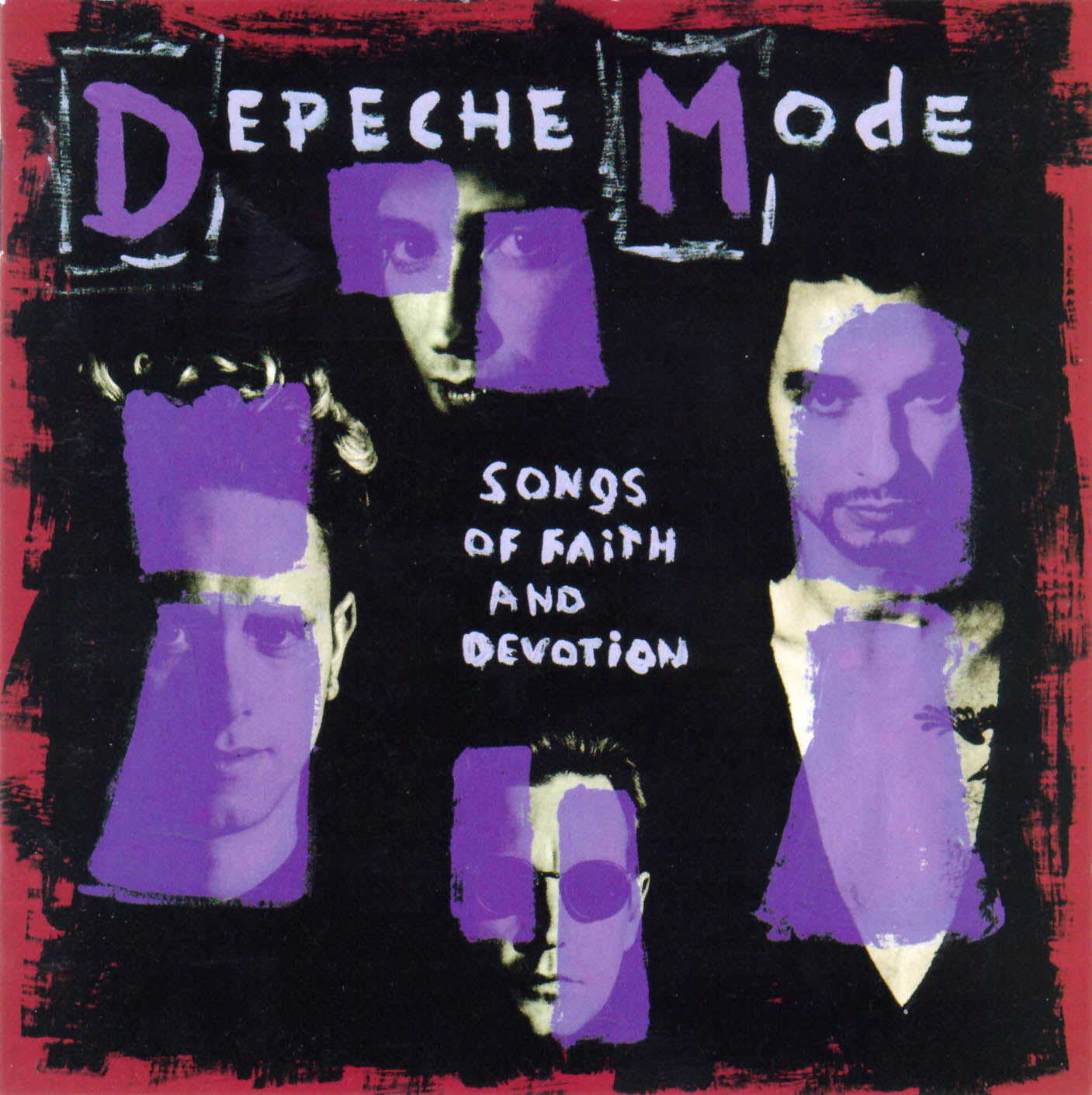
I consciously avoided and found myself irritated by Depeche Mode for the first 10 years of their career. But when Violator came out in 1991, I was intrigued by the singles and the positive reviews. This was my original thought for the round (as the title does sound like something you might select from a specialist magazine for those interested in the darker side of discipline). However, I plumped for their next album instead. Clearly (ahem…), the observance of discipline takes a good deal of faith and devotion.

Looking back it seemed to slip a lot of people’s attention that the “Mode” had already broken America with this album going to no1 in US, a year or two before the “brit pop” pretenders tried the same. A lot of better informed people than me put this albums sound down to the emergence of grunge, but I don’t really see it myself. There are some “gutty guitar” moments (for reference see http://www.youtube.com/watch?v=BgAKNy23RSA) and a few bits of distortion, but for me it’s more about dark, pounding beats.

It’s a brave move on some of the tracks for Dave Gahan to take his vocals to such prominence. But even on the gospel orientated ‘Condemnation’, he just about gets away with it. It takes a moment to remind yourself you are still listening to the same band that were on “Swap Shop” in 1981 with (http://www.youtube.com/watch?v=JyG4NtpdO-Q).

‘In your room’ has always been the stand out track for me, with a feeling that it just sums up the claustrophobic sound they were trying to achieve. To lighten proceedings, the gospel theme returns on ‘Get right with me’ and just before the end the there is the softer ‘One Caress’, with nothing but vocals and strings.

Electro/techno or whatever doesn’t feature highly in my listening, but these two albums have always filled a niche. I’ve never felt the need to go looking for the 4 albums that followed, always concerned that they wouldn’t stand up against this one.

Rob listened: I’ve never felt a great deal for Depeche Mode. Their fans always seemed a little too earnest, their music a little too pedestrian, never really transcending. Even within these extremely narrow boundaries, i’m at the opposite end of the Depeche spectrum from Graham. Their singles compilations are divided between 81-85 and 86-98 and, looking down the track listings, there’s nothing on the second album I feel like I have time to hear again, whereas there is something a little delicious about the moment the drum machine kicks into ‘New Life’ and ‘Just Can’t Get Enough’ is good enough for any 80s revival night. As for ‘Songs of Faith and Devotion’, well, I came in half way through and didn’t really manage to get a grip of it. I picked up the darkness, but it sounded like a band trying to be dark. I know Dave Gahan has been through difficult times and perhaps the rest of the band have too, but I didn’t get anything from this listen that really captured how that might have been. I guess i’m just not a believer.

Tom Listened: I would echo pretty much everything that Rob has written only to add that I quite liked it! But, as he has hinted, I couldn’t lose the feeling that there was something intangibly soulless about this record. No idea what it was that caused me to feel this way but, if I’m honest, this is how I’ve always felt about Depeche Mode and this feeling is probably too ingrained to be overturned, even through the strange and magical alchemy that is DRC. So, whilst I found it enjoyable to listen to, it didn’t leave a lasting impression on me – I guess me and the Mode will continue to be occasional acquaintances rather than soul mates!

Nick listened: I’m broadly with Rob here, even though I own Violator, and like it well enough – there’s just something a little too try-hard synth-goth about early 90s Depeche Mode. I didn’t mind it, but I pretty much never play Violator, and felt no need to get to know this any better.

John Maus – We Must Become The Pitiless Censors Of Ourselves: Round 41 – Tom’s Selection

WeMustBecomeThePitilessWhen it comes to (self) discipline (Graham’s well thought through and carefully considered theme for Round 41) I can’t think of a better album title than ‘We Must Become the Pitiless Censors of Ourselves’ which happens to be the name of John Maus’ album from 2011. This title seems particularly prescient at the moment seeing as the British press is currently under such intense scrutiny following the publication of the Leveson report. If only Rebekah Brooks, Andy Caulson, Paul McMullen and the like had listened to John Maus, the media in this country might not be in the perilous state it is currently in.

To be honest, the main reason I took this album to record club is the title – We Must Become…is an album I bought on the basis of scouring the end of year polls and internet chatter at the end of last year and, whilst I have always liked it well enough, it’s been pressed to play at 45rpm which is such a faff on my turntable (as I have to lift the platter and fiddle with a rubber band to change the speed) that I have never really got to know it properly. At this point I must take this opportunity to implore Record Companies to put the playing speed on their albums as this was the second time I have listened to an album for a considerable length of time (the other occasion was Yellow House by Grizzly Bear) before realising that I was playing it at the wrong speed…I had read that the vocals were quite ‘doomy’ and odd on We Must Become…so my eyebrows were a little raised when I first played it, but I soon came round to the idea and actually quite enjoyed the record in its ‘extra-baritone’ state until I realised the error of my ways. But there are probably millions, if not billions, of folks out there listening to their John Maus and Grizzly Bear albums at the wrong speed and none the wiser…which is really a great shame as they are actually a little better (if less unusual) when played at the intended pitch.

The album itself is an odd one, but one that I have grown increasingly fond of over time. For me there are two pinnacles that, a little bit like towering transmitter masts, radiate their quality over the rest of the album, gradually working their influence into acclimatising the listener to some of the less accessible tracks that surround them. Believer and Hey Moon are two of my favourite songs of the past few years and I am mesmerised by their grandeur and the lightness of touch that Maus demonstrates in creating such a perilously wonderful soundscape. In the wrong hands Believer could be an 80s Xmas single by some horrible synth band – it’s all there, the washes of ever-so slightly cheesy synthesisers, the tinny metronomic drums, the lumpy bass. But Maus skilfully navigates the line, treading ever so close to it at times but (just about) always staying on the timeless, vaguely Eno-esque side of it as opposed to crossing over into Flock of Seagulls territory. Someone on Youtube has commented: ‘Damn, Phil Collins got much better’; about as slight as a compliment can get, but I know what he means. Hey Moon is, for me, even better – a beautiful ballad that was originally recorded by one Molly Nilsson (Swedish so presumably nothing to do with Nilsson of Without You fame). It’s a stunning track that emanates its quality over the rest of the album so effectively that before many listens even the most awkward of songs (I’m looking at you Matter of Fact) start to sound like works of near-genius.

Many internet folk rated this one of the very best albums of last year and whilst it has become cool to lambast the end of year list in some quarters I probably wouldn’t have discovered this overlooked gem without them. And looking back at the records I have now heard from 2011, I have to say that, in my opinion, We Must Become the Pitiless Censors of Ourselves is right up there with the best of them!

Rob listened: This is a mercurial record. I listened to it a few times after it placed so strongly in so many end of year lists and found it too elusive to get a grip of. I’m sure that my tinny laptop speakers didn’t help because this evening it sounded like a totally different proposition. I’m not quite sure why that might be. Maus’s aesthetic seems to involve writing reasonably straight electronic pop songs and then processing the hell out of them to drag every note, every drumbeat, every synth wash back to some muddy mid-80’s netherworld, topping the whole with his voice, a sort of stunned Mark Burgess doom-boom. Listening back again now i’m caught between the two. I don’t know why he does it, but i’m glad he does. I’m not sure whether it’s okay to like a song like ‘Keep Pushing On’ which is essentially ‘Electric Dreams’ played down a quarter-mile sewer pipe, but I do. I can see how insidiously this could grow on you, and I reckon i’ll give it a change to take root.

Nick listened: Like Rob I noticed this place well in lists 12 months ago, but unlike him I didn’t feel at all compelled to investigate. Listening to it hasn’t changed this ambivalence – it wasn’t bad in any way, but I struggled to get a sense of the songs beneath the aesthetic, and, because the aesthetic didn’t really do it for me, there was little else for me to walk away with.

Graham Listened: If Tom could see my hands, he would instantly recognise them as the “wrong”. Put this album in them and it is unlikely to come out well. Maybe my elderly years means I’m can recall some of the worst of new romantic/synth pop better than others. Anyway my prejudice got firmly in the way and I didn’t really get past the “this sounds like….”, and trying to figure out why you would want to recreate such a sound.

Metronomy – The English Riviera: Round 40 – Tom’s Selection

As someone who grew up a few miles away from PJ Harvey (in fact my old schoolmate Max Griffiths was in a band with her but chucked her out on account of her ‘not being good enough’ – Max, where are you now?) and, until last year, never having owned one of her records, I think it is safe to say that I find it hard to appreciate music that has been made on my doorstep. I suppose I have always felt that something made nearby is only known to me because it’s local, rather than good, and therefore I have tended to be suspicious of its worth. However, The English Riviera has bucked this trend and, seeing as it is a concept album about Torbay, its charming reverence towards my local area is now working to its advantage. I am incredibly proud of soggy old South Devon and feel privileged to live here…and listening to The English Riviera you get the impression that Joseph Mount (Metronomy in all but name) feels the same way.

I was intending on playing The English Riviera at Record Club at some point anyway – I knew that Nick and Rob both had pretty ‘meh’ (as I believe we say these days) reactions to it when they had given it a casual listen last year but was confident that the DRC treatment would help them appreciate its lush sound and nigh-on perfect pop melodies – so when Nick suggested the ‘Home’ theme it didn’t take much thought for me to decide on my choice. I can not think of any other album I own that has such a defined sense of place and when that place is your doorstep and your doorstep is somewhere you’re very fond of, it’s hard not to fall in love.

The English Riviera is, for me, quite a different sort of album from many of my recent offerings. This is not one of those records where the songs have to co-exist to make sense. Although there is an underlying theme on The English Riviera, these are pop gems that more than hold their own in isolation. The English Riviera is the album I hoped Peter Bjorn and John’s ‘Writer’s Block’ might have been. Having heard Young Folks before I bought it, I was hoping for an album crammed with similarly infectious hooks and sweet melodies. But, to be frank, Young Folks towers over the rest of the album, the other offerings occasionally veering perilously close to atrocious (Poor Cow, Amsterdam, Let’s Call It Off). Metronomy’s latest album, however, keeps the bar impressively high throughout and whilst the singles, The Look, The Bay and Everything Goes My Way (a bit like a cross between Don’t You Want Me and Young Folks with the whistling replaced with cooing) are probably the most immediate songs on the album, I enjoy all the tracks just as much now that I have got to know the album  – in fact I might even venture to say that these days I like the latter half of side two even more than the beginning of side one!

Although I am always a little wary of lauding a record that I haven’t possessed for long, I am pretty confident that long after the newness of The English Riviera has worn off, the warm glow I get from its affectionate take on Devonian seaside life will continue to burn.

Nick listened: I downloaded The English Riviera out of curiosity but hadn’t really given it more than a cursory listen before the other night – I quite liked the singles but hadn’t been struck by anything else, and to be honest I’m not sure I’d actually sat down and played it start to finish. Forced into doing that by DRC, I was pleasantly surprised – there was more subtlety and nuance, and less ‘ego song’, than I’d suspected / expected: often the songs seemed to get the tune out of the way relatively quickly, leaving space for a groove or instrumental, achieving a nice balance of tunes-to-music, much like the last Antlers record. Also like that record, none of the songs here screamed I-AM-A-SONG at the listener; rather the tunes and melodies unfurled themselves slowly, suggesting they’ll reward attention and repeated exposure. Very pleasantly surprised.

Rob listened: I gave ‘The English Riviera’ an extremely cursory listen via Spotify shortly after it had been released. I was at work at the time, didn’t concentrate and didn’t hear anything to make me want to listen again. I suspect I have a slight repulsion for very local music, the opposite to Tom’s attraction to this. It’s a stupid attitude, I know. Regardless, I find music from across the Atlantic endlessly exotic, even when it might be crass and dumb when understood in cultural context. The more you understand the musical idiom, the easier it is for a record to hit a grating note, for an artist to choose a clanging word. Records by English artists have to be near perfect for me to love them. That’s not fair and I’m sure I’m the loser in that equation.

Anyway… DRC exists for us to listen properly to records we haven’t given attention to before. This one, on second listen, was great. It reminded me of Wild Beasts ‘Smother’ (a near perfect English record) in its restraint and economy, which make it all the more delicate and delicious. Packed with understated tunes too. It’s a growing favourite in our house already.

Caspar Brötzmann Massaker – ‘Home’: Round 40 – Rob’s choice

Caspar Brotzmann Massaker - HomeThere’s a thread on I Love Music called ‘I Never Play My Caspar Brötzmann Records! And Yet, I’ll Probably Never Get Rid Of Them‘. In fact, it’s the only Caspar Brötzmann thread on I Love Music. On it are some familiar descriptions of records accrued and never really listened to, of artists pursued who never quite produce what the listener is chasing in hope of finding. It’s a familiar pattern and not, one imagines, confined to Caspar Brötzmann. I’m sure the sentiments expressed are pretty common amongst all those who pursue experimental/ambient/noise acts down the rabbit hole, buying record after record, each time hoping that the next one will see the sound coalescing into that thing they’ve always wanted to hear but which they can’t quite imagine for themselves. I have some sympathy.

I only have one Caspar Brötzmann record and it’s this one. I like it pretty well.

Brötzmann is the son of Peter, a German free jazz saxophonist who is prolific in a way that perhaps only free jazz saxophonists are able to be (“Sie wollen mich wie lange spielen? Kein problem”). I’ve never heard him, but he seems well renowned. I know no better than to take the direct route and surmise that his son Caspar followed his dad’s lead, wielding an electric guitar rather than a saxophone. We could pause to pick the wild assumptions out of that statement but let’s move on instead. Time is short.

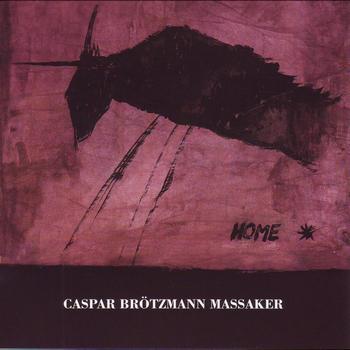
Caspar Brötzmann Massaker are a trio of musicians who, in this guise, recorded 5 albums from 1987-95, of which ‘Home’ is the last. It’s a record ably summed up by its cover, a pseudo cave painting of a bison, also made by Bröztmann. The album’s five tracks come down as if carved from rock by willpower and weaponry. They’re long and harsh and doomy but not self-consciously complex. Most veer around heavy lurching grooves, the three players slipping into and out of gear with each other and giving the whole piece a momentum which sometimes stutters, sometimes roars. Too focussed and direct to be free jams but too wild and brutal to be careful compositions, the best sections begin to create a sort of stunned energy as the three players get stuck into their instruments and each other.

I have no idea where ‘Home’ sits in the Brötzmann family canon, but it’ll do for me. Perhaps I should start my own thread: ‘I Have One Caspar Brötzmann Record and I’m Happy With That Thank You Very Much’.

Tom Listened: For me, this was the musical equivalent of multi-variable calculus – bloody difficult. That’s not to say it was not good to hear it, I now can at least start a thread ‘I have no Caspar Brötzmann Records and I’m Happy With That Thank You Very Much’ and have a vague understanding of what I’m talking about. Besides that 50+ minutes of doom laden monolith rock – I think I just made up a genre (get me!) – certainly acted as a contrast between what came before and after it. And at least Rob stuck to the theme.

I guess by now, Rob can predict what I am going to like and dislike before he plays it to me so he probably won’t be all that surprised by my reaction. Thinking about it, I am probably at my most predictable when the adjective that can used to describe the music is ‘oppressive*’ – I’ll add Home to the records we’ve had by These New Puritans, Sun 0))) and Mark Hollis.

* I freely admit this is my adjective and that my fellow club members will probably be wondering what I’m talking about, thinking that all these bands make music that is in the same sonic ballpark as Katrina and the Waves.

Nick listened: Whereas I thought this fitted almost perfectly with the mood established by Arvo and evolved by Swans – sonically it felt like it inhabited the same universe as the latter, albeit coming from a different direction. There was a certain jazziness, probably genetic, in this, but it was subtle and foundational rather than overt or explicit. Tom’s on the money describing it as ‘oppressive’ though, and I have no qualms with him using that adjective – I just happened to rather like it where he didn’t seem to. The only thing I might say is that once Brötzmann had established his aesthetic there was little deviation from it – I wasn’t surprised or intrigued at any point by directions the music took, not that this is necessarily a problem. Having said that, Brötzmann was on during takeaway time, so I may have missed some nuances. Rob, when you read this, I’d be grateful for a lend of your one Caspar Brötzmann record, and that will probably be enough for me.

Arvo Pärt – Te Deum / Swans – Avatar (from The Seer): Round 40, Nick’s choices

I’d half-heartedly set the theme of “moving house, or home, or furniture, or newness” at the end of our last meeting, as round 40 was to be the first DRC at my new house, but without really thinking about what this might mean. I’ve already played the Fever Ray album, which could be a contender, didn’t want to pick (half of) Aerial by Kate Bush, and couldn’t think of any snappily-house-related-titled bands or albums.

So I ignored the theme, pretty much, and plumped for something I’ve been thinking about playing for a while. I explained it as being a completely new type of music for DRC to listen to at a completely new venue, but no one was biting.

I know next to nothing about classical music, and even less about modern classical music, despite the best efforts of our old neighbour (from before we moved). I recall being recommended, or intrigued by something written about, Te Deum by Estonian composer Arvo Pärt some years ago, and buying a copy as a result. I have, I believe, only listened to it once: classical is not my go-to music, and Pärt’s Te Deum is an intense, involved, enveloping listen; it’s not something you can just throw on the do the dishes to. I’ve been intrigued since we started DRC to see how we respond to something classical and unfamiliar, that we have little or no frame of reference for.

Some context, drawn shameless from the Wikipedia page because I know not what I talk about: Pärt is just one of many composers to set the verses of Te Deum, which dates from AD 387, to music. He composed his version in the 80s, and the recording I have, on the ECM label, is from 1993. It is scored for three choirs (women’s choir, men’s choir, and mixed choir), prepared piano, divisi strings, and wind harp. To my ears, it’s a predominantly choral piece which slowly swells from literally nothing into huge, almost overwhelming rolls of voices, strings, and surreptitious drones. I don’t understand it, but it does move me.

Pärt has said that the original text Te Deum contains “immutable truths,” reminding him of the “immeasurable serenity imparted by a mountain panorama”, and that it seeks to communicate a mood “that could be infinite in time—out of the flow of infinity. I had to draw this music gently out of silence and emptiness.” That pretty much sums it up.

This is a translation of the original verses of Te Deum:

We praise thee, O God :
we acknowledge thee to be the Lord.
All the earth doth worship thee :
the Father everlasting.
To thee all Angels cry aloud :
the Heavens, and all the Powers therein.
To thee Cherubim and Seraphim :
continually do cry,
Holy, Holy, Holy :
Lord God of Sabaoth;
Heaven and earth are full of the Majesty :
of thy glory.
The glorious company of the Apostles : praise thee.
The goodly fellowship of the Prophets : praise thee.
The noble army of Martyrs : praise thee.
The holy Church throughout all the world :
doth acknowledge thee;
The Father : of an infinite Majesty;
Thine honourable, true : and only Son;
Also the Holy Ghost : the Comforter.
Thou art the King of Glory : O Christ.
Thou art the everlasting Son : of the Father.
When thou tookest upon thee to deliver man :
thou didst not abhor the Virgin’s womb.
When thou hadst overcome the sharpness of death :
thou didst open the Kingdom of Heaven to all believers.
Thou sittest at the right hand of God : in the glory of the Father.
We believe that thou shalt come : to be our Judge.
We therefore pray thee, help thy servants :
whom thou hast redeemed with thy precious blood.
Make them to be numbered with thy Saints : in glory everlasting.

As a counterpart, and because Te Deum lasts for only 29 minutes, I played Avatar by Swans from their current album The Seer, which has a similarly intense, devout atmosphere, but creates this ethos in a very different way, with strikingly different tools, and heading in a very different direction.

Tom Listened: Although Nick is spot on when he said in his response to Rob’s offering from this meeting (Home by Casper Brötzmann Massaker) that Te Deum complemented it well, for some reason it did not elicit the same reaction from me despite sharing many atmospheric (if not sonic) similarities. I was already vaguely familiar with the work of Arvo Part as my parents own a few of his CDs and I have always found them pleasantly interesting whilst also being somewhat perplexed by them.  There are, for me, many paradoxes contained in his music…it’s modern yet sounds like it’s hundreds of years old, it drifts by without making much of a fuss yet it demands attention, it’s not unsettling yet it isn’t without its unsettling moments, it’s VERY quiet and then VERY loud…music for cars it most definitely is not! Unsurprisingly, I’m not really sure what I thought of it but I certainly wouldn’t be against another listen.

Rob listened: We have an Arvo Pärt record which i’m reasonably familiar with. My Mother-in-Law bought it for us. It’s the only record we both like, as far as I know, although I do recall her commenting favourably on hearing portions of Low’s ‘A Lifetime of Temporary Relief’. Our album is called, pretty definitively, ‘The Best of Arvo Pärt’ and this piece is not on it, therefore it must be one of his shitter numbers. I really enjoyed it though. What a glib sentence to write about music written with the single intention of stirring the soul and offering humble praise to a divine being. I did enjoy it though, really.

Swans have been one of my favourite bands since I reviewed ‘The Great Annihilator’ in 1995 and ‘The Seer’ does genuinely seem to be, as Michael Gira has claimed, “the culmination of every previous Swans album as well as any other music I’ve ever made, been involved in or imagined.” Coincidentally, as we met for DRC on a Wednesday evening, my ears were still ringing, not yet fully recovered from seeing this very band play in Manchester four days earlier in a pulverising, devastating, transcendental performance which, as it happened, achieved for me the pure holy intensity that Mrs Pärt’s lad was aiming for with ‘Te Deum’.