Sunset Rubdown – ‘Random Spirit Lover’: Round 47 – Rob’s choice

Sunset Rubdown - Random Spirit Lover“It’s a bit ‘Wizard Rock’ isn’t it?”

I trust my Cousin-in-law Sarah’s taste in music, but I have trouble predicting it. I guess I also assume that as a bona-fide Canuck, and Vancouver’s most adeptly sarcastic nurse, she’ll be so excited by the very notion of me liking Canadian bands that she’ll immediately like any that I recommend to her. Stupid of me.

So, she went to see Sunset Rubdown, one of my very favourite bands of the last few years, and current holders of my ‘Best Band Name Ever’ award, and thought they were “a bit ‘Wizard Rock'”. It’s a difficult charge to refute. Spencer Krug, the songwriter, singer, keyboard player and essentially main man of the band, plus about half a dozen other outfits, just writes songs that way.

Across Sunset Rubdown’s three widely released albums he weaves abstract tales stuffed full of kings and queens, horses and horsemen, dragons and snakes, leopards and birds. And synchronised swimmers. On ‘Random Spirit Lover’, the middle of the three, these tales spin out across his most ornate, self-consciously complex compositions, drawing in clear classical influences and constructing songs with interlocking themes, movements and sub-plots. Once you’re familiarised they are bright, delightful, compelling and quite unlike the work of any other songwriter i’ve come across.

Paul Klee described drawing as “taking a line for a walk” and Krug seems to be the Klee of keyboard klatter. Take the opener here, ‘The Mending of the Gown’. It veers all over the place, but always with disarming gusto. The first couple of times you listen it’s almost impossible to get a grip of. By the fourth of fifth time you’ve heard the song arrive at “This one’s for Maggie/This one’s for Sam/… I have lusted after you/the way bloodsuckers do!” you realise that the enchanted journey simply couldn’t have ended anywhere else. From then on following the route each time becomes pure pleasure.

There’s a leap of faith to be taken here. The “Wizard Rock” brickbat is sharp and accurately tossed, and pretty funny too. But there is such pleasure in Sunset Rubdown that clinging to ones sense of propriety is simply self-defeating. ‘Up On Your Leopard, Upon the End of Your Feral Days’ is absolutely one of my favourite songs of the last decade. It’s ludicrous in almost every respect, from the deranged madrigal opening through the hilarious cod-accusatory lyrics (“You’re the one who’s riding around on a leopard!/You’re the one who’s throwing dead birds in the air!”) but above below and right through the middle of all this, all these signals that tell the discerning music lover that this is NOT RIGHT AT ALL, the song is immense fun and that’s a quality that much indie rock seems to have incredible problems with.

I’m choosing this record partly because the word ‘Prog’ has been used in anger a few times over recent meetings. I sense we all have slightly different takes on it. I was brought up to loathe its pomposity, its empty grandeur and its po-faced self-satisfaction with its own perceived complexity. I don’t consider Sunset Rubdown to be ‘Prog’, but I’m hopeful that in considering the question we’ll be able to figure our way around the territory a little more.

Oh, I forgot to mention that ‘Random Spirit Lover’, unlike ‘Shut Up I Am Dreaming’ before it and ‘Dragonslayer’ after, sounds for large parts like it was probably recorded on a bunch of plastic musical instruments intended for use by children. For years I thought it was an album with no bass guitar on it. It’s tinny, tumbling, unhinged and liberating.

So, Sarah, yes it’s a bit ‘Wizard Rock’, but that’s absolutely fine by me. At least in this particular case.

Nick listened: Rob announced as he introduced this that he thought I’d hate it, and that it was long. Thanks, Rob. (Good job Graham was absent, as we each brought 50+ minute records this week, as if to compensate.)

Rob was pretty on the money too, sadly. This fell squarely into the school of mid-00s American indie that I don’t get; what I’d describe (borrowing from Dan Bejar a little) as post Neutral Milk Hotel and Soft Bulletin “West coast maximalism”, where everything gets thrown into the mix (“let’s have an accordion! And a banjo! And a harp! And a dog barking! And a cello! And a trumpet! And a celesete! And a Jews harp! And a massive acoustic guitar! And huge distorted drums! And let’s mix it so you can’t tell any of them from any other of them!”) and everything gets turned up. So it didn’t sound so much like plastic toy instruments as mushed-up instruments, and as a consequence I have no idea what the hell was being sung about (wizards or not) or how the songs went. And frankly, for me, life is too short to revisit Sunset Rubdown and get to know what it is that Rob gets out of it. But he probably suspected I’d say that!

Tom Listened: Well, as far as Random Spirit Lover is concerned I fall somewhere in between Nick and Rob’s two stools…I don’t fawn over it and I find much of it unwieldy to the point of distraction but I do enjoy much of it and have no problem with ‘the cramming of the instruments’ or ‘the tinniness of the sound’ and for some bizarre reason, (I think it’s Spencer Krug’s obvious playfulness) I find the lyrical content amusing rather than annoying. It’s a ridiculously over-reaching, overambitious record that, somehow, just about gets away with it and, interestingly, is a more intriguing and, I would attest, successful work than its more restrained and (moderately) more conventional successor Dragonslayer.

Joy Division – ‘Closer’: Round 46 – Rob’s choice

Joy Division - CloserI’m not sure how to write about ‘Closer’. I wasn’t sure how to speak about it when called upon to introduce it to the assembled DRC members. I fell back largely to shaking my head and squawking, “It’s perfect. It’s perfect.” Over and over.

That part at least i’m sure about. I bought ‘Closer’ in 1987, and I can’t think of a better record I’ve bought since. Years pass when I don’t listen to it, but it retains its power, its grace, its majesty, sealed up in marble as if preserved, embalmed.

I must have listened to it 20 times in the last two weeks, and it just grows and grows in stature. Age will not weather it.

Perhaps the one thing everyone knows about Joy Division’s second album is that it was a swan song. It was recorded in March 1980. Ian Curtis committed suicide on 18 May that year and the album, already complete and being readied for release, including the cover with its image of the tomb of the Appiani family in Genoa, came out exactly two months later on 18 July.

Every piece written since about the album is duty-bound to point out that it is impossible to disentangle the content of the record from the context of what happened to Curtis following its completion. Why would we want to?

‘Closer’ is populated by young men, outcasts, walking away from humanity and towards eternity, to a doomed and inevitable netherworld. It may not be quite “a cry for help, a hint of anaesthesia”. From his lyrics, Curtis sounds beyond that, beyond saving. Hindsight is a wonderful thing, but it seems incredible that no-one heard these songs and foresaw what would follow, all of which makes the testimony of those who survived him, who genuinely saw him as one of the lads and had no idea what was happening, all the more heartfelt and affecting.

But Curtis’s tragically early death did not make ‘Closer’ one tiny bit better. The only thing that happened once the recording had finished on 30 March 1980 that made ‘Closer’ any more remarkable was whatever producer Martin Hannett did to take the tracks laid down, under his legendarily strict supervision, by these four young men and turn them into crystallised flashes of icy lightening. Not only are these 9 songs perfect, in their austere, compulsive beauty, but they also sound perfect. The balance between and space around the nagging, abrasive guitars, Peter Hook’s most restrained and haunting bass work, and Curtis’s vocals, at once friable and authoritative, is enough to bring tears to the eyes.

And then there are the drums. Hannett was obsessed with drums, and in Stephen Morris he found a drummer with the instinctive virtuosity to allow him to realise his visions. He famously made Morris reassemble his kit and mike it up on the flat roof of the studio, before recording the playback via a single speaker on top of the studio toilet during the ‘Unknown Pleasures’ sessions. For ‘Closer’ he went even further, recording every drum sound separately, Morris playing the other parts of each track by striking his knees, so that each sound could be treated individually.  He may have been deranged, a megalomaniac, but by god, drums have never sounded better. If the openings of ‘Passover’ and ‘Heart and Soul’ could be captured alive in jars and exhibited like fireflies, they’d burn forever. So crisp, so light, so ephemeral, so perfect.

Nothing on ‘Closer’ is not perfect. It anticipates so much of the music which has followed it, none of which can approach it. It has none of the noise and bluster, none of the rock or the roll, but all of the stillness, pulsing life and timeless genius. It’s the essential distillation of what these five men, Curtis, Sumner, Hook, Morris and Hannett, had in them to give. It’s a monumental album in the true sense of the word.

Nick listened: It hadn’t struck me until the evening when Rob played this that its title can be read two ways: “nearer to” and “to close”. Given what happened afterwards, and the lyrics and mood of this record, I’m almost inclined to think that Ian Curtis had the latter interpretation in mind. But that can only ever be speculation. No one really knows.

I’ve owned Closer for many years, but I’m not sure I’ve ever actually listened to it all the way through. I was a year and three days old when he died, so to me he has always been dead, and this album has always been a totem of… darkness. Isolation. I think I’ve deliberately never investigated Joy Division’s music properly (or even New Order’s) lest it prove to be too much, to be haunted. Even at record club, amidst friends and curry, it’s a you listen, harrowing in sound and sense.

Rob butted in: Nick, Curtis was one of four, and the others still say “nearer to”. Perhaps the ambiguity was deliberate, but the pronunciation has only ever been one way. http://www.youtube.com/watch?v=969bX03pFg4

Tom Listened: As I have hinted in my write up of Spiderland, Closer is one of those albums that I acquired with a huge weight of expectation already on its shoulders…possibly too heavy even for Joy Division.

I had always been put off Joy Division because I never really got Love Will Tear Us Apart – it was just too gloomy for my 13 year old self to appreciate. In fact, it remains one of the few Joy Division songs I have never really clicked with (there are some on Unknown Pleasures too). But I chanced my hard earned cash on Closer anyway, mainly due to the overwhelming number of name checks in the music press at the time. And once I had got over my initial disappointment and actually listened to the album on its own terms, I began to see what all the fuss was about. For me Closer is a more accomplished piece of work than its predecessor, it works better as a whole and there are no weak links at all. And it feels so confident and timeless whereas Unknown Pleasures is much more identifiable as a post-punk album. So it’s odd that, despite all the boxes ticked and the awe with which I view the record, I hardly ever feel the urge to play it. Is that strange or unsurprising?

Graham listened: Being 14 year old on its release, this record passed me by at first. In fact it was probably a further 4 years until someone persuaded me I really should listen to this band. I wasn’t overwhelmed at first but as soon as I gave it time I was in. Devoured the back catalogue quickly and continued to buy the collections on cd. Simply awesome, but strangely something I wouldn’t think to play that often myself. I suppose that could be a degree of reverance that this album desrves.

The Books – ‘Thought For Food’: Round 45 – Rob’s choice

The Books - Thought For FoodGuitarist Nick Zammuto and cellist Paul de Jong met in New York in 1999 where they shared an apartment building and, after realising they shared a musical aesthetic, formed The Books. ‘Thought For Food’, released in 2002, is the first of their four albums.

So far, so straightforward. From here on in it gets a little more difficult. There’s no simple label to cover what they do on ‘Thought For Food’. I’m not even going to list the labels which come closest in an attempt to substantiate this point. I’m not sure where I’d start, but i’m sure even telling you what this record is not would somehow be misleading.

Telling you that the record blends acoustic and electric guitars, delicate strings, occasional vocals and percussion and then spreads this backdrop with a dark and glittering collection of vocal samples might put you in mind of The Avalanches, or any number of quirky one hit wonders. If so, we’re nowhere near.

For a start, those guitars, those strings. Although exquisitely played, with every note perfectly enunciated, the instruments here, even when acoustic, are often played percussively. They are spiked, pulsating, aggravated. This is fretwork as a means of attack. There are a number of tracks wherein Zammuto plays what may well be a perfectly lilting melody, using pretty complex guitar lines, but refuses to let any notes overlap, refuses to allow harmonics and chords to form. The result is tense, troubling, and difficult in ways which are hard to specify.

These urgent, disorienting pieces are shot through with samples of speech from TV, radio and films which serve only to make the experience stranger. Snatches of golf commentary, uncomfortably robotic flirting, the deadened tone of a schoolboy repeating the word ‘aleatoric’ before attempting it in a spelling bee. Winston Churchill puts in an appearance.

Given its meaning (“dependant on chance, luck or uncertain outcome”) and its prominence in the album’s second track, one might expect there to be something aleatoric about The Books’ approach. However, despite the unusual results, there seems to me to be nothing left to chance at all in ‘Thought For Food’. It’s incredibly carefully assembled, with nary a note or string out of place amid all the apparently chaotic complexity.

I wanted to bring it this week as it offers a complete contrast to the Mount Eerie record I offered at the last meeting. ‘Thought For Food’ is about as far from the natural world as acoustic music can get. It’s a paean to all things human. This is a man-made record and it seeks to portray the simultaneously bewildering, alientating and meaningless complexity of the world we have built. It comes across like the soundtrack to its own ‘world in a day’ documentary film. What is not clear, however, is whether it’s a hymn of celebration, or of warning.

All of which perhaps sounds a little dour, a little worthy, which it shouldn’t. The record is richly rewarding, brimming with brio, enchantingly constructed and played and, in its own dark way, great fun. Its certainly one of the most singular and impressive albums of the last decade and one you should want to spend a lot of time with.

Nick listened: For some reason I missed The Books in the same way as Rob missed Boredoms; around the time of this record I was listening to a lot of superficially similar music – Four Tet, Manitoba / Caribou, múm, Clue To Kalo, Cornelius, Koushik – which fell under the ‘folktronica’ banner and which mined the area between acoustic instruments and electronic manipulation. I wrote about a lot of it, was invited to contribute to a magazine in the states that specialised in stuff of this ilk, received promos by the armload of stuff like it, but somehow managed never to divert any attention towards The Books. I suspect, prosaically, predictably, stupidly, because they were called The Books, and I therefore filed them next to The Shins and all those other wimpy definite-article indie bands that were doing the rounds back then in my mental taxonomy. My loss, because this was really interesting, and I’d like to hear it (and The Lemon Of Pink) again.

Tom Listened: I have tried and tried (I was going to add a third ‘tried’ but I haven’t tried THAT hard) to get into Thought for Food for many years now but never have. So I was really keen to hear it at record club and was sure that a close listen and Rob’s eloquence and insightfulness would unlock the album for me at long last. But…a bit like Tony Curtis’ character in Some Like It Hot when Marilyn is kissing him to convince him he isn’t impotent, ‘No…nothing’. I appreciate The Books are doing something very original and probably unique in producing the sound they do, and I can also see that there is great skill and vision there too but, to be honest I will probably end up playing their less well regarded third album, Lost and Safe, a whole lot more because it has those things that Thought For Food does not; you know, songs and melodies and singing and (a little) momentum and the like. And yet, despite all this, there is still a tiny little bit of me that thinks, ‘don’t give up just yet, one more try and it will all fall into place’. What to do?

Graham Listened: First time listen to this band for me and immediate thoughts were confused. Slowly began to appreciate what was going on here and then managed to latch on. Complicated structure which needs to be allowed to wash over you rather than examined too much. Eventually found the minimal melodies truly absorbing, and all that in one listen!

Mount Eerie – ‘Clear Moon’: Round 44 – Rob’s choice

mount eerie - clear moonTowards the end of ‘Through The Trees pt. 2’, the opening track of ‘Clear Moon’, Phil Elverum sings, “I’ve held aloft some delusions/From now on, I will be perfectly clear”.  That, like so much else on this record, is just what I needed to hear.

I’ve spent a reasonable amount of time listening to Elverum sing and play music, both as Mount Eerie and under his revered former moniker of The Microphones. I’ve always found his records nagging, beguiling, frustrating and slippery. They are artful and obtuse enough to keep me coming back, but never so attainable as to win me over. ‘Clear Moon’ is different. It’s a beautiful record, but it’s a beautiful record with intent.

Elverum recorded two albums, ‘Clear Moon’ and ‘Ocean Roar’, over a 15 month period in his home of Anacortes, Washington. This record is his meditation on the landscape, images of which suffuse the lyrics and echoes of which scratch against windows and roar under feet throughout, and Elverum’s place within it. He meditates on life, death, impermanence, meaning and chaos all of which he sees embodied in his evolving relationship with his environment. It seems clear, listening from a distance, that through this meditation Elverum has reached some hard won and sometimes equally hard to bear conclusions and accommodations. One leaves ‘Clear Moon’ imagining that he has begun to find some answers and to understand his place in the world.

I’m in danger of gushing about this album, something which i’m keen to resist for all sorts of different reasons. It does however seem important to say that not since I was a mopey teenager can I recall a record connecting so directly and intensely with how I was feeling about life.

Sonically, ‘Clear Moon’ is breathtaking, finding ways to express feelings about the vastness of the landscape, shifting from strummed acoustic guitar to synthesised drones, pulsing krautrock and pastoral black metal fogs. Elverum’s voice, fragile yet permanent, glows like a distant lighthouse.

It seems telling that ‘Clear Moon’ has also inspired some of the most careful, devotional and insightful reviews I’ve read in recent years. I would draw your attention particularly to Jayson Greene for Pitchfork and Ed Comentale’s piece for Tiny Mix Tapes, where this prosaic yet perfect sentence sums up the problem of distilling the record into words:

“As a reviewer, you’re not wrestling with the question of whether or not the music is any good. Rather, you’re confronted with the problem of writing about music that seems to demand nothing less than silence. Speaking about the music of Mount Eerie feels like dumping your trash in the woods.”

I’ll leave it there.

Tom Listened: I was surprised by Clear Moon, as I often am by records that Rob plays us by artists that I have long given up on but that he has stuck loyally by. And I mean surprised in a good way. Clear Moon was an excellent listen and did conjure up images of wild Northwestern USA (or did Rob put them there in his introduction?). The way the sound was so big, yet Elverum’s vocals are so pathetic and weak and distant definitely amplified the feeling of an individual lost in nature’s vastness, overwhelmed by its magnitude.

I find it interesting tracking Rob’s path to this album and comparing it with my own. For both of us, our first experience of Elverum’s work was with The Microphones’ “classic”, The Glow Pt 2.  I think we both liked it but not unreservedly and I, for one, have never really ‘got it’. I haven’t bought any more Elverum albums (either Mt Eerie or Microphones) working on the assumption that if I don’t really like his ‘best’ work, surely anything else would be a case of diminishing returns. Rob, a far more astute individual than myself as it happens, did what he so often does and stuck with Elverum, obviously working on a hunch that there was enough potential in The Glow.. to suggest that Elverum would go on to produce work that he would fall for…and so it has turned out. I don’t think I’ll ever change my ways; I am far too stingy to risk spending loads of money on albums I don’t really want and I also love discovering new stuff, new artists, but I can see that Rob’s approach is leading him to some very interesting and in some cases (this case?) inspirational work.

Nick listened: I’m having to cast my mind way back for this, as it’s a long time since our last meeting (and, alas, we should have been meeting tonight, but snow has made traversing Devon treacherous). If I remember rightly, I was intrigued and impressed by Clear Moon, which is my first encounter with the work of Phil Elverum. It worked almost like ambient music at times, songs starting, changing, evolving into shapes unlike songs, evoking landscapes rather than emotions or narratives. I’d be very happy to hear this again and see where it takes me.

Graham listened: I really enjoyed this for a first time listen. I didn’t really feel overtaken by any National Geographic imagery, but I was was deeply intrigued by the style of sound/recording/production on this album. Could possibly feature in my 2013 purchases, but as it only January, and I only bought  2 new releases in 2012, its too early to commit!

Frank Ocean – ‘Channel Orange’: Round 43 – Rob’s choice

Channel Orange - Frank OceanFrank Ocean’s debut album proper was the most critically lauded of 2012. It shifted a few copies too reaching number 2 in both the UK and US album charts and, crucially, hitting the top spot in Norway. Not, perhaps, the most obvious choice for DRC but it seemed important to play it for two reasons. Firstly, we had a great ‘End Of Year’ before Christmas meeting where this thing never even came up, other than for my fellow members to confirm that they hadn’t heard it. It seemed unfair or at least remiss for us to let the year close without paying proper attention to its most talked about record. Secondly, I love it. At least as much as any record this year, it has glued itself to the inside of my head and proved unshiftable. If Jo has to hear me woozily declaring “Got on my buttercream/silk shirt and it’s Versace” just once more, I fear for my safety. And yet I can’t help myself, even though i’m actually wearing a green wooly jumper.

So what’s left to say? How about we assume you’ve heard everything and move on. Now i’ll tell you what I think. It’s a great album. Sweet songs, produced and delivered exquisitely, combining an almost brazen restraint, so poised and almost infuriatingly fabulous as to be illegal, with unadorned, unshowy and, largely because of this, beautiful vocal melodies. That’ll do for starters, in fact it’s sufficient to make this a classic album, but there’s more. It’s also a seriously impressive artistic statement.

There has been some discussion and debate, at best unresolvable hairshirted posturing, at worst bullheaded stupidity, about whether Frank Ocean and some contemporaries are ‘hipster/indie R&B’. I have no idea. I don’t know enough about R&B. Which is precisely the sort of fly-by-night attitude that has apparently caused offence to those who think great music is best left unappreciated by as many people as possible. I do know that when I’ve attempted to engage with artists like Usher and R Kelly i’ve quickly grown tired of what seem to me to be their paper thin concerns: having money, having girls, er… that’s it. Lyrically, Frank Ocean takes a rapier to the vacant rich. ‘Channel Orange’ is as keen a dissection of entitlement and the spiritual bankruptcy which it precipitates as i’ve heard. Both ‘Sweet Life’ and ‘Super Rich Kids’ could have been lifted wholesale from late-period JG Ballard if he’d used Hollywood as his milieu rather than the French Riviera.

Like many, I started to really pay attention to Frank Ocean when I read his now famous open letter which dealt with a prior relationship with a man. It goes without saying (which is partly the problem) that it’s a disgrace that this should be such a transgressive act in R&B, hip-hop, music, culture, life. Whatever, the letter is beautifully written and bravely published.  I have no interest in how many women/girls R Kelly has slept with and how cataclysmically happy they were with the whole experience and, no matter how technically astonishing, how texturally breathtaking his music is, i’m really never going to be interested. But Frank Ocean seems like different sort of artist, an enquiring, dissatisfied artist and, to boot, a sensitive, astute and real human being. Those seem like good things to me. This might make me a lily-livered hipster (the former: maybe, the latter: I wish) and indeed, 90% of contemporary R&B might consist of fascinating political and philosophical enquiry set to astonishing machine-tooled beats, in which case i’m missing out.

But that’s okay for now, because ‘Channel Orange’ is pretty damned good.

Tom Listened: For me, this meeting more or less created its own theme – confounding expectations. Both Radiohead and modern day R&B have managed to convince me in the past that I have no interest in them. 90s Radiohead I really tried to like but they were too whiny and maudlin and they seemed to take themselves VERY seriously. R&B was a turn off for all the reasons Rob has stated, plus…I just didn’t like the songs – let’s face it, I Believe I Can Fly is not a million miles away from some of The Lighthouse Family’s worst atrocities (and there are plenty of those to choose from).

Curiously for me, however, many of Rob’s stated misgivings with regard to R&B I find are echoed by much of the Hip-Hop I have heard. Misogyny? Check. Avarice? Check. Hell, you often get a dose of gangland aggression and intimidation thrown in for good measure! That’s why, when we were listening to Niggamortis way back in Round 6, Nick and Rob’s reactions to my own (no doubt poorly articulated) misgivings left me somewhat confused. Maybe I have misunderstood what the bulk of Hip Hop is trying to do. Maybe Rob is prepared to overlook the subject matter because he likes the music. Maybe Nick doesn’t have a problem with the subject matter at all; he is quite ganglandy after all!

One of the points I made in April 2011 (!) was to do with the uniformity of the artwork and packaging of Hip-Hop and how this implies a homogeneity of ethos and values. This is much the same in R&B. I have never understood why a recording artist wouldn’t want to stand outside the crowd, to let their work speak for itself without having to buy into the genre, to be in the club. It is fascinating that Frank Ocean (and Death Grips and (to a lesser extent) Madvilliany) have all been selected by Rob for record club, all are trying to push the boundaries or alter expectations and, tellingly, you would never know by looking at the album covers (or from the names of the artists themselves for that matter) that these works fit into their assigned genres (although all, it seems to me, are not THAT easy to pigeonhole in the first place). Personally, I feel this is a very healthy thing, it suggests to me that the artists are confident enough to exist without the safety net of the club/gang and, in the process, bend the rules and produce something interesting, fresh and ground-breaking. After all, the truly influential records are usually the ones that have only been able to be categorized by the genre they have spawned precisely because there hasn’t been one for them to inhabit when the record was released.

So, I loved Channel Orange, I was thrilled by lack of cliche, the songs sounded great and I am very glad it exists. About bloody time I say. Why did it take so long?

Nick listened: I’ve dipped my toe into contemporary R&B on several occasions, via Kelis, Maxwell, D’Angelo, Aaliya, plus R&B-leaning popstars like Justin Timberlake and hip-hoppers like Missy Elliot. I’ve been particularly obsessed by Timbaland and The Neptunes, ravenously hoovering up individual tracks they’d produced for other people (from Björk to Bubba Sparxxx to Britney Spears).

But I’ve never really fallen for R&B’s charms when it comes to album-length expositions of the genre, which is part of the reason why I’d avoided Channel Orange until the other night when Rob stuck it in the CD player. The “indie R&B” talk wafting around the internet hasn’t helped either; if you’re going to engage with a genre it ought to be on its own terms, not because it’s suddenly perceived as pandering to you as an audience (especially when the “indie” audience is essentially middle-class white boys, who don’t really need pandering to. Do they?). (R&B also needs approximately zero help being ‘experimental’, either – Timbaland routinely churned out the most radical-sounding music I heard at the start of the naughties.)

Channel Orange still suffered from several of the symptoms that have blighted enjoyment of other R&B albums for me – it’s longer than I’d like, doesn’t vary pace much, injects short skits into the running order, etcetera. None of the tunes jumped out at me on first listen like the best Stevie Wonder or Curtis Mayfield songs do, either. (Granted, expecting this is like expecting indie bands to churn out “We Can Work It Out” every other song.)

But it was, as Rob and Tom pointed out, refreshingly sensitive and lacking in braggadocio, without swan-diving into the kind of mystical sex bullshit Maxwell made his own, either. There’s not the thrill of weird spirituality and musicianship that underpins D’Angelo’s Voodoo, but the lyrical and musical palettes on show both reach beyond slow jams and avarice, which, even though I’m obviously as gangland as heck, yo, I do find off-putting.

The raging sceptic in me suspects that some of the acclaim hoisted upon Channel Orange by critics is due to the sudden rush of affirmation experienced when the thing previously fetishised as ‘other’ suddenly makes tokenistic nods towards the aesthetic of your critical comfort zone. But that’s insanely cynical of me. And, you know, the listener in me did enjoy Channel Orange enough, on first listen, to want to hear it again.

Rob responded: Just wanted to add that ‘Channel Orange’ isn’t packed with hooks. Its restraint is one of it’s most delicious features, something I tried but failed to express after too much coffee the day I wrote my piece. It’s definitely a grower and worth sticking with. Secondly, let’s separate what happened to the album when it got into the wild from what it actually contains. I don’t hear any leanings towards ‘indie’ in it at all. It’s a straight urban record. If the hipster crowd decided it was leaning towards their territory (as they clearly did) then that’s about what happened between their ears and their brains and how that got filtered by whichever tumblr they were getting their direction from that week.

Graham listened but is so not able to offer anything further to the debate above: R&B is not my thing at all. Rob caught my attention with his introduction and I’m glad I listened to the whole thing. Without DRC as a conduit I would normally turn over the radio if something like this came on. It sounded like straightforward R&B to me but the back story kept me interested for once. I quite liked the few hooky bits and skits throughout. That’s it really.

Perfume Genius – ‘Put Your Back N 2 It’: Round 42 – Rob’s choice

perfume genius - put your back n 2 itFor me 2012 has been dominated and, to some extent book-ended, by two albums, ‘Mr M’ by Lambchop and ‘The Seer’ by Swans. Both are favourite artists of long-standing who have, after many, many years, produced career-defining records. Both albums manage to distill the essence of what has made their creators so important, to me at least, and still move their music on to yet another level of beauty, brutality, virtuosity and wonder (delete as appropriate). I saw both bands play devastatingly brilliant live shows this year. Kurt Wagner and Lambchop were exquisite, care-worn and heartbreakingly beautiful at the Bristol Fleece. Michael Gira and Swans were jaw-dropping, almost jaw-breaking, in their symphonic violence, a pulverising yet ultimately sublime experience which took days to recover from. I’m hopeless at remembering past gigs, but both these shows felt like they would fit comfortably within my top ten all-time list, if only I could recall the other 8.

I’ve already presented ‘Mr M’ to the Record Club and ‘The Seer’ is pretty much twice as long as the upper limit that DRC can tolerate. Which brings me for my record of the year choice, happily, to the second album by Mike Hadreas, aka Perfume Genius, which has also been on almost constant rotation this year. Superficially, there is little to bind this record to the other two. It’s a short album, just a little over half an hour, populated by 12 concise songs, most of which are simple sketches for piano and voice. However, Kurt Wagner would surely recognise the timeless delicacy of the songs and M. Gira would certainly appreciate the existential bleakness of the lyrics.

Hadreas has an incredible touch when it comes to melody. These are such simple, delicate, still songs but somehow he manages to breath a warm and fragile life into each. They are, in essence, torch songs, as memorable and beautiful as any, but meticulously drained of melodrama and sentimentality to leave brittle bones and reverberating husks. Within these he lays bare his passion, his self-loathing, his wounds and his desolate desires.

If this year has produced a lyric as bleakly poetic as ’17’ then i’ve yet to hear it. Almost laughable set down on the inner sleeve, in the context of the record it is horrifyingly direct and distressing. If this year has produced a song as heart-stopping as the 2 minutes of ‘Hood’, a moment more vertiginous than that when the drums swell in the middle of this track, then I don’t want to hear it for fear I may swoon clean away.

Hadreas is a rare, if tortured, talent. I have no idea where he may go from here, but ‘Put Your Back N 2 It’ is an album which approaches perfection. If Lambchop and Swans built the two major musical monuments of 2012, then Perfume Genius connected the two with a frozen river of votive songs.

Graham listened: I’ve left many a DRC meeting thinking about buying what someone else has brought along and gone on to do so. After listening to this I just knew I had to have  it, and with Christmas coming it went straight on my list. Simply astonishing.

Nick listened: Two for two. Emma and I saw Perfume Genius live (albeit very briefly) at ATP earlier this month, and also saw Owen Pallett follow him onstage and enthuse sincerely about how much Hadreas’ music means to him. On first exposure, in a Pontins discotheque, his piano-lead eulogies to youth, emotion, sensation, and regret didn’t come across that well (partly down to the very drunk girl puking on the carpet in front of us), but on record, Perfume Genius’ intimate talents were much more understandable. ‘Hood’, as Rob suggests, was worth the admission price alone. Suspecting that Emma would love the record’s bleak intimacy and simplicity, I bought her a copy last week in The Drift for Christmas. I’m looking forward to listening to it again myself.

Tom Listened: I was really glad that Rob brought Put Your Back In 2 It’ as his album of the year not least because I gave it to him for his birthday! I bought it with next to no knowledge of the band – I had read a few positive reviews and had a cursory listen in The Drift (how many plugs to they get from us nowadays? Surely it’s time to sort out some sort of commission…) to the first couple of tracks and, on hearing track 2 I came to the conclusion it sounded a bit like Will Oldham and would therefore nestle happily amongst the vinyl in Rob’s collection. It turned out that Rob already knew and liked Perfume Genius, that he had already played a track from the debut album at Record Club and, therefore, that I had shown supreme lack of imagination in making my choice of purchase. It also turns out that track 2 – the (ironically(?)) named Normal Song) is a red herring, being a couple of plucked strings on a guitar rather than the piano led torch songs that populate the rest of the album.

I liked the record – it sounded like a more honest, poignant and (much) less theatrical Anthony and the Johnsons (and I much preferred it to I Am A Bird Now, the one AATJ album I own) – but I wasn’t as blown away by it as I sensed Nick and Graham were…yet again I feel this is a record I would quickly grow to love if I spent some time with it, but I wish Hadreas had placed a more equal balance of guitar and piano on the record as I am a complete sucker for a parched acoustic guitar and a plaintive vocal (see the aforementioned Normal Song).

The Beat – ‘I Just Can’t Stop It’: Round 41 – Rob’s choice

the beatTo beat: to discipline. Geddit?

The rupture caused, or at least symbolised, by punk rock not only persuaded a thousand kids that they could be musicians without conservatory educations, but it also cleared space for styles and genres which had not previously troubled the mainstream to break through in their own rights or, in some cases, in thrilling new combinations.

The Beat formed in Birmingham in 1978 and, in the words of their angle-cheeked frontman Dave Wakeling, combined reggae drums, pop guitar and punk bass, all finished off by the warm vocal interplay between toaster Ranking Roger and Wakeling himself. They weren’t alone in blending such apparently disparate influences and although The Specials seemed to retain the hipster vote (baffingly to my ears) and Madness went on to become bona fide pop alchemists, The Beat were at least equal to both over their brief five-year, three-album career.

‘I Just Can’t Stop It’ is their 1980 debut, featuring the restless, spiky pulse of ‘Mirror in the Bathroom’, the irresistible rushing reggae of ‘Hands Off… She’s Mine’ and ‘Best Friend’, which takes their saxophone strut and strays deliciously into what I guess would later be called indie pop territory, to be populated by Orange Juice (contemporaries of The Beat) and Lloyd Cole and the Commotions.

‘Best Friend’ was my favourite song for about six months in the late 90s when ‘BPM: The Best of the Beat’ was released. I’m increasingly drawn back to the music that I absorbed via the radio as a child. I assumed it would always be there, and most of it is still lodged somewhere in my head. When I started to buy my own records I looked forward relentlessly, leaving the likes of The Beat along with XTC, The Associates, Elvis Costello, The Jam, Joe Jackson, The Police, Ian Dury and the Blockheads almost completely unexplored, beyond the Top 40 singles which remain firmly embedded. It’s only recently that i’ve begun to go back and collect albums by some of these artists and, in some cases, it has felt like unearthing beautiful hidden treasure.

The Beat went on to tour the US with REM as support. I recall hearing Michael Stipe bracket them with Gang of Four and Wire as influences on his early records and, listening to ‘I Just Can’t Stop It’, it’s possible to hear murmurs of the chiming, restless guitar sound which would come from Athens, Georgia over the next few years. When the Beat stopped, Wakeling and Ranking Roger became General Public, whilst Dave Steele and Andy Cox formed Fine Young Cannibals. The Beat have reformed in various competing combinations over the last decade or so, both here and in the US where they were known as The English Beat and where they have, even more confusingly, gone on to share a bill with the US outfit who had the name The Beat before them.

Regardless of what they’re up to now, those first few records were as sharp as pop gets, and they deserve to be held in the highest company.

Tom Listened: This was splendid! As Rob says, it’s a little bewildering that nowadays The Specials should be just so lauded and The Beat never get a mention. Listening back to The Specials, I have to concede that whilst they have a few killer tunes (and Ghost Town is one of those perfect songs that don’t some along all that often) their song-writing just doesn’t seem as consistently high quality as The Beat on I Just Can’t Stop It. Reminiscent of all sorts (it’s so long ago that I can’t remember many specifics although I was reminded of Costello’s Get Happy on quite a few occasions as the record played) yet very much with its own sound, this was a real treat. Cheers Rob, made up for your last offering! 

Nick listened: Tenuous linkage at best, Mitchell. This was great though, so I’ll let you off. I’ve never knowingly heard The Beat before, though I’ve heard of them plenty, and while I think The Specials are unnecessarily derided here (the debut is great!), I can see why you’d prefer The Beat.

Graham listened: What a treat! Rob managed to remind me of a band which, at the time, I always thought deserved far more credit for their work. Just as sharp and spiky as I remembered.

Caspar Brötzmann Massaker – ‘Home’: Round 40 – Rob’s choice

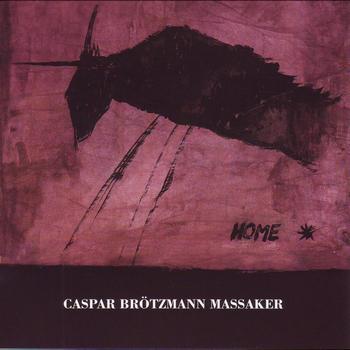
Caspar Brotzmann Massaker - HomeThere’s a thread on I Love Music called ‘I Never Play My Caspar Brötzmann Records! And Yet, I’ll Probably Never Get Rid Of Them‘. In fact, it’s the only Caspar Brötzmann thread on I Love Music. On it are some familiar descriptions of records accrued and never really listened to, of artists pursued who never quite produce what the listener is chasing in hope of finding. It’s a familiar pattern and not, one imagines, confined to Caspar Brötzmann. I’m sure the sentiments expressed are pretty common amongst all those who pursue experimental/ambient/noise acts down the rabbit hole, buying record after record, each time hoping that the next one will see the sound coalescing into that thing they’ve always wanted to hear but which they can’t quite imagine for themselves. I have some sympathy.

I only have one Caspar Brötzmann record and it’s this one. I like it pretty well.

Brötzmann is the son of Peter, a German free jazz saxophonist who is prolific in a way that perhaps only free jazz saxophonists are able to be (“Sie wollen mich wie lange spielen? Kein problem”). I’ve never heard him, but he seems well renowned. I know no better than to take the direct route and surmise that his son Caspar followed his dad’s lead, wielding an electric guitar rather than a saxophone. We could pause to pick the wild assumptions out of that statement but let’s move on instead. Time is short.

Caspar Brötzmann Massaker are a trio of musicians who, in this guise, recorded 5 albums from 1987-95, of which ‘Home’ is the last. It’s a record ably summed up by its cover, a pseudo cave painting of a bison, also made by Bröztmann. The album’s five tracks come down as if carved from rock by willpower and weaponry. They’re long and harsh and doomy but not self-consciously complex. Most veer around heavy lurching grooves, the three players slipping into and out of gear with each other and giving the whole piece a momentum which sometimes stutters, sometimes roars. Too focussed and direct to be free jams but too wild and brutal to be careful compositions, the best sections begin to create a sort of stunned energy as the three players get stuck into their instruments and each other.

I have no idea where ‘Home’ sits in the Brötzmann family canon, but it’ll do for me. Perhaps I should start my own thread: ‘I Have One Caspar Brötzmann Record and I’m Happy With That Thank You Very Much’.

Tom Listened: For me, this was the musical equivalent of multi-variable calculus – bloody difficult. That’s not to say it was not good to hear it, I now can at least start a thread ‘I have no Caspar Brötzmann Records and I’m Happy With That Thank You Very Much’ and have a vague understanding of what I’m talking about. Besides that 50+ minutes of doom laden monolith rock – I think I just made up a genre (get me!) – certainly acted as a contrast between what came before and after it. And at least Rob stuck to the theme.

I guess by now, Rob can predict what I am going to like and dislike before he plays it to me so he probably won’t be all that surprised by my reaction. Thinking about it, I am probably at my most predictable when the adjective that can used to describe the music is ‘oppressive*’ – I’ll add Home to the records we’ve had by These New Puritans, Sun 0))) and Mark Hollis.

* I freely admit this is my adjective and that my fellow club members will probably be wondering what I’m talking about, thinking that all these bands make music that is in the same sonic ballpark as Katrina and the Waves.

Nick listened: Whereas I thought this fitted almost perfectly with the mood established by Arvo and evolved by Swans – sonically it felt like it inhabited the same universe as the latter, albeit coming from a different direction. There was a certain jazziness, probably genetic, in this, but it was subtle and foundational rather than overt or explicit. Tom’s on the money describing it as ‘oppressive’ though, and I have no qualms with him using that adjective – I just happened to rather like it where he didn’t seem to. The only thing I might say is that once Brötzmann had established his aesthetic there was little deviation from it – I wasn’t surprised or intrigued at any point by directions the music took, not that this is necessarily a problem. Having said that, Brötzmann was on during takeaway time, so I may have missed some nuances. Rob, when you read this, I’d be grateful for a lend of your one Caspar Brötzmann record, and that will probably be enough for me.

Madvillain – ‘Madvillainy’: Round 39 – Rob’s choice

Mavilliany by MadvillainGenuinely successful comebacks are pretty rare in music. Whilst Daniel Dumile may not have topped the charts first time around with his pals KMD, their debut on 3rd Bass’s legendary ‘The Gas Face’ counts as significant success in my book. The way the London-born rapper later vanished and reappeared next counts as remarkable.

In 1993 KMD’s second album ‘Black Bastards’ was rejected by Elektra and the outfit were dropped. All this mere days after Dumile’s brother Dingilizwe, aka fellow KMD member DJ Subroc, was hit and killed by a car in New York. Dumile spent the next few years in the wilderness living “damn near homeless” before making tentative steps back via open mic nights, hiding his identity behind rudimentary masks.

By the time he made it to 2004 he was the metal-masked MF DOOM, partnering producer MadLib on ‘Madvillainy’ and gatecrashing the top ten of Pitchfork’s end of year list, the same website later naming the album the 25th best of the decade. The record is as intriguing as the backstory.

Hailed by some as ‘indie rap’, and dismissed by others as ‘indie rap’, ‘Madvillainy’ is poorly served by the label no matter from which direction it’s being applied. It’s a complex, layered swirl of beats, samples, sweeping supervillain soundeffects and deadpan wordplay. It contains as much straight head-nodding hip-hop as it does smoke-filled flights of fancy. DOOM’s rhymes and Madlib’s beats seem to have been born for each other. The rhythm track and scratchy instrumental curlicues stagger and step slipping into and out of sync with DOOM’s flat and woozy flow creating between them a sound which manages simultaneously to be comforting and disorienting.

And the ideas keep on coming. With 22 tracks crammed into 46 minutes for me ‘Madvillainy’ is the hip-hop equivalent of ‘Bee Thousand’. The songs go on as long as they  merit and then they move on to something else. If that means laying down just a beat and a single verse, then so be it. The result is bewildering, impossible to pin down, sprinkled with transcendent moments and never ever dull.

And like the GBV masterpiece, the more you listen, the more you get back. I don’t listen to a huge amount of hip-hop. ‘Madvillainy’ makes me realise what I might be missing out on, but it’s also one of the reasons I don’t feel compelled to look much further.

Tom Listened: When Rob likened Madvillainy to Bee Thousand I mentally strapped myself in expecting a much bumpier ride than actually transpired. I can see where he’s coming from in drawing this likeness but where as Bee Thousand sounds spontaneous, tangential and extremely discombobulating at first, I found Madvillainy quite accessible, considered and straightforward in comparison. I don’t think I’ll ever feel compelled to buy it (but I remember saying the same thing about Captain Beefheart when I first heard him) but I enjoyed the listen and have come to the conclusion that ‘Indie Rap’ is where I’m currently at in my appreciation of Hip-Hop.

Graham Listened: After warming so to Death Grips, from Rob’s introduction I wondered if this might be a little “tame” for a “bad-ass” like myself. But no, there were plenty of accessible/commercial sounding hooks and beats to cling on to, broken up by clever “off piste” moments that stimulate, rather than irritate. Other than what I have learned at DRC, I know nothing about this type of genre, but I’m willing to find out more.

Nick listened: I’ve owned Madvillainy for years, pretty much since it came out, but never fully got to grips or fallen in love with it: it came out as my interest in hip hop was waning after a couple of years of being fascinated by the more commercial end of the genre (Missy Elliot, Jay-Z, Neptunes) with occasional divergences into more modernist, sci-fi, techno-influenced stuff (Cannibal Ox and other Def Jux stuff, essentially). I’ve been intending to delve into it again properly for some time, as it was a big favourite with a lot of people whose taste I respect. Listening now, it was strikingly turntable and sampler based, and the short songs, abstract lyrics, and absence of dancefloor-aimed beats mark it out as something very different to Timbaland and Missy: it’s a real head-nodder. I’m going to need to spend a lot more time with it before I can form a proper opinion.

‘Saturday Night Fever: The Original Movie Soundtrack’: Round 38 – Rob’s choice

Saturday Night Fever1978 produced the attitudinal brio of Elvis Costello’s ‘This Year’s Model’, the sleek futurism of Kraftwerk’s ‘Man Machine’ and the bubblegum swagger of Blondie’s ‘Parallel Lines’. I listened to all three a lot in the run up to this week’s meeting but ultimately, and if I’m honest rapidly, I passed them all over in favour of the best-selling record of my given year, a record which co-opted, some say plundered and eviscerated, the sound of the mid-seventies underground and in doing so changed the face of pop music.

You can say what you will about ‘Saturday Night Fever’, and there are arguments a plenty here for those who wish to have them. It took an emerging musical subculture which was significantly black, Latino, gay, blue collar and made it white, straight, elitist, aspirational. It grabbed the niche sounds of New York and Philadelphia dance clubs and turned them into mainstream millions. It’s ridiculous and silly – woolly-headed music made in a time of social and economic strife which, despite, or perhaps because of, its focus on pleasure rather than politics, struck a hefty blow against activist punk and intellectual new wave. In doing so it created a schism between pop and these more engaged forms which had briefly, fleetingly threatened to unify. It opened the door for a generation of preening poseurs, more concerned with the state of their hair than the state of the nations.

All these are arguable points. You may wish to add the view that the Bee Gees, who contribute around half the tracks on the album, have possibly the most ludicrous vocal stylings in history. Again that’s arguable, but I would disagree. By 1978 Barry Gibb was esseqtially the lead singer, with his brothers supporting with harmonies and trills. Their falsettos are perhaps the most distinctive voices in pop. They are a marvel, as impossible to explain as they are to imitate.

But once the arguing is done, this remains: ‘Saturday Night Fever’ contains eight or nine unimpeachably perfect pop songs. ‘Staying Alive’, ‘How Deep Is Your Love?’, ‘Night Fever’, ‘More Than A Woman’, ‘If I Can’t Have You’… Pitchfork pretty much nailed it when they said “The first five songs on this double LP could be considered the greatest album side of all time”. Scattered across the remaining three are ‘Jive Talkin’, ‘You Should Be Dancing’ and the ten minute version of ‘Disco Inferno’.

Between the ages of 14 and 30, I would have scorned this record. How very stupid of me. Half of it is brilliant, the rest is forgiven.

Graham Listened: Certainly didn’t expect this one, but brilliant choice. Much as Rob says, there are so many reasons that this should be all wrong and not work, but it just has a quality to it that makes many of these tracks unforgettable and unrivaled classics. Because this record helped (or more or less single-handedly) took Disco mainstream, I would have avoided it like the plague  But there’s that moment in life when year’s later you discover what you have been missing. Who knows what other previously despised genre could be next for me to embrace?

Tom Listened: I have just returned from a five day jaunt to the tiny Pyrenneen mountain town/village of Bielsa – a funny little place nestling (as if against the cold) at an altitude of 1600m amongst the mighty peaks that form the French/Spanish border. The last time I was in Bielsa was as a 7 year old when my brother and I joined my father on a school trip he was running. My one lasting memory of Bielsa itself were our evenings in the local bar; an Orangina, some table football and the jukebox for company. All I can recall of the jukebox was, somewhat appositely, that it had plenty of songs from the Saturday Night Fever soundtrack. We weren’t interested in any of the other songs – SNF was where it was at – pop songs that were a cut above anything else…at least that was what it seemed like at the time. So, for me, Bielsa will always be connected to the Bee Gees and being there the other day seemed even odder given that Rob had just brought this to record club.

35 years on, the songs still sound as fresh and vital today as they did then – old friends that you’re always happy to reacquaint yourself with. The songs themselves are near-ubiquitous and I hear them often enough to not feel the need to own the record but you can’t help but marvel at just how many corkers there are on SNF – most bands would give their eyeteeth to have written just one of these songs!

Nick listened: As iterated by everyone above, this is great – these songs are as woven into the public psyche of the UK and US as anything by The Beatles or Elvis or Madonna or anyone else you could care to mention. Pretty much faultless.