Van Dyke Parks – Discover America: Round 37 – Tom’s Selection

The themes, assuming we have to adhere to them, comrades, are definitely getting more challenging. For our latest meeting we had to bring something that the others would find surprising (I suspect this was Graham’s attempt for the rest of us to join him in Marillion based shame). In the weeks following our last club night I have wrestled with this idea, as in, ‘How do the others perceive my musical leanings?’ Cue much heart wrenching psycho-analysis. You see, I have had an ever more overwhelming sense that my selections for record club up until now have been depressingly predictable. Even the less likely records have been predictable in their unpredictability. So, short of going to a second hand record shop and making some random selection I was more than a little stumped. In the end I opted for Discover America, probably a blindingly obvious choice for me to bring, but a music that is so unusual that until I bought it a couple of months ago, I had no idea existed. Surely that must be surprising?

I almost didn’t buy Discover America. Although I have been on the look out for some Van Dyke Parks on vinyl for most of my adult life, when it eventually turned up in The Drift record shop in Totnes, brand spanking new reissues of Discover America, Song Cycle and Clang of the Yankee Reaper, I was tempted to leave them on the shelf.

The reason? Until recently all I knew of Van Dyke Parks was that he released a few odd but revered records in the late 60s and early 70s and that he was closely involved in the Beach Boys’ Smile project. As a big fan of Pet Sounds (see Round 14) I had eagerly bought Brian Wilson’s Smile when it was released a few years ago. Hated it. When the true version saw the light of day in 2011 I was given it as a birthday present and was shocked to find it wasn’t much better. So my eagerness to check out some Van Dyke Parks had already cooled somewhat. Nevertheless, it seemed churlish to pass up the opportunity when it finally arose, so I asked the lady behind the desk in the shop which of Song Cycle or Discover America she would recommend in particular, to which she replied, ‘Neither. I don’t really get anything from Van Dyke Parks records. Do you?’ and she turned to her assistant who agreed wholeheartedly that VDP records were most definitely to be avoided. Whilst I admire the honesty of their answers, I can’t help but question their sales technique. Surely the idea of stocking a record is to sell it!?! Luckily for me, Mr Parks and The Drift, I stubbornly disregarded their advice and bought Discover America anyway, no doubt falling for the oldest sales trick in the book in the process.

Regardless, I have quickly grown to love Discover America. But that’s not to say that it wasn’t tricky at first. In his review of the first three VDP albums, Pitchfork’s Jayson Greene said, ‘If you’ve heard any of Van Dyke Parks‘ solo records in your life, your first reaction was likely some variant on “I don’t get it.” That’s okay, you weren’t supposed to.’ In fact, the only person I know who has unequivocally expressed a liking to Discover America first time through is my “notoriously hard to impress because she is ten” ten year old daughter, Tess. Maybe that’s because she is coming to it without the weight of expectation that decades of homogeny in modern music produces in us. You see, Discover America is an album of cover versions of 1940s calypso songs as played out in the mind of a 29 year old American composer. It’s different!

The album starts with Mighty Sparrow’s own recording of Jack Palance but from then on it’s all Parks’ own interpretations. And it’s clear a few listens in that this is a work of complete reverence for the material, Parks’ tongue is most definitely not in his cheek! It’s charming stuff and definitely not an album to section up into chunks – not many of these songs would make sense on a compilation of white American music of the last few decades. That said, current faves include the Toussaint compositions, Occapella and Riverboat, the bluesy vibraphones of John Jones and the lilting ‘Franco’ style Bing Crosby. But it’s the sort of album where the favourites chop and change and the whole is much greater than the sum of its parts.  Whether Discover America constitutes a surprising choice or not remains to be seen, I’m just as interested to see if the DRC crew can see past the weight of popular opinion and join Tess in ‘getting it’ from the off.

Nick listened: Clearly I ignored the vague theme to “bring something surprising” (my records are all, bar new purchases, still packed ready for moving, so I’ve not got much choice for “surprising”!). But so did everyone else! Except Tom, who now has an exceptional track record of bringing records by artists I’ve been aware of for what seems like aeons but never got round to listening to. VDP is very much one of those – I knew he hung out with the Beach Boys and Byrds, scored other people’s records, and was generally a significant “figure” in that era of “classic” US pop/rock that certain print magazines have never got over, but I’ve never been curious enough to pick up a record. If I had, it would almost certainly have been Song Cycle, his debut, rather than this strange curio of a record. I have no idea how faithful VDP’s versions of these calypso songs are – I suspect his arrangements are considerably more ornate (orchestras not being that prevalent in the calypso I know!), but he does throw in steel drums and suchlike from time to time. It took me a few tracks to get a grip of what Discover America was doing, but by the second half I’d got into the vibe, and found myself really enjoying it. Would listen again.

Rob listened: Tom had played this to me a few weeks earlier when he was still in his period of bafflement with it. In my appreciation of music, or at least in the way I approach musical appreciation, I’m much closer to Tom’s children Tess and Kit than I am to the great man himself. I never feel the need to get underneath the skin of a record, unpick what makes it work, disassemble and reassemble it to learn how it fits together. I’d rather not know. It spoils the magic somehow.

Even if I did feel the need, I just don’t have the musical acuity of a Rainbow Snr or the critical vocabulary of a Southall. I just go with gut feeling. I found ‘Discover America’ supremely disorienting the first time I heard it. The second time it sounded like a crazy, sunny wonder. My only complaint is that it leaves me tantalised. Why is this such a curio? Why didn’t a tributary of the pop floodplain flow down from this record? How would the next 20 years have been different if our most prominent songwriters has displayed such  wild abandon and then chucked in such grin-spreading tunes?

Graham listened: When I saw the cover of this immediately concluded we were in for  something like REO Speedwagon or Journey. Not that I have have any of their albums, it just looks like the album cover that they would have.

That scary moment aside, I was very confused by this and the who/why’s/what’s it all about for a while. Something definitely not to bother too much about with this album and far better just to sit back and enjoy a very strange but ultimately ‘feelgood’ classic that I had never heard of prior to DRC.

Liars – WIXIW: Round 37, Nick’s choice

Since Rob played They Were Wrong, So We Drowned at us almost a year ago, I’ve been wanting to properly re-evaluate Liars, who I’d dismissed circa Drum’s Not Dead rather too quickly. When I heard that they were releasing a new album earlier this year, and that it saw them fulsomely exploring electronic music, it seemed like the perfect opportunity to tackle my preconceptions.

So I bought WIXIW (pronounced “wish you”) on day of release, and dove in enthusiastically. I’ve not been disappointed – alongside Field Music it’s probably the album I’ve listened to most this year, and it’s very definitely amongst my favourites. It feels to me like an important record, somehow, like it has a purpose and a point to make. I thought I’d passed a point of caring about “importance” in things like that, but Liars and Swans are making me doubt that I have.

Eschewing “rock” instruments and textures almost entirely, Liars recruited Mute label boss Daniel Miller to produce WIXIW, and his lifetime’s expertise in and knowledge of electronic music apparently awed (and almost overwhelmed) this otherwise seemingly pugnaciously confident trio. The resulting album, whilst sonically extremely confident and accomplished, is spiritually and lyrically conflicted and ambiguous: Liars here vacillate between the desire for proximity and intimacy, and solitude which borders on solipsism, and the cumulative effect is of a record full of and beset by doubt. The doubt that subsequently infects these songs seems to be about the creative process as much as it is outside relationships.

I’m fascinated by WIXIW, by the way its looped synthesisers, found-sounds and rhythms simultaneously attract and unsettle you, by the way its lyrics seem both obstinate and unsure (“I refuse to be a person”; “I wish you were here with me… / wish you would not come back to me”), by the way it marries beatific near-ambience (The Exact Colour of Doubt) with unrepentant, electro-shock-therapy 21st century punk (Brats). A handful of the songs seem straightforward accessible, with hooks, refrains and rhythms to tempt you in (the afrorementioned Brats, No. 1 Against the Rush), whilst others trade in complex, obfuscating structures (the title track) or spooked textures and messages (Ill Valley Prodigies), adding to the sense of doubt and duality.

Liars’ closest sonic and spiritual cousins on WIXIW are, rather unsurprisingly, latter-day Radiohead, and the vocals and melodies here are occasionally redolent of specific moments of that band’s career (one lyrical melody in particular reminds me of Amnesiac-era b-side Cuttooth), but there’s something edgier, more outsider, about Liars. I’ve delved backwards from WIXIW into Sisterworld, intend to reacquaint myself with Drum’s Not Dead as soon as our CD collection is unpacked after we move house, and I have another three albums to investigate after that. Exploring them from a distance, I’m rather disappointed not to have been along for the ride since the beginning.

Tom Listened: I was very taken with this (however you spell it/pronounce it). As opposed to other Liars records I have heard (records 2 and 3 in their discography), WIXIV seemed really accessible and friendly, even warm…which is not something I would have thought I would ever be writing with regard to a Liars album. Whilst it is probably a tad less intriguing than Drum’s Not Dead or the other one with the very long name, it seemed a much more enjoyable (in its purest sense) listen to me – kind of like comparing Clear Spot to Trout Mask Replica. I’d take the latter to my desert island but I have played the former far more times and am much fonder of it.

For some reason, and I am can not put my finger on why, there was something in the sound of WIXIV that reminded me of Tame Impala, but seeing as Liars are definitely not a retro-psych-rock outfit, I can only imagine its Angus Andrew’s Antipodean origins that are creating any vague similarities, most likely in vocal style.

Rob listened: Liars are one of my favourite bands of the last ten years. Any band that makes successively startling records, with no hint from album to album where they may be heading next, is surely a treasure to be clasped to the collective bosom. I’ve been trying really really hard not to buy records this year, and as such ‘WIXIW’ is at the top of my Christmas List and had remained deliberately unheard until this evening. I found myself deliberately failing to listen closely, deferring that particular pleasure, but the album sounded every bit as intriguing and mesmerising as Nick describes. I got lots and lots of echoes of ‘They Were Wrong, So We Drowned’ which is possibly my favourite of the preceding five albums. Whilst it’s a first to hear an album of theirs that seems to have such overlap with a previous effort, this simply serves to put a double underline underneath the first item in my letter to Santa.

Graham listened: I am a dinosaur.

Perhaps to expand a little, I mean the above in relation to all electronic/dance type music since the early/mid 1990’s. I nearly had a moment with The Knife and Fever Ray and its the closest I have come to an eureka moment. While choices like this continue to challenge me, I seem to be immune to the stuff and I’m gonna have to face it (apologies, but my anxieties around modern electronic music has led to me suffering a Palmerism).

I’m in no position to comment really but enjoyed listening to this and maybe if I had been at Round 18 I could have appreciated more the distance of travel from Rob’s offering earlier on.

Marillion – Misplaced Childhood – Round 36 – Graham’s Choice

When Nick set us the challenge of finding a concept album, my immediate reaction was where to begin with the options I had lurking in my collection. Then the reality dawned that I had not purchased anything resembling a concept album since 1987.

By then I had learned to leave such things well alone as there were far more interesting things to be listened to.

I referred fellow members to the sleeve notes which accompanied my copy of ‘Radio K.A.O.S.’ (http://en.wikipedia.org/wiki/Radio_K.A.O.S.) should they need any further evidence that my not having bought a concept album since 1987 was a very good thing. That still left me with a problem as to what to play. Rather than dip out, as I had done on debut album round, I assembled my dozen or so Floyd/Genesis etc. options and set off to, at least what I regarded, as the second novelty round (see round Round 17) of DRC.

My final choice above was inspired by a number of factors. I knew that Nick had had this inflicted on him at a vulnerable age and was interested to see how he felt about it now. I also retained a little bit of affection for Marillion having watched them live and seen them being savaged by the music press at the beginning of their career. Looking back, it almost feels like the music press had to invent the “neo-prog” genre just to explain them away. The suggestion was that they tapped in to a group of fans that had been in hibernation since the mid 70’s and were to suddenly reawaken when Marillion appeared in 1982. They didn’t fit the scene, they weren’t good looking, had questionable album cover art, but had a huge following and sold millions of records.

Anyway, with this 1985 album they managed a pretty neat trick by delivering their first full concept album and managed to produce a couple of AOR singles which charted both sides of the Atlantic. A challenge for fellow members would be to find another album which had such a significant impact on the naming of children, as in late 2005, 96% of Kayleighs living in the United Kingdom were born after 1985 (though maybe a few parents couldn’t spell “Kylie”). Anyway, while some of us sang along, recounting lyrics word for word after a 25 year break, others shifted nervously in their seats, while some bordered on spontaneous combustion. The album features the commercial singles at the beginning which then settles you in to a proggy/rocky ride to the triumphant U2’esque closer.

A lot of ground was covered in discussion and it was even speculated that in 1985 the logical implication, LM  NG was true, (where LM was expressing a liking for Marillion and NG was having no girlfriend). Some seemed to enjoy the ride, but I suspect not all.

Nick listened: When I was 10 I was a contestant on a BBC kids’ TV quiz show, and I won a Sony Walkman. Around about the same time, I inherited a box of albums on cassette from my older brothers (they’re 9 and 11 years older than me). One thing leads to another, and three of those cassettes got listened to a lot. An awful, awful lot. So much so that, probably 20 years since I last heard Misplaced Childhood in full, I could remember almost every lyric, every musical fill and riff and turn, every spoken-word passage about poetic Scottish spiders.

(If you’re wondering, the other two were Open Up And Say… Ahhhhh! by Poison, and Appetite for Destruction by Guns ‘n’ Roses.)

At 33, I have no idea whether I like Misplaced Childhood or not; there’s too much time, too much baggage, too much association to make a genuine value judgement. I never really investigated Marillion any further – I think Script For A Jester’s Tear was in that shoebox too but I didn’t take to it – probably because it was lacking Kayleigh and Lavender as frontloaded hooks to lure in the pre-adolescent me. I’ve threatened several times to buy it on CD, but never done so. Not because of Emma’s threats to divorce me, but out of some sense of learned guilt – this music is bad, is wrong, is pompous and decadent and all that bad stuff that punk washed away.

But it’s also, occasionally, incredibly catchy, melodic… and beautiful? Exciting? It was absolutely fantastic fun singing along the other night, pulling faces, throwing comedy prog-shapes, watching Rob squirm uncomfortably. I’d say, if pushed, that I don’t believe in “guilty” pleasures (I’m not religious and certainly not Catholic): Misplaced Childhood comes pretty damn close to being one, though.

As an aside, I used to moderate a band’s forum, and whenever arguments broke out, as they tend to do on forums, I would post the complete lyrics to this album as a way of making people shut up and leave the offending thread. I’ve not done that in years and years and years. So, in that great tradition, here are the lyrics to Kayleigh. Please feel free to pick your cheesiest remembrance from amongst Derek Dick’s words…

“Do you remember chalk hearts melting on a playground wall
Do you remember dawn escapes from moon washed college halls
Do you remember that cherry blossom in the market square
Do you remember I thought it was confetti in our hair
By the way didn’t I break your heart?
Please excuse me, I never meant to break your heart
So sorry, I never meant to break your heart
But you broke mine

Kayleigh is it too late to say I’m sorry? But Kayleigh could we get it together again?
I just can’t go on pretending that it came to a natural end

Kayleigh, oh I never thought I’d miss you
And Kayleigh I thought that we’d always be friends
We said our love would last forever
So how did it come to this bitter end?

Do you remember barefoot on the lawn with shooting stars
Do you remember loving on the floor in Belsize Park
Do you remember dancing in stilletoes in the snow
Do you remember you never understood I had to go
By the way, didn’t I break your heart?
Please excuse me, I never meant to break your heart
So sorry, I never meant to break your heart
But you broke mine

Kayleigh I just wanna say I’m sorry
But Kayleigh I’m too scared to pick up the phone
to hear you’ve found another lover to patch up our broken home

Kayleigh I’m still trying to write that love song
Kayleigh it’s more important to me now you’re gone
Maybe it will prove that you were right
or it will prove that I was wrong”

Tom Listened: This was undoubtedly one of Graham’s more inspired choices. Just to see the look on Rob’s face when Marillion was compared to Low (the band not the album). Don’t believe me? Go listen to Lavender, imagine it slowed down to a funereal lilt, chuck in some mumbled lyrics and an acoustic strum. It’s a dead ringer. And the best bit? That little look in Rob’s face when he suddenly realised that this comparison was not so wide of the mark after all. Priceless! Now, he will of course deny it but it was there, just for a split second admittedly, but definitely, undeniably, there.

Of course the record itself is preposterous, the production of the music is almost as horrible as the production of the cover art…and the lyrics?…Well, just see Nick’s post. However, some of the melodies are sweet and I reckon I may just get in touch with Mimi and Alan and suggest that they follow through.

Rob didn’t listen: 

“Awful, awful” – Nick Southall

“I may just follow through”  – Tom Rainbow

“I retained a little affection for them being savaged” – Graham Pollock

Reactions can easily be taken out of context. If Tom saw a look which he interpreted as acceptance crossing my face when he talked about ‘Lavender’ sounding like my beloved Low it could have actually represented any of the following fleeting thoughts: ‘Why am I in a room listening to Marillion?’ ‘Why aren’t these people who I thought were my friends smashing this record to pieces?’ ‘Did someone just mention Low and does this mean i’m being talked down to safety?’ Amusing as the point is, in the interest of accuracy I have to say that I did not even fleetingly give it credence. Here’s why: Imagine ANY rock song, in fact ANY SONG AT ALL, slowed down to an acoustic brush and hum and it will sound like Low. Here’s one: http://www.youtube.com/watch?v=_nVrwzptNVc. So, it’s like observing that the sky appears to be blue or suggesting that the Pope shits in the woods, or somesuch.

Secondly. Oh god, do I have to go on? When I was fifteen I decided that the music I liked was Public Image Limited and this begat The Smiths which begat The Fall. In making this choice, I set myself against a number of the opposite positions I could easily, accidentally, have adopted. These included any records made pre-1977. I have softened on this. Most importantly I adopted an ideological repulsion for prog rock and, particularly Marillion and Genesis. I have not softened on this. I never listened to their records, but some of my friends did. Hating those records was one of the things I did as a teenager to create my adolescent self. I see now that this was, essentially, just blind luck. I could have gone the other way. But I didn’t. To go back now, or at any point over the last 25 years, would be to strike at the very foundations of the person I’ve become. Everyone likes a revolution, and addressing preconceptions about oneself has to be healthy, but some keystones need to stay in place or else the asylum beckons.

Prior to this evening I didn’t give a fuck what this record sounded like, it was kryptonite as far as I was concerned. That’s a poor attitude, I know, but it explains the largely physical reaction I had when confronted with a record I had never heard but which I had arbitrarily yet passionately set myself against.

Now, against my will, I’ve sort of heard it and I was right all along.

Owen Pallett – Heartland: Round 36, Nick’s choice

Heartland is another record I’ve been hankering after playing at DRC since we started, and my determination to play it is what inspired me, mischievously, to set us a theme of ‘Concept Albums’, aware of the horror which that phrase inspires in Tom and Rob.

Because that’s what Heartland is: set in a fictional land called Spectrum, it concerns a young, violent farmer called Lewis, who is plucked from the fields and anointed for some higher purpose, embarks on an adventure, realises his status as a character within a song, rebels against his god / author (who is, of course, called Owen), who he then kills, and, possibly, assumes control of his own destiny. Or something. Sonically, Heartland is like a techno-classical soundtrack to the most amazing all-night role-playing session ever, and it’s also amazingly, beautifully listenable. It’s one of my very favourite records of the last few years, and I played it for months and months almost as instrumental music, before I even started taking in the narrative conveyed in the lyrics.

I’m lucky enough to know Owen Pallett (in an online sense) from his posts on ILM and his Twitter. We talk online reasonably frequently and occasionally exchange emails too, so I thought I’d ask if he’d like to say a bit more about Heartland for the benefit of our little club. Being a gracious and amenable individual, he did just that. This is what he said.

Owen writes: When Heartland came out I tried to have my cake and eat it too. I made a concept record but then asked that people ignore that fact; all I said was “Lewis is a farmer living in the fictional world of Spectrum.” So I spent most of 2010 being asked to explain the plot…

There have been some very detailed explanations online that people have written, parsing out all the references and annotating everything. At first, I thought I might do it myself, a la Barthes’ “A Lover’s Discourse”, but then I thought that’d deny listeners the pleasure of figuring it out for themselves. And they did; check out the Alpentine website for some pretty concise breakdowns, and Nick Thornborrow, who wrote an amazingly insightful and beautifully illustrated comic that offered up his own wordless interpretation of the events.

Lewis and myself, just like Barthes and his beloved in “A Lover’s Discourse”, are the same thing. Written by the same person, so it’s a false dialogue. The final track, “What Do You Think Will Happen Now”, is meant to allude to this falseness of the narrative: Lewis is doing this Puck-style “give me your hands” monologue which is actually a critique of quantitative listening, of aggregation, the fact that numerical critique leaves no room for human shit, human dirt. It’s not a very Lewis-y monologue, but what has been? Our voices are entwined and inextricable. Then, my own voice, entering halfway through and saying “oh my god get me out of the house I’ve been working too long on this record”, becomes the more concrete statement, and the theatre disintegrates.

There’s meant to be a liminal quality to me and Lewis; the whole record could be entirely set in a fictional world, or it could be me singing about my own issues. The most liminal moments are where voices are overlaid: “What Do You Think Will Happen Now”, and also “Oh Heartland, Up Yours”; I hoped that the sentiment “My homeland / I will not sing your praises here” would echo as being about both Spectrum and Canada, which has its own issues.

Lewis’ execution of Owen can be taken in many different ways. Is it a rehearsal of an in-real-life suicide/murder, like Mishima’s “Patriotism”? Is it symbolic of a cutting off of one’s dishonest narrative voice, the voice that lets a rhyming dictionary shape his meaning? Is it meant to be a commentary on in-real-life atheism, the physical execution of that which is said to govern you? Or a Boulez-style patricidal version of modernism? I thought about it from all these viewpoints and in the end, I just went with what sounded coolest, onomatopoeically. That’s kind of the burden of lyric-writing, you’ve got to make it sound good!

Musically, I wanted to try and create an arrangement language for this album that didn’t sound like Glass or Bach or Shostakovich or any other typically “Classical” composer. I didn’t fully end up succeeding; The Drift attempts the same thing and gets further than I did. But I tried it out.

So I basically tried to interpret various synthesis ideas and re-imagine them as orchestral music. “Midnight Directives” and “The Great Elsewhere” feature arrangements that are transcriptions of generative music patches I’d built in Max/MSP. “Flare Gun” and “Keep The Dog Quiet” both feature heavy noise gating and unnatural panning, which I wanted to sound more like Planningtorock’s “Have It All” than Prokofiev.

When I play “Lewis Takes Action” live I run my violin through a ring modulator at the end: for the recording, I transcribed that solo with all the resultant overtones reflected in the winds and strings. “Lewis Takes Off His Shirt” has the orchestra behaving like it’s controlled by an eight-step sequencer. “E Is For Estranged” begins with an approximation of ‘white noise’ with a comb filter running through it. I hoped that listeners would be like “oh, OMD, Cluster, I get it”, instead of “sounds like Gershwin!!”

I listen to albums with the lyric sheet in my hand. I work hard on my lyrics and I don’t like listening to records where the voice is mixed louder than everything else. If it seems like arrogance to think that listeners would sit down and decode this album like a puzzle, I’d just say that this is just the way I listen to albums, repeatedly, trying to figure them out. Conversely, I hope too that people could just put it on and enjoy it!

Tom Listened: I have owned Heartland for a few years now but, as I have it on CD, I have only ‘listened’ to it whilst driving (I don’t tend to listen to CDs in the house – why settle for second best when you can indulge in some prime vinyl?). It’s not really driving music! Whilst there are some great songs on Heartland that are enjoyable enough to let wash over you whilst your mind struggles to cope with the stresses of negotiating British roads, I now know that it requires proper, close attention to get the most out of it and that is something I haven’t really given it as yet. Listening at Record Club, it made a lot more sense but I still feel some way off a proper understanding of how the songs work, in both lyrical and musical capacities, and it’s the sort of record where my lack of comprehension bothers me. I sense it just needs more time and intend to give it that if I ever remember to bring the CD in from the car!

Graham Listened: Given my selection for this round, I probably have no right in commenting on the artistic merits of any of the other selections. With Heartland I don’t feel at all qualified to comment as I haven’t begun to scratch at the surface of it all. Reading the lyrics alongside the first listen of an album was a throwback to my teens and something I haven’t done since. Like Tom said, this needs very close attention and should have just let it wash over me and then picked up the lyric sheet later, trying to immediately tie the story to the music was too much. When I put down the lyric sheets I began to enjoy the music far more and will need to approach a future listen far more carefully.

Rob listened: Nick’s not good at keeping secrets and I figured out fairly early what his choice was going to be. I listened to ‘Heartland’ a couple of times in the run-up to the DRC get-together, enough for it to start to become penetrable, for detail and texture to begin to emerge from the gently babbling brook. I enjoyed it yet more when we listened to it this evening.

It’s fascinating to read Owen’s thoughts – huge thanks to him for taking the time and to Nick for soliciting them. One of our recurrent discussion points is whether artists intend the depths and complexities that we as listeners subsequently find in their recordings. I guess the answer has to be ‘it depends’ but it’s pleasing to know that in some cases, and in this case in particular, incredible care and detailed preparation and planning has gone into the conceptual construction and lyrical execution of the finished work.

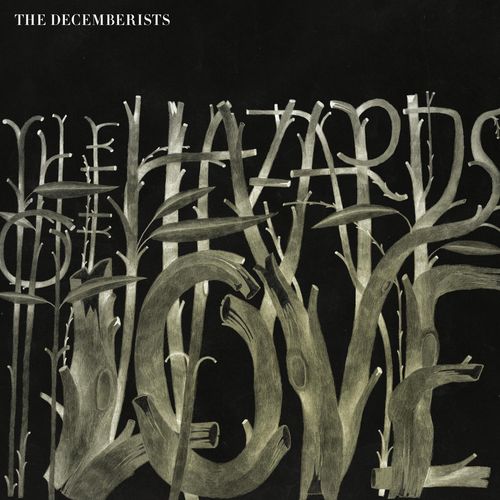
The Decemberists – ‘The Hazards of Love’: Round 36 – Rob’s choice

The Decemberists - The Hazards of LoveIn 2008 Colin Meloy and his troupe of troubadours attempted to lay to rest a question which had been troubling indie rock fans for some years: ‘What exactly would the Decemberists have to do to score less than 8.0 on Pitchfork?’ The answer, released in 2009, was ‘The Hazards of Love’.

It’s a proper concept album, a rock opera if you will, telling the tale of Margaret, who loses her heart to a shape-shifting forest spirit, the pair of them subsequently falling foul of his Mother, the abominable Queen. As you do.

It’s executed with verve and glee and, crucially, without any sense of irony. Meloy and co. had long acknowledged a debt to Pentangle, Fairport Convention and the artists of the British folk revival of the late 60s and early 70s. On their earlier records ‘The Tain’ and ‘The Crane Wife’ they dabbled with both song cycles and ornate folk-rock compositions and ‘The Hazards of Love’ sees them work this through to its logical conclusion.

I think it’s fair to say that the reception for the album was mixed. No-one really seemed to know what to make of it. The band had broken through with ‘The Crane Wife’ and i’m sure were expected to turn out a collection of stadium-sized tunes to cement their success and buy some bigger touring buses. Instead, this, an elaborate and full-blooded take on an outmoded form drawing in several singers to play a cast of ripe characters tottering their way through a pseudo-mediaeval narrative.

The first time I listened to THOL I cleared the evening, opened the gatefold sleeve for the lyrics,  and carefully followed along the themes and characters through the plot development. Turns out that’s the very worst way to go about it. The joy and the beauty of the record is not in the concept itself, rather in its execution. As soon as I gave up on it and began to treat it as a collection of songs, it opened itself up as  a delightful puzzle and a whole lot of fun to get involved with. The recurrent riffs and motifs that run throughout the piece form seams which occasionally erupt to the surface, coming to sound like old friends when they return. The cast of vocalists work well together but none can hold a torch to Shara Worden of My Brightest Diamond, who gives a full-throated turn as The Queen. If this opera had scenery, she’d be chewing it Pacino style.

My impression at the time was that most critics thought ‘The Hazards of Love’ was a mildly embarrassing mis-step, an indulgence from a band who had delved too deeply into their own affection for the music, the styles and the stories of the Olden Dayes. These days it just sounds like one of the Decemberists best albums, with memorable songs, great performances and a sense of a band coming together to create something in unison.

Nick listened: When I mentioned in my office that we were having a “concept album” evening a DRC, Ian (a potential future member) immediately said “The Hazards of Love!” I bought a Decemberists album once (The Crane Wife, I think – they’re still packed away for moving still so I can’t check) but wasn’t entirely taken with it for whatever reason – sometimes it’s just not the right time to get into a record or a band, is it?

So I was intrigued to hear THOL when Rob said he’d thought of it immediately too. I wasn’t disappointed; in fact I really enjoyed it, although, as usual on first listen to a record, I paid absolutely sod-all attention to the actual lyrics (Twilight-esque as they seem to be, with their tales of shapeshifting romance), but quite a lot of attention to the music, which was rich and rewarding, even when it dove headlong into prime Deep Purple Hammond-and-guitar-solo territory. Perhaps a little long (I’ve little tolerance for records that stretch much beyond 45 minutes these days), the only other criticism I’d throw at THOL is that I don’t really like Colin Meloy’s voice, which is too close to the pancreatic lost-my-dog-on-a-string moan of that guy from Neutral Milk Hotel. I’d love to hear THOL again, and maybe even pay attention to the words.

Tom Listened: We’ve had Marillion. May as well quote Meatloaf….Nick took the words right out of my mouth (thankfully not while he was kissing me). I don’t have a problem with Colin Meloy’s, or Jeff Mangum’s, voice and I haven’t ever connected the two but other than that I echo everything he said – a little too long, a little too indulgent at times, but, in general, surprisingly enjoyable, accessible and catchy…and on an initial listen much better than The Crane Wife. I liked it!

Graham Listened: Heartland lesson learnt, I just listened to this and picked up the lyric sheet on the odd occasion. Really grabbed me from the off with and immediately accessible (perhaps it had the Kayleigh factor in concept album terms?). Sad old hippy that I am, I really ‘dug’ the “John Lord’ish” keyboards and some of the guitar solo’s that I wasn’t really expecting to hear. Would take a good few listens for me to appreciate the full ‘concept’ as it were, but something I would be quite happy to do.

Tom Waits – Bone Machine: Round 36 – Tom’s Selection

As a consumer of music who rarely listens to the words, let alone thinks about their meaning, concept albums usually pass me by. So it was with a sense of mild despair that I scoured my collection once Nick had suggested this as the theme for our latest meeting. It turns out, once I had actually thought about the lyrical content of a few ‘possibles’ that I own far more ‘concept’ albums than I initially thought (I put the word concept in inverted commas here because I am still unsure as to what a ‘concept’ album is). But I read somewhere on the internet – and the internet never lies, right? –  that Bone Machine is a concept album about death (THE concept album about death?) and as it is also one of my favourite albums… in the world…. ever, I didn’t ponder the voracity of the claim for too long before convincing myself that I could convince the others that Bone Machine is most definitely an album with a concept. After all, even though it doesn’t have any pixie queens or made up kingdoms, it does have locusts…just like any other concept album worth its salt.

Then a funny thing happened. As I listened to Bone Machine in the run up to the meeting, I began to hear things I had never heard before. Like…the words, for example. Of course, I had heard the words before. But I had never really thought about them and how they fitted together with each other and what they were trying to say and the like, so whilst I had always loved the lines ‘What does it matter, a dream of love or a dream of lies? We’re all gonna be in the same place when we die’, loved the way they sound and the images they evoke, I hadn’t really thought about what Tom Waits was trying to say with them. And I never really thought about how this song, Dirt in the Ground, fitted with the preceeding The Earth Died Screaming and the succeeding Such a Scream, a song whose main character (presumably Waits’ wife Kathleen Brennan) has ‘a halo, wings, horns and a chain’. It seems an awareness that Bone Machine is a concept album about death (or mortality) has made me appreciate it even more, which is quite an achievement as it was already languishing somewhere in my top ten albums…in the world…ever.

Whilst I am a huge fan of Waits, I still section his albums into divisions. In my mind Mule Variations and Real Gone belong with some of the pre-Kathleen Brennan albums in the third division of Waits’ discography. Second division and we have Frank’s Wild Years, The Black Rider and Alice. First division – Swordfishtrombones and Rain Dogs.* But Bone Machine is the Tom Waits equivalent of Liverpool FC circa 1975-1985 (as opposed to Liverpool FC circa 2012/13 – sorry Graham, couldn’t resist). Unimpeachable! It’s a parched album, tinder dry and is the most evoking of tumbleweed/dustiness of all his records. I got to know it whilst spending a year in the Australian outback and I can think of no better soundtrack or location depending on which way you’re looking at it. And although the album is riddled with death, it’s by no means a depressing listen. As always, Waits treats us to some exquisite ballads (A Little Rain ends with the devastating lyric, ‘She was 15 years old and she’d never seen the ocean…and the last thing she said was “I love you Mom”), and the album ends with the kooky ‘pop’ song, I Don’t Want To Grow Up and the sweet redemption of the closer, That Feel.

For me however, it’s the one-two-three of Goin’ Out West, Murder in the Red Barn and Black Wings that elevate the album from classic to  top ten…in the world…ever….and now that I have thought about the words, it’s even better than before!

* Of the later Waits albums I do not own Blood Money, Orphans or Bad As Me so they are currently not ‘divisioned’. I am not really a fan of pre-Brennan Waits…they lack the all important ‘clank’, and they are unlikely to ever be ‘divisioned’ as a result.

Nick listened: I know Bone Machine pretty well, but in an abstracted, ambient-music way – when I ran the film and music department of the university library we used to play this album quite often in the office (it was an unusual office!), and it was probably my introduction to Tom Waits. I’ve since bought several other albums by him, and would count Rain Dogs as my favourite, with this coming in second. I’ve never really thought of it as a concept album about death, but then again I seldom have a clue what Tom Waits’ cheese-grater-and-bourbon voice is actually singing about. So yes, a great record (I adore Waits and Brennan’s clattering, ramshackle percussion and live-in-a-workshop[!] vibe), and brilliant to hear in the company of the DRC crew.

Graham Listened: Firstly, in order to qualify my selection for Round 38, I heartily agree    with Tom that members should not be too constrained by any particular theme. Having never heard a full album by Mr Waits this was a real treat. I can’t think of an album I have listened to in the last few years that conjures up such strong all round sensory images of the types of places it was recorded in/conceived in/meant to be played in/set in etc., etc. The equivalent of the physical poetry of Dalglish underpinned by the grit and steel of Souness and Case.

Tom Replied: …but what about Fairclough?

Graham Responded:………….http://www.youtube.com/watch?v=Iu7vySQbgXI

Rob listened: I love Tom Waits, but i’m not a completist. ‘Bone Machine’ is one of the two or three of his albums of the last 30 years that I don’t have so it was an absolute pleasure to hear it. I’m finding it hard to place it within the discography as for me Waits is one of those artists who just IS, like an elemental being, he just exists on some other plane. His work is unique and, as a body, almost unimpeachable. I certainly don’t have the critical tools to start dissecting it, I just love it all, like Nick Cave or Will Oldham.

I think I received a ribbing on the night for suggesting that he sounds lke he lives in a workshop full of broken instruments, but it’s flattering that Nick has appropriated the line nonetheless. I certainly can’t claim involvement in or comprehension of the Liverpool AFC metaphor which Tom and Graham seem to be one-twoing merrily along.

The Sisterhood – Gift – Round 35 – Graham’s Choice


The Sisterhood - Gift
Inspired by listening to Fever Ray in previous round I decided to probe the darker regions of my album collection. Given my difficulties with modern day dance/electro I thought I should also explore something from when I used to frequent the New Wave “club scene”, as I’m far too old to have anything to do with that sort of thing now.

I brought this little curio along, prompted to some extent by the back story behind the album itself. I suppose I should have saved this for the theme night of “spiteful albums released as a commercial weapon”, but what the heck!

I bought this in 1986, because basically I would have bought anything related to the Sisters of Mercy at that time. Behind the dry ice and the darkness, there was a great live show and a few decent tunes. However the original band imploded leaving Andrew Eldritch the rest of the band (which later became The Mission), with fans baying for output and financial commitments to existing record and publishing deals. It all gets a bit complicated there and the full story is here http://en.wikipedia.org/wiki/The_Sisterhood.

Simply put Eldritch managed to retain the original Sisters name, stop the rest of the band calling themselves The Sisterhood and meet his financial commitments with the release of this album. I can’t say I noticed it was apparently proto-techno/dark wave when I bought it. But when some of these tracks, like this http://www.youtube.com/watch?v=tpW8JOXr-Hc&feature=related, were playing in nightclubs,  I was probably too drunk to care. There are vague hints of the sound of the Sisters debut, ‘First and Last and Always’, though the harsh electro sound is a mile away from their original sound. Eldritch’s wish to move away from guitar based songs led to the original band’s demise. Listening to this again 26 years later (yikes!) I’m thinking Mr Eldritch was experimenting with something quite interesting. However one listen to the official Sisters follow up, ‘Floodland’, was enough for me to drop them immediately, as what had been initially interesting had transformed itself into some pumped up and bombastic nonsense inspired by Jim Steinman (or was it Todd Rundgren?).

From that point on I reverted back to The Mission and became a part-time ‘Eskimo’. Anyway if nothing else, my fellow members are now thoroughly familiar with the operating manual for an AK47 and they have me to thank for that. http://www.youtube.com/watch?v=Vkrs6SEMcUk

Nick listened: About half of this was absolutely fantastic; really dark, compelling synthetic grooves that segued perfectly on from The Knife and which reminded me of so many things, from 90s-onwards dance music to 70s krautrock and kosmische to post-millennial indie-goes-electro. The other half of it wasn’t particularly different or bad, it just didn’t quite find the beats or moods that the best tracks achieved (the opener was splendid, as was the one about building an AK-47). Really glad I’ve heard it – I had absolutely no idea it existed before the other night.

Rob Listened: Graham’s uncanny knack for picking a record none of us know but which sits on the equidistant between two of our other choices continues. None of us had heard of The Sisterhood and the petty hilarity of its origin, yet it sat as an almost perfect buffer between ‘Silent Shout’ and ‘The Money Store’, giving us pause to reflect on similar records created as fillers, tests or contractual get-outs, which are now held up as high art or futurist classics. ‘Gift’ isn’t quite in that league but, tonight at least, it was a fun listen.

Tom Listened: The trouble with getting to know a group at the bum end of their career is that the rest of their catalogue can get tarred with the same brush….’better to burn out than to fade away’, as Neil Young (ironically as it turned out) put it. So when Graham produced something with the word ‘sister’ on the cover my immediate instinct was to dive for cover. However, Gift turned out to be more interesting and palatable than I initially feared – sonically it was a complete surprise to me, lengthy grooves, not too much doom and gloom and, although a couple of tracks towards the end of the album dragged a little, I enjoyed the listen in the main.

As Rob has stated, Gift was an inspired companion to Silent Shout and The Money Store and comparing them made us wonder as to whether it’s present day technology or musical vision or a combination of both that is leading to work that is so much more complex, busy and intricate than that of 25 years ago. Whatever, Gift sounded like the musical equivalent of the ZX81 in comparison which is not necessarily a bad thing per se…just different.

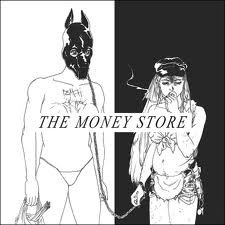
Death Grips – ‘The Money Store’: Round 35 – Rob’s choice

Death Grips - The Money StoreWhen ‘The Money Store’ was reviewed on its release earlier this year, most critics seemed to fall over themselves trying to explain how they had struggled to categorise the Death Grips sound (was it ‘Rock Rap’? was it punk hip-hop?) before magnanimously declaring that pigeonholing was a waste of time. Perhaps it’s only critics who worry when they can’t slot a record into a well-worn genre slot.

For me ‘The Money Store’ is a delirious, ravenous, rampaging record. It’s blunt: witness Stefan Burnett’s brick-in-the-face vocals. It’s dazzling: samples and electronics course through the album like lightning bolts. It’s brutal, both in the heavy hit of individual tracks and the pounding pressure that builds up across the record as the blows keep coming. It’s also huge fun. Try doing the washing up to ‘The Money Store’ without either dancing around the kitchen or stomping around the house pretending to be a yobbish street hustler.

E.B. White famously said, “Analyzing humour is like dissecting a frog. Few people are interested and the frog dies of it.” When I hear a record like ‘The Money Store’ the folly of labelling music seems pure and palpable. Artists like Death Grips, Flying Lotus and M.I.A. don’t belong in a set but all seem to be smashing together sounds to reproduce the noise of the urban 21st century. Why bother worrying where to file it? Just dive in an enjoy the sheer energy, insistence and inventiveness.

Tom Listened: Rob’s choices have become increasingly cacophonous over the past few meetings. Since the tranquility and grace of Lambchop, he has pleasured us with albums by Fugazi, Babes in Toyland and now this (I missed the Dumb offering but I gather that was no walk in the park either). I’d be happy to wager that he won’t be bringing Richard Clayderman to the next one!

Death Grips is everything Rob has said it is in his write up. I thought it was wonderful – messy, irreverent and packed full of interest and invention. Having said that (and we talked about this on the night), I don’t really feel the urge to own it – even in those increasingly rare moments when my still just about innocent children are safely out of earshot, I reckon The Money Store would be unlikely to find itself on my turntable as, in a similar way to Babes in Toyland, it’s such a demanding and exhausting listen that I’d need to get me some Clayderman as an antidote…and I don’t want to have to do that.

Nick listened: Big cosign with both Rob and Tom; this is as brutal, rambunctious, crazed, and enervated as described, and then some. It’s a very modern, 21st centruy style of cacophany, too, and as Rob suggests, difficult (pointless) to try and pigeonhole to the point where even trying seems ridiculous: I’d add Animal Collective to MIA and Flying Lotus in the post-millenial kitchen-sink-eclectic artists list, and there are plenty of others too, who throw seemingly everything into the mix, process it, chop it, add a crazy beat, and call it pop music despite it being really quite sonically extreme an awful lot of the time. I guess, in these post-genre times, ‘pop’ is about the most efficient catch-all term.

Like Tom, I’m not sure what use I’d have for Death Grips in my day-to-day life, when I’d listen to them or for what purpose. Of course, music doesn’t need to have a purpose; it is a purpose in itself, and when the crazy, angry clattering coalesced into bona fide dancefloor hooks on the final track, Death Grips’ purpose was brilliant.

Graham listened: The first album at DRC which inspired me to consider fitting a sub-woofer in my car, tint the windows and drive around the ‘hood with intimidation in mind (even if just going to the Co-Op). As a parent I would be moderately concerned if it appeared on my daughter’s ipod but I might just sneak it in the car to pump myself up for a difficult day at work. Fantastic.

Swell – …Well?: Round 35 – Tom’s Selection

When my brother Ben died of cancer in 1997 I had the distinctly uncomfortable experience of going through his record collection and picking through those albums that had been stacked in his room at my parents’ house. It was a horrible process, one that I really would have preferred to have avoided at the time but now, 15 years later, I treasure those records of his and the memories they evoke.

Ben and I had always been competitive with each other; whether playing table tennis or Elite, doing our ‘O’ levels or winding up our Dad, we were constantly trying to outdo each other. Sure, he was my best mate (he was lots of peoples’ best mate) but I suppose one-up-man ship is part of the territory. However, we shared a love a music and for most of our teenage lives our tastes pretty much coincided – The Beatles, Dire Straits, Queen and Elton John….typical teenage fodder! However, once we went to university and our musical horizons broadened our musical preferences aligned far less frequently. I don’t know whether this was our competitive relationship subconsciously seeping into our musical world but whilst I had a thing for Big Star, Ben opted for The Rockingbirds; I fell in love with Love’s Forever Changes, Ben with Ben Folds Five and so on. Of course there was much we agreed on, many bands or artists that were just too irresistible. Swell were one of these bands. …Well? was an album that Ben discovered and we both enjoyed immensely. And I still do to this day!

Swell are/were a four piece formed in San Fransisco in 1989. They played indie-rock. They were often mentioned in the same breath as Red House Painters and American Music Club but this was down to geographical reasons and journalistic laziness rather than any similarity in aesthetic. Swell sound (to my ears) nothing like either of the aforementioned bands. In fact I struggled to think of any of Swell’s contemporaries who were producing a remotely similar sound. Pavement? Too scuzzy and lo-fi. Fugazi? Too hardcore and shouty. Slint? Too portentous and ominous. The closest soundalike I could come up with when listening to …Well? prior to record club is Spoon, but only in as much as both bands build the majority of their songs around a briskly strummed acoustic guitar, layering the sound with clean electric guitars, often groovy bass runs and usually nimble and light percussion. But they don’t really sound all that similar, as I am sure the others will attest!

Regardless, Swell were unlucky. Their sound is immediately accessible, all the songs on …Well? are hook-laden and captivating and they deserved to sell a lot more records than they did. From ear worming its way into my consciousness all those years ago …Well? has become one of those records that always gives me that little thrill of anticipation just before the needle finds its groove. It’s one of those records I’m very glad my kid brother purchased – I just wish he’d bought a few more records by Swell and a few less by The Rockingbirds!

Nick listened: I wasn’t blown away by Swell (who I hadn’t heard of prior, I don’t think), but I did enjoy listening to Well, and sometimes that’s enough. I’ve been vacillating between the sheer existential assault of The Seer by Swans and the just very pleasant, enjoyable grooves and hooks of A Thing Called Divine Fits this week, and wondering which I prefer. It’s like comparing apples and oranges, obviously, but the enjoyable, easy-to-parse, safe-to-consume-in-company records often get listened to far more often than the astonishing, perception-realigning stuff. Anyway, I digress. Whilst I definitely didn’t get Red House Painters or American Music Club (not that I know either all that well), I didn’t quite get Spoon either, but it was certainly closer to that end of the spectrum. Joy Division were mentioned, and whilst there wasn’t the sense of present desolation you get from that band (nowhere near, in fact), there was something a little doomy about the linear, propulsive, crawling basslines that drove the songs along. And who on earth are The Rockingbirds?!

Rob listened: I don’t get Spoon, or Joy Division, or Red House Painters, but I do get a healthy dose of Ben when I listen to Swell. I loved ‘…Well?’ the first time he played it to me and I went on to love 3 or 4 more of their albums. There’s something smoky, sassy and backwoods about ‘…Well?’. It sounds handmade and warm, like getting back together with an old friend and conversing in a shared language. Which, in a way, I suppose it is.

Graham listened: I had never heard anything by the band but was aware of the name. If this had been on my radar at the time I am sure I would have indulged. Wonderfully accessible, loose and relaxed sound which would have ticked lots of boxes for me, just at the time (post ‘Green’) I was falling out of love with American bands. Will be asking Tom for  a borrow.

The Knife – Silent Shout: Round 35, Nick’s choice


After playing Karin Dreijer Andersson’s solo debut at our last meeting and explaining my strained journey to liking Silent Shout by The Knife (Fever Ray’s parent-group, if you like), it seemed like an obvious choice to bring that album along last night, so I did. Since our last meeting I reckon I’d had the extra half a dozen listens I predicted I’d need to really, really like it.

I bought Silent Shout not long after it came out in February 2006, enticed by the rabid hyperbole being thrown its way on messageboards and blogs. The idea of atmospheric, intriguing Scandinavian dance music seemed like it would be right up my street, and, indeed, I loved the opening title track from the off. But it stopped there. Something about Silent Shout rubbed me up the wrong way, and I took against it vehemently, and cast it out. Or, at least, let it gather dust on the bottom-shelf (had The Knife been called The Spatula or The Baster, they’d have been situated on a higher shelf, at approximately eye-level, and thus harder to ignore, perhaps).

Partly I think my antipathy was to do with the thickness and density of the sound; in early 2006 I was at the height of my anti-compression campaigning, and I think I was looking for spacious, intricate, architectural sounds more akin to The Box by Orbital than what Silent Shout actually offered. Something nagged me about it; I wanted to understand what the fuss was about, to catch a glimpse of what I was missing and worm my way in. When I loved the Fever Ray album from the off, my desire to get Silent Shout only intensified.

Though it’s just as creepy and strange as The Box, Silent Shout gets there by different means; by and large it’s an album of direct, thumping, dancefloor-focussed electropop, irresistible beats and synth riffs (just get a load of the crazy, hook-laden opening to Like A Pen, which could be off Debut by Björk), but that thick production allows an array of startlingly cold, unnerving, and edgy textures and melodies in almost by the back door.

And then there are the voices; processed, performative, unrecognisable and alien. Both Karin and Olof sing, but it’s often hard to tell who is who, or if either of them are even human, let alone what the actual words they’re enunciating are. But when you do start to notice the words (or, you know, look at them in the sleeve), and you realise that you’ve been dancing to a song about domestic abuse or tapping your steering wheel to a song about childhood alienation. It’s… discomforting, to say the least.

But that’s Silent Shout’s genius, like a lot of great music; it has the push-me/pull-you dynamic that we’ve talked about before at DRC, beats and hooks to lure you in, textures and atmospheres to make you feel uncomfortable. Finally, I get it.

Tom Listened: Silent Shout was, in many ways, the record of 2006 – it topped numerous end of year album polls and signaled a new sound in electro-pop. Compared to, say, last month’s Junior Boys album the glacial fragility of Silent Shout produces an effect that is a million miles away from the bedroom environment that much of this genre evokes. It’s impossible to listen to Silent Shout and not think of snowy wastes, dark days and interminable nights, howling, icy Arctic blasts and mile upon mile of impenetrable evergreen forest. It’s a fantastic album, one that I listen to rarely, have always admired and, in a similar way to Nick, feel an ever increasing affinity towards as my understanding of it improves.

Rob listened: I knew nothing of The Knife until ‘Silent Shout’ topped the Pitchfork end of year poll in 2006. I bought it straight away and was entranced by it from the first listen. The skipping arpeggios of the title track, the clanging factory propulsion of ‘We Share Our Mothers’ Health’, the spooked domestic doom of ‘From Off To On’, the heartbreak of ‘Still Light’. It’s a wonderful record, one of contrast and coherence, motion and emotion and one of my very favourites of the last ten years.

Graham listened: Really enjoyed the atmospherics of this and some clever touches when it did the unexpected on a few tracks. I’m not sure I was getting the landscapes it painted for some of my colleagues but it oozed subversion and tension with hooks that keep you listening.